
Culture16 min read
Kimchi culture and history: from salted vegetables to UNESCO
Koreans were salting vegetables by the third century, the word was first written in 1241, chilli did not enter a kimchi recipe until 1766, and the whole-cabbage kimchi is about 150 years old. The texts and the dates, and what kimjang is actually for.
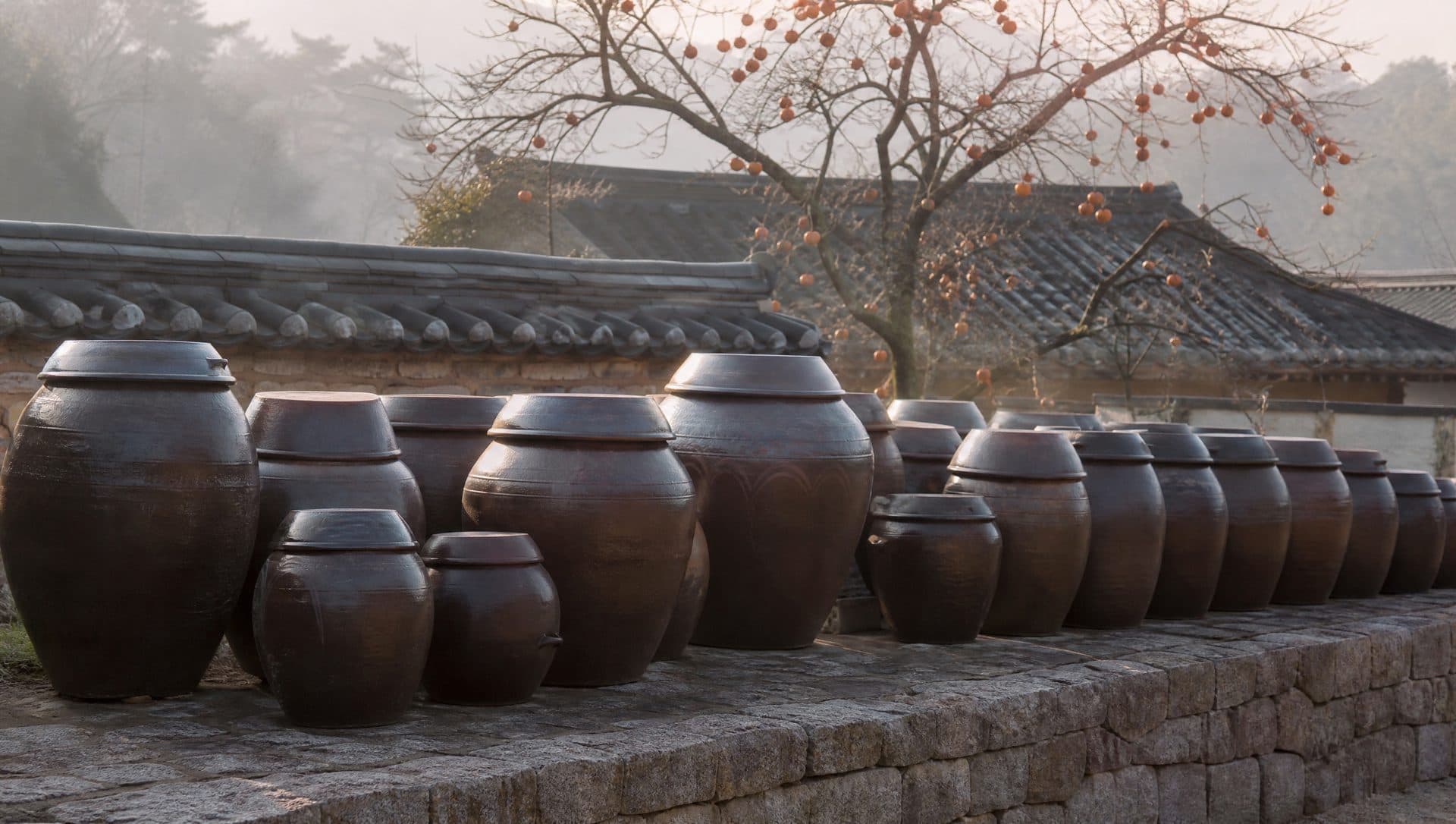
Kimchi (김치) began as salted vegetables, and the earliest description of Koreans fermenting food is a third-century Chinese record. The word itself is first written in the 1200s, chilli did not go into kimchi until 1766, and the red whole-cabbage kimchi the world recognises is barely 150 years old. Kimjang, the communal winter making, was inscribed by UNESCO in 2013.
Kimchi's history is usually told as one unbroken line from antiquity to the jar in your fridge. The documents tell a more interesting story: a food that changed its vegetables, its colour and its name several times, and that is still changing now.
Where does kimchi come from?
The oldest layer of the story is not a recipe. It is salt.
Before refrigeration, a vegetable harvest had to be preserved through the winter, and every culture with a cold season worked out that salt does it. Salt draws water out of the plant, suppresses the microbes that rot it, and leaves the field to lactic acid bacteria, which sour the vegetable and keep it safe. Sauerkraut in Central Europe, tsukemono in Japan and the many salted vegetables of China all sit on this foundation. So does kimchi.
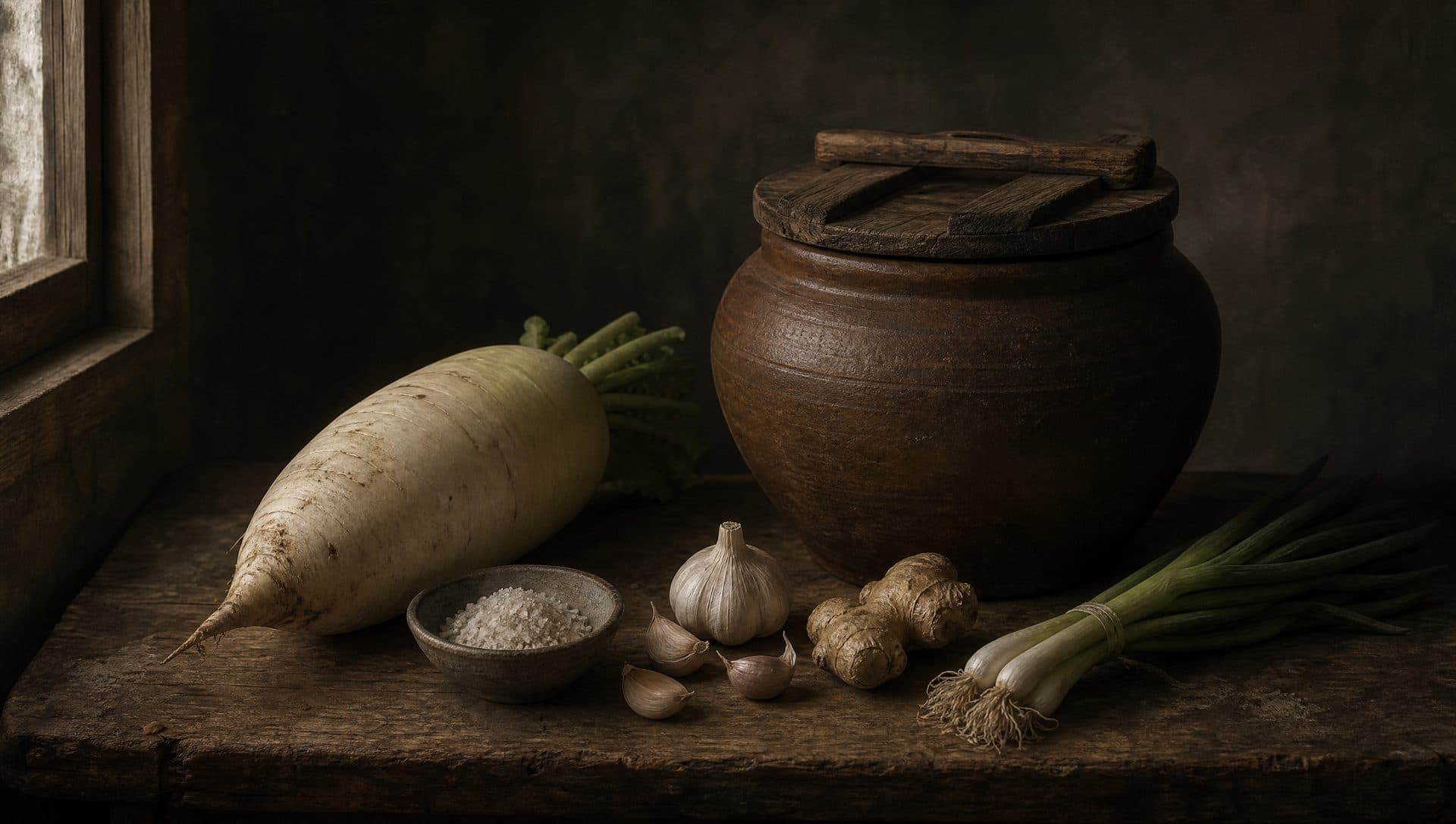
The earliest description of Koreans doing this is not Korean. The Sanguozhi (삼국지, Records of the Three Kingdoms), a Chinese history written in the third century, describes the people of Goguryeo in its section on the eastern peoples: they ate vegetables, brought salt in from a distance, and were skilled at brewing and at making fermented foods. Korean historians read that passage, cited by the National Institute of Korean History, as the first outside notice of a fermentation culture that would later produce kimchi. What was being salted then, as far as the records allow, was radish, aubergine, cucumber and garlic, kept in the manner of what Koreans now call jangajji, vegetables preserved in salt or in soy sauce. The Chinese character used for the method is 지 (漬), to soak or steep, and that syllable survives inside the modern word.
There was no chilli. There was no napa cabbage. There was salt, a vegetable, and a jar.
When was kimchi invented?
It was not. There is no year in which someone made the first kimchi, and anyone who gives you one is guessing. What the sources do give is the first time the thing is described in Korean writing, and that is the thirteenth century.
The scholar Yi Gyu-bo (1168 to 1241) included six short poems about his kitchen garden in his collected works, the Dongguk isangguk jip (동국이상국집), compiled in 1241. One of them describes what he did with his turnips: buried in soybean paste they were good to eat in summer, and salted they lasted through the winter. That couplet is the earliest surviving Korean description of the two things kimchi has always been, a paste-pickle for now and a salt-pickle for later. He called the salted version 지염 (漬鹽), salt-steeped.
The Goryeosa (고려사), the official history of the Goryeo dynasty, adds a second glimpse. Its section on rites lists the foods placed on the altar at state ceremonies, and among them are four kinds of 저 (菹), the classical word for pickled vegetables: made from Chinese chives, turnip, water dropwort and bamboo shoot. Kimchi was ceremonial food before it was everyday food, or at least it was recorded that way. Korean food historians place the emergence of two dishes still on the table today, dongchimi (동치미, radish in cold brine) and nabak kimchi (나박김치, thin radish and cabbage squares in a light brine), in the Goryeo period as well.
What did kimchi look like before chilli?
White, mostly, and closer to what is now called mul-kimchi or baek-kimchi than to anything red.
The oldest surviving Korean cookbook, the Sanga yorok (산가요록), was written around 1450 by Jeon Sun-ui, a physician at the royal court. It records kimchi made from cucumber, aubergine and radish, seasoned with salt and kept in brine, with seasonal variations. Sourness came from fermentation. Heat, where it was wanted, came from mustard, from Sichuan pepper (초피, chopi) and from ginger, the same aromatics that flavoured pickles across East Asia.
Fermented seafood was also already in the picture. Sixteenth-century letters and court records describe cucumber kimchi made with salted shrimp, so the pairing of vegetable and jeotgal (젓갈) that defines modern kimchi predates the chilli that people assume came with it.
When did chilli reach Korea, and when did it go into kimchi?
These are two different questions with an unexpected gap between the answers.
Chilli is a New World plant. It reached Korea from Japan in the late sixteenth century, most likely during or just after the Imjin War of 1592 to 1598. The first Korean text to mention it is Yi Su-gwang's encyclopaedia Jibong yuseol (지봉유설) of 1614, which calls it a plant from the southern barbarians that had come by way of Japan, and adds a warning: it was thought to be poisonous, and tavern-keepers who stirred it into liquor had killed customers with it. Not the introduction of a beloved national ingredient. A suspicious foreign weed.
Then, for a century and a half, nothing. The cookbook Eumsik dimibang (음식디미방) of around 1670 gives kimchi recipes without chilli. The agricultural manual Sallim gyeongje (산림경제) of around 1715 still has no chilli in its kimchi. The National Institute of Korean History puts it plainly: chilli arrived in the early 1600s, and for more than a hundred years it was not added to kimchi.
The first documented chilli kimchi is in the expanded edition of that manual, the Jeungbo sallim gyeongje (증보산림경제) of 1766, compiled by Yu Jung-rim. It describes a salted radish kimchi that resembles today's chonggak kimchi (총각김치) and a cucumber kimchi that is the ancestor of oi-sobagi (오이소박이), with chilli powder packed in alongside sliced garlic before hot brine is poured over the sealed jar. The same book lists more than forty kimchi preparations using chilli. Between 1715 and 1766, in other words, red kimchi went from unrecorded to routine.
| Year | Text or event | What it tells us |
|---|---|---|
| 3rd century | Sanguozhi, Chinese history | Goguryeo people import salt and are skilled at fermented foods |
| 1241 | Yi Gyu-bo, Dongguk isangguk jip | First Korean description: turnips in paste for summer, in salt for winter |
| Goryeo period | Goryeosa, section on rites | Four kinds of pickled vegetable on the ceremonial altar |
| c. 1450 | Sanga yorok, oldest Korean cookbook | Cucumber, aubergine and radish kimchi in brine; no chilli |
| 1527 | Hunmong jahoe, character primer | The word written in hangul for the first time, as 딤채 |
| 1592 to 1598 | Imjin War | Chilli enters Korea from Japan around this time |
| 1614 | Jibong yuseol | First mention of chilli, described as foreign and dangerous |
| c. 1670 | Eumsik dimibang | Kimchi recipes, still without chilli |
| c. 1715 | Sallim gyeongje | Kimchi recipes, still without chilli |
| 1766 | Jeungbo sallim gyeongje | First documented chilli in kimchi; more than forty chilli kimchi |
| 1809 | Gyuhap chongseo | Mixed vegetable kimchi with fermented seafood and chilli, close to modern methods |
| 1849 | Dongguk sesigi | Kimjang described as one of the two great annual household tasks |
| Late 1800s | Siui jeonseo | Instruction to layer a whole head of cabbage with seasoning: whole-cabbage kimchi appears |
| 1950s | U Jang-chun's breeding programme | Korea produces its own kimchi cabbage and radish seed |
| 1984 | Goldstar GR-063 | The first Korean kimchi refrigerator |
| 1995 | Dimchae, Mando Machinery | The kimchi refrigerator becomes a mass product |
| 2013 | UNESCO | Kimjang inscribed as Intangible Cultural Heritage of Humanity |
Why did chilli win?
The World Institute of Kimchi (세계김치연구소) gives a practical answer rather than a romantic one. Chilli did three jobs at once.
It let makers use less salt. Chilli inhibits some of the spoilage organisms that salt had been controlling on its own, so kimchi could be made less salty and still keep through the winter, and it kept longer. It masked the fishy edge of jeotgal, which made it possible to use more fermented seafood for depth without the smell taking over. And it was red, which mattered more than it sounds: the colour signalled a well-made, well-seasoned jar in a way pale brine never had.
Nineteenth-century writers, the institute notes, praised the new kimchi as soft and refreshing, which is a strange thing to say about chilli until you realise they were comparing it with the older, saltier, sharper pickles it replaced. Chilli did not make kimchi hotter so much as it made it milder in every other way.
When did the napa cabbage arrive?
Later than the chilli, which surprises people. The headed napa cabbage that now defines kimchi is the youngest of its major ingredients.
Koreans grew a loose-leaved cabbage for centuries, and the fifteenth-century writer Seong Hyeon recorded that it was cultivated widely outside the gates of Seoul. But its seed came from China, it did not grow reliably, and it did not form a dense head. You could salt its leaves, but you could not pack seasoning between them.
The World Institute of Kimchi dates the arrival of headed cabbage, 결구배추, to the 1800s: improved strains from northern China that could be grown stably in Korea. By the late 1800s Korean-bred varieties, the Seoul cabbage and the Gaeseong cabbage, had overtaken the imports. The cookbook Siui jeonseo (시의전서), from the end of the nineteenth century, contains the instruction that marks the turn: take a whole head of cabbage and layer it with seasoning. That is whole-cabbage kimchi, 통배추김치, and it is the recipe that Koreans and the rest of the world now mean by the word.
Even then the seed problem remained. Korea depended on imported seed until the agronomist U Jang-chun returned from Japan in 1950 to lead the Central Horticultural Technical Institute. His breeding programme gave the country self-sufficiency in vegetable seed during the 1950s, including the dense, sweet napa cabbage and the kimchi radish grown today. The modern kimchi cabbage is, in a real sense, a post-war variety.
What does the word kimchi mean?
It means "steeped vegetables", and it has been through more spellings than most words in the language.
The Sino-Korean term 침채 (沈菜), vegetables sunk in brine, was coined in Korea rather than borrowed from China. When Koreans began writing their language in hangul, they wrote that word the way they said it. The character primer Hunmong jahoe (훈몽자회) of 1527 glosses the classical pickle character 저 with the hangul 딤채, dimchae, and the Sohak eonhae of 1587 has 팀채, timchae. Over the seventeenth and eighteenth centuries the first consonant palatalised and dimchae became jimchae, 짐채, and in the nineteenth century a reverse change turned jimchae into kimchae and then kimchi. The 2022 study of kimchi names by Kim Ji-suk in the journal Hanguk minjok munhwa traces the same shift through regional dialects, where older forms like jimchi and chimchi survive.
A parallel word ran alongside it the whole time. The native form 디히, dihi, appears in a 1481 text as "winter dihi" for the character 저, and it wore down to 지, ji. That syllable is still the everyday ending for pickles today: jjanji, oiji, seokbakji. When a Korean grandmother calls her kimchi 지, she is using the older of the two names.
What is kimjang, and why is it on the UNESCO list?
Kimjang (김장) is the making of a household's winter kimchi in one concentrated effort in late autumn, and it is older than the whole-cabbage kimchi it now produces.
The Dongguk sesigi (동국세시기) of 1849, Hong Seok-mo's record of Seoul's seasonal customs, describes the tenth lunar month as the time when households made their kimchi in quantity, and calls it, together with the spring making of soy sauce and pastes, one of the two great annual tasks of a home. The reason is arithmetic. A family that ate kimchi with every meal through a five-month winter needed a great deal of it, the cabbage came in all at once in November, and the work of salting, rinsing, seasoning and packing a hundred heads of cabbage cannot be done by one person. So neighbours did it together, house by house, and each household gave some of its kimchi to those who had helped.
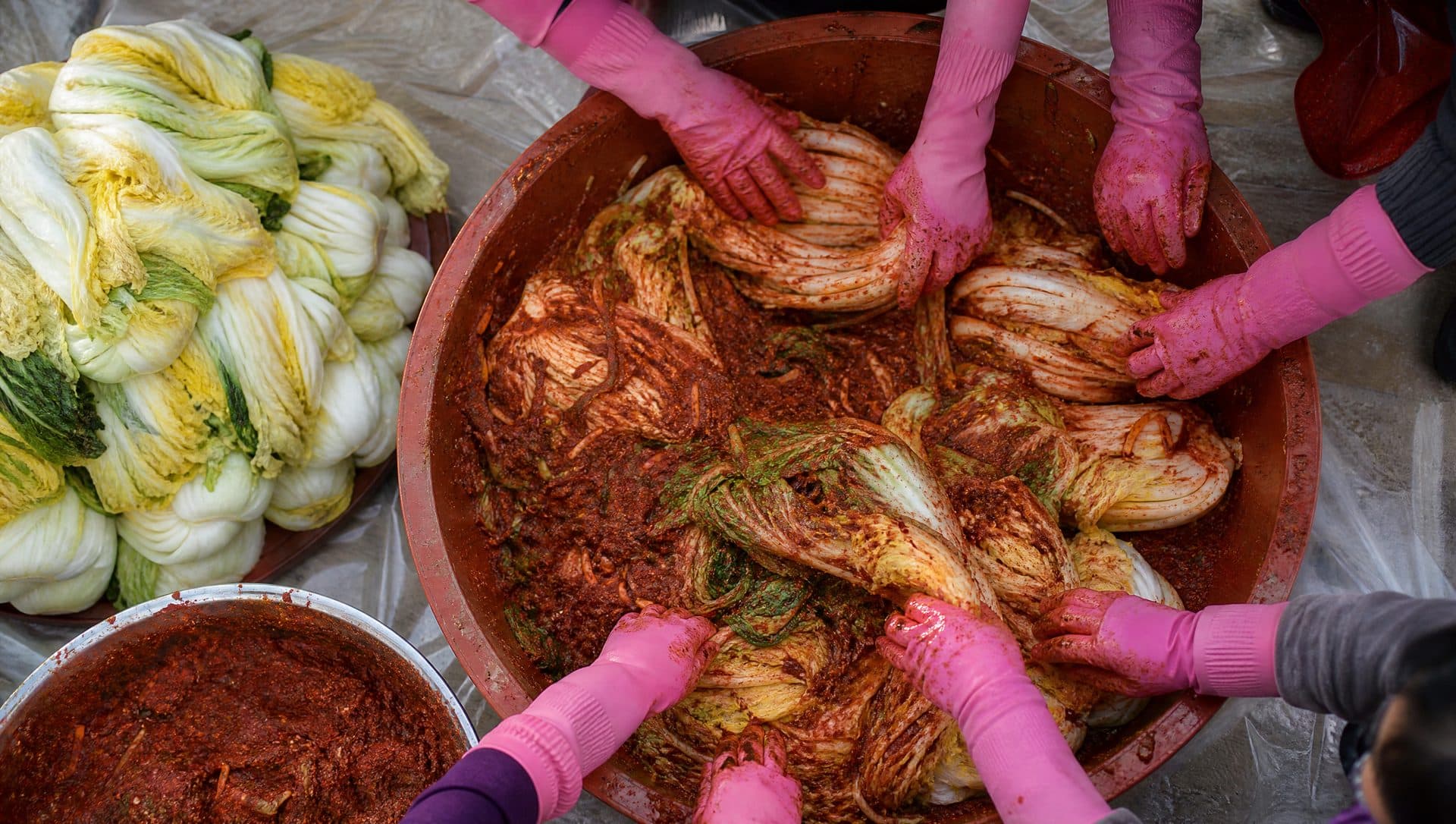
That social structure, rather than the food, is what UNESCO recognised. In December 2013 it inscribed "Kimjang, making and sharing kimchi in the Republic of Korea" on the Representative List of the Intangible Cultural Heritage of Humanity. The citation describes late autumn as the season when communities collectively make and share large quantities of kimchi so that every household has enough for the long winter, and notes that the specific methods and ingredients are treated as family heritage, typically passed from a mother-in-law to a newly married daughter-in-law. In 2015 UNESCO added a separate inscription for the tradition of kimchi-making in the Democratic People's Republic of Korea, with a description that puts the same emphasis on kimjang as a source of cooperation among families and villages. In 2017 South Korea designated kimchi-making as a national intangible cultural heritage in its own right, item 133, with the same reasoning: the value is communal, not technical.
The timing has barely moved. The Korea Rural Economic Institute's 2025 kimjang survey found that 73.1% of households planned to make their kimchi between mid-November and early December, with the capital region and Chungcheong starting earlier and the south and Jeju finishing later. Hong Seok-mo would recognise the calendar.
What happened to kimchi in the last forty years?
Two things: it moved indoors, and it started coming from a factory.
For as long as kimchi has existed it was stored in earthenware jars, 옹기 (onggi), half-buried in the ground where the winter soil held the temperature just above freezing. Apartment living ended that. In 1984 Goldstar, now LG Electronics, released the GR-063, a 45-litre box that was the first Korean kimchi refrigerator, and sold very few of them. The product that made the category was Dimchae (딤채), launched by Mando Machinery in 1995 with a name taken from the sixteenth-century spelling of kimchi. Mando lent 5,000 units to Gangnam apartment households for three months, word spread, and demand grew from 4,000 units in 1995 to 1.8 million in 2002, by which point the market was worth more than a trillion won a year. A kimchi refrigerator holds the jar at the temperature of the buried onggi, and in most Korean kitchens it is now a second fridge.

The second change is who makes it. The same 2025 survey found that 62.3% of households still make their own kimchi, down from 64.5% the year before, while 32.5% buy commercial kimchi, up from 29.5% and rising every year since 2022. The reasons households gave for buying were that they could buy only as much as they needed and that making it was too much work. The reasons households gave for making their own were taste, fitting the family's preference, and trusting the ingredients.
Underneath both trends is a simple decline in how much kimchi Koreans eat. An analysis of the national nutrition survey published in 2026 found that the share of adults who ate no kimchi at all on the survey day rose from 11.7% in 2010 to 22.7% in 2024. Kimchi is still on most tables, but for a growing minority of Koreans it is no longer daily food. That is the newest chapter, and it is being written now.
Along the way kimchi has collected claims of its own, from curing SARS to being a kind of Chinese pao cai. We checked seven of them in kimchi myths, debunked.
Frequently asked questions
When was kimchi invented?
There is no invention date. Koreans were salting vegetables by the third century, when a Chinese history noted Goguryeo's skill at fermented foods, and the first Korean description of salted turnips for winter is a poem from 1241. Red chilli kimchi is documented from 1766 and whole napa cabbage kimchi from the late 1800s.
Was kimchi always spicy?
No. For roughly the first thousand years of its recorded history kimchi was salted, sometimes seasoned with mustard, ginger or Sichuan pepper, and mostly pale. Chilli reached Korea around 1600, was distrusted for a century, and first appears in a kimchi recipe in 1766.
When did napa cabbage kimchi appear?
Headed napa cabbage that could be seasoned between the leaves was established in Korea during the 1800s, and the first recipe instructing the cook to layer a whole head with seasoning is in the Siui jeonseo at the end of that century. The cabbage varieties used today were bred in Korea in the 1950s.
What does the word kimchi mean?
It comes from chimchae, a Sino-Korean term for vegetables steeped in brine that was coined in Korea. Written in hangul as dimchae in 1527, it shifted through jimchae to kimchi by the nineteenth century. The native word ji, still heard in names like oiji and jjanji, is older.
What is kimjang?
Kimjang is the making of a household's winter kimchi in one large batch in late autumn, traditionally with neighbours and relatives sharing the labour and the result. It is recorded as a major annual custom by 1849 and was inscribed by UNESCO as Intangible Cultural Heritage of Humanity in 2013.
Do Koreans still do kimjang?
Most do. In the Korea Rural Economic Institute's 2025 survey, 62.3% of households said they make their own kimchi and 73.1% planned to do so between mid-November and early December. The share buying commercial kimchi has risen every year since 2022 and stood at 32.5%.