
Fermenting8 min read
Kimchi fermentation explained: what happens in the jar, day by day
At 20°C the bacteria in a new jar multiply more than a thousandfold in two days and the pH drops a full point on day two. When to move it to the fridge and why a warm start matters for months, how long ripening takes at each temperature, which bacteria and yeasts take over as the weeks pass, and what the white film on old kimchi is.
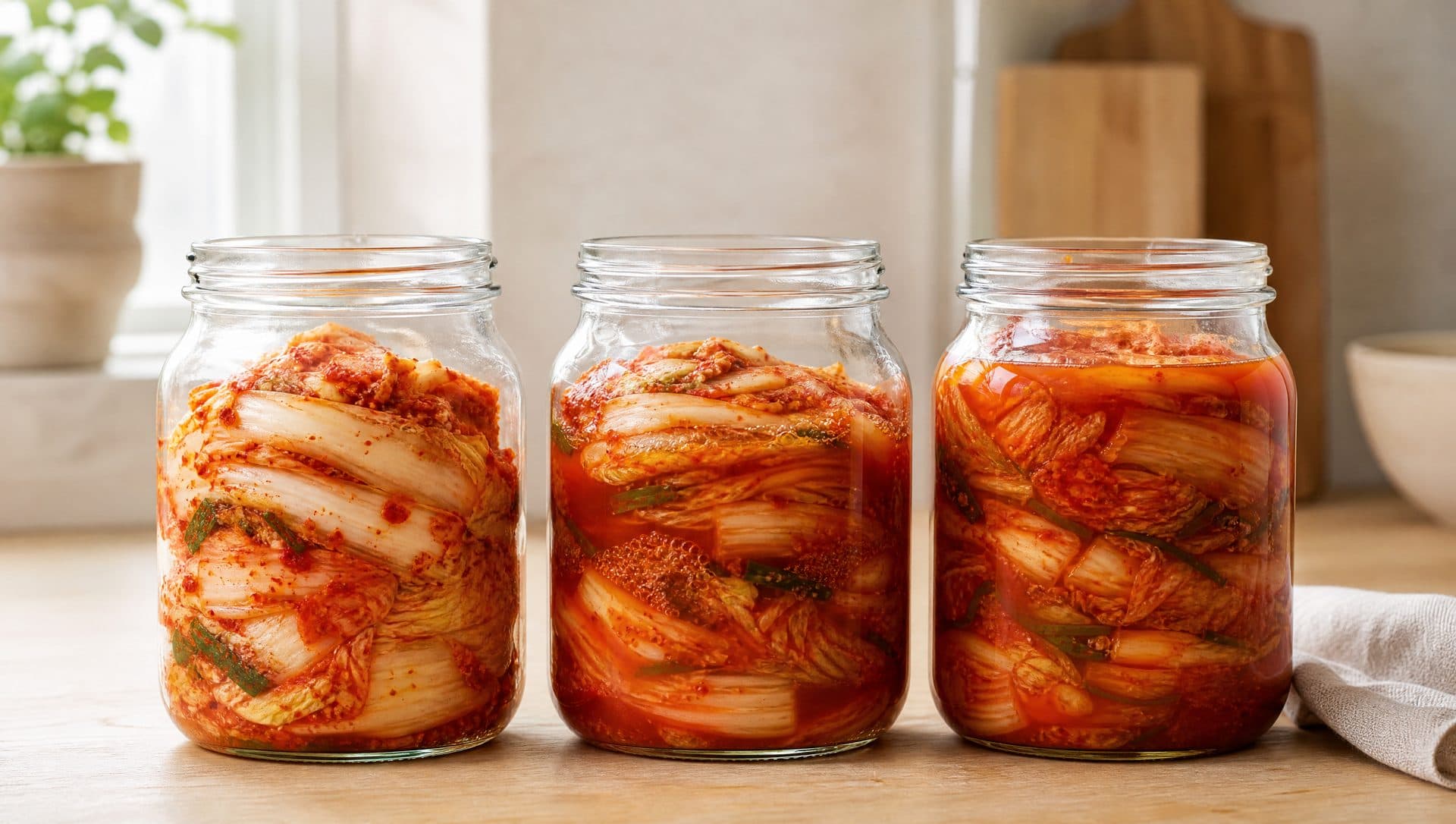
Kimchi does most of its changing in the first two days. At about 20°C (68°F), lactic acid bacteria multiply more than a thousandfold by day two and the pH falls from 5.5 to near 4. In a 4°C fridge, getting to ripe takes four to seven weeks. Most cooks give a new jar a day or two out, then refrigerate it.
The recipe ends when the lid goes on. After that the bacteria do the work, and the one thing you still control is how warm they are.
What is in the jar on day zero?
Freshly packed kimchi is a salted salad carrying a small population of bacteria. Nobody adds a starter. The microbes ride in on the ingredients, mostly on the cabbage and the garlic, as we set out in the seven core ingredients of kimchi.
The starting measurements sit close together. A 2011 study in Applied and Environmental Microbiology put napa cabbage kimchi at about pH 5.5 on the day it was made. A 2025 study in Foods measured 5.57 in kimchi salted to 2.3 per cent. At that point the brine tastes of salt, garlic and raw radish, and there is no sourness yet because there is almost no acid.
What happens on day one and day two?
This is the fast part. A Korea University review of lactic acid bacteria in Asian fermented foods (Rhee, Lee and Lee, Microbial Cell Factories, 2011) reprints day-by-day measurements of napa cabbage kimchi kept at 20°C:
| Day at 20°C | pH | Lactic acid bacteria per mL |
|---|---|---|
| 0 | 5.44 | 200,000 |
| 1 | 5.12 | 7.3 million |
| 2 | 4.11 | 280 million |
| 3 | 3.86 | 570 million |
| 5 | 3.70 | 560 million |
| 7 | 3.63 | 600 million |
The bacteria multiplied about 36 times in the first 24 hours and another 38 times in the next. The pH hardly moved on day one, then dropped a full point on day two, once there were enough cells to make acid in quantity. After day three the population stopped growing. The acid kept creeping up, only much more slowly.
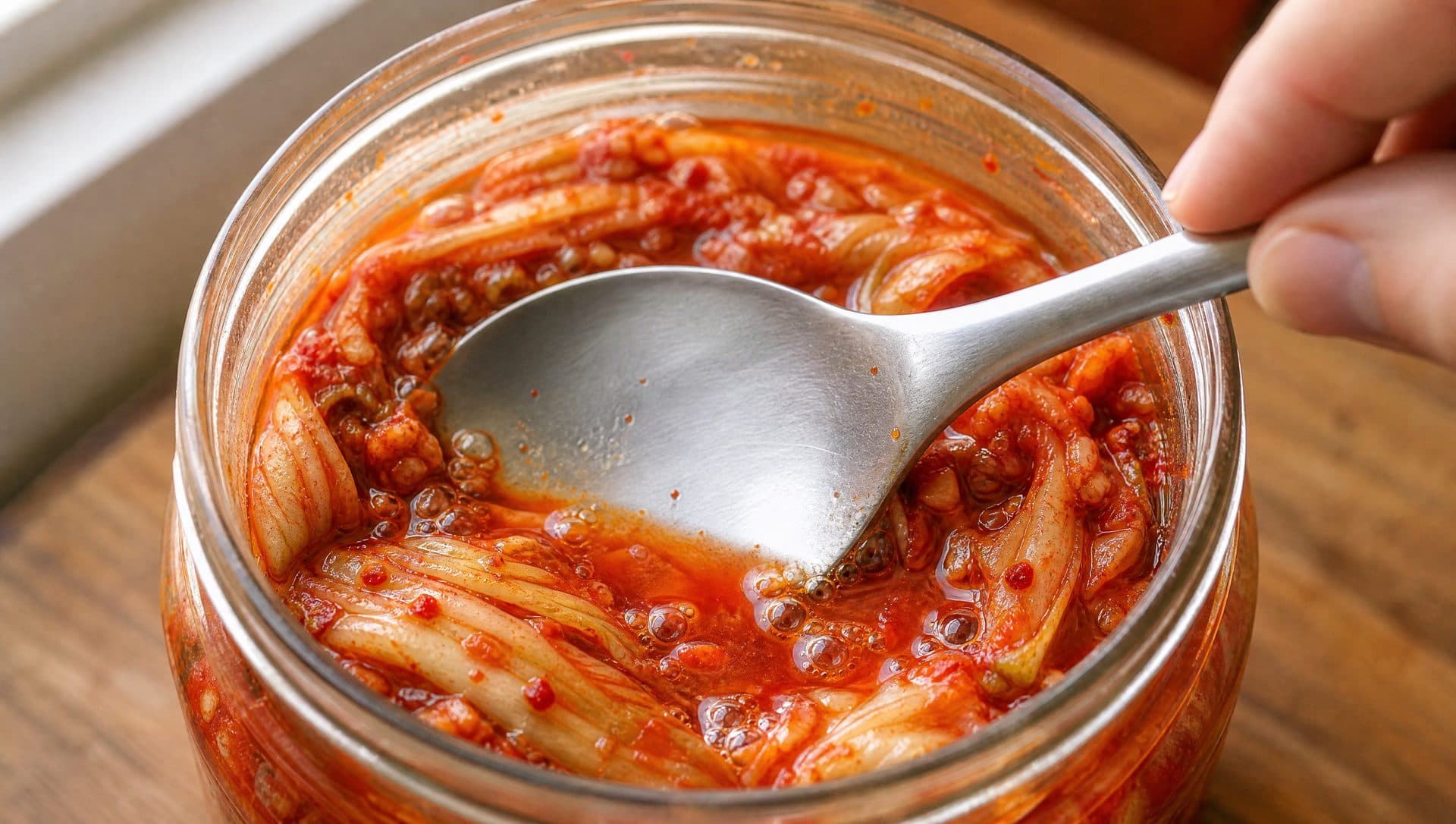
The first wave is mostly Leuconostoc and Weissella. Both are heterofermentative, meaning they turn sugar into a mixture of products instead of lactic acid alone. A 2017 genome study of Leuconostoc mesenteroides in Scientific Reports lists lactate, acetate, ethanol, mannitol and carbon dioxide among them. The carbon dioxide is the fizz. It is also part of why the brine climbs the jar and a tight lid hisses when you open it.
The same table tracked six food-poisoning bacteria, from Salmonella to Listeria, starting at tens of thousands per millilitre. None was detectable by day five. In the cold the acid builds far more slowly and the same clean-up takes weeks, which we went through in how long kimchi lasts.
When should kimchi go in the fridge?
Once it has started to sour. At 20°C that point falls between the end of day one and the end of day two, the stretch where the pH drops through the high fours. Three things tell you it has arrived. Pressing the surface sends up bubbles, the brine has risen around the leaves, and a spoonful of brine tastes faintly sour under the salt. In a hot kitchen, check the next morning.
Korean researchers have tested this handover closely, because kimchi refrigerators are built around it. A 2007 paper in the Korean Journal of Food Science and Technology recommended fermenting at 15°C until acidity reached 0.4 per cent, then holding the kimchi at −2°C. A 2012 study in the Journal of the Korean Society of Food Science and Nutrition then compared four ways of starting winter kimchi, timing how long each took to reach pH 4.4 and 0.6 per cent acidity:
| Start | Then held at | Weeks to pH 4.4 |
|---|---|---|
| 5 days at 10°C (50°F) | −2.5°C (27.5°F) | 2 |
| 1 day at 15°C (59°F) | −2.5°C | 8 |
| Straight into the cold | −1°C (30°F) | 12 |
| Straight into the cold | −2.5°C | 22 |
The kimchi given five days at 10°C was also the one the researchers judged best after six months of storage. The batches that went straight into the cold took six to eleven times as long to ripen.
How long does kimchi take to ferment at each temperature?
Temperature sets the pace more than anything else in the jar. Here is napa cabbage kimchi from three studies:
| Temperature | What the kimchi reached | Study |
|---|---|---|
| 20°C (68°F) | pH 4.11 on day 2, 3.86 on day 3 | Rhee et al., 2011 |
| 15°C (59°F) | pH 4.36 on day 3, 3.89 by day 14 | Kim et al., Foods, 2025 |
| 4°C (39°F) | Below pH 4.5 by about day 27 | Jung et al., 2011 |
| 4°C (39°F) | pH 4.32 on day 47, 3.98 by day 168 | Kim et al., Foods, 2025 |
The two 4°C results differ by three weeks. Salt level, the amount of radish and fruit, and how cold the ingredients were when they went in all move the numbers. The shape of the curve stays the same.
That curve is not a straight line, either. A 2002 study of diced radish kimchi, 깍두기, kkakdugi, timed how long it took to reach 0.6 per cent acidity: 6 days at 15°C, 7 at 10°C, 18 at 5°C and 30 at 0°C. Dropping from 15°C to 10°C cost one day. Dropping from 10°C to 5°C cost eleven. A fridge that runs a couple of degrees warm, or a jar kept in the door, sits on the steep part of that curve.
Which bacteria take over as the weeks go by?
A team at the World Institute of Kimchi followed a single batch of kimchi at 4°C for 500 days and published the results in Food Research International in 2022. Leuconostoc and Weissella led early. Latilactobacillus took over in the middle stage and Levilactobacillus in the late one. Both of those were filed under Lactobacillus until a 2020 reclassification, which is why older papers, and older articles on this site, use that name.
The yeasts changed too. Pichia and Hanseniaspora rose in the middle and late stages. And 55.7 per cent of the compounds present at day 500 had already formed within the first 15 days, so even in the cold, more than half of what ends up in the jar is made in its first two weeks.
Not every jar follows that order. In a 2020 study in the Journal of Applied Biological Chemistry, Latilactobacillus sakei was already present in the earliest samples at 8, 15 and 25°C, while Weissella koreensis did not appear until day 12, day 9 and day 6 respectively. The warmer the jar, the sooner each group arrives.
What happens after a month or two?
The jar keeps souring. Once titratable acidity passes about 0.9 per cent, Korean researchers class kimchi as over-ripe, and the 2025 Foods study labelled its kimchi excessively fermented at pH 3.89 and 3.98. The colour darkens and the leaves soften. The stages, and what each one tastes like, are laid out on our fermentation page.
The softening is the cabbage's pectin breaking down. Pectin holds the plant cells together, and polygalacturonase is one of the enzymes that takes it apart. A 1999 study in the Korean Journal of Food Science and Technology measured that enzyme across kimchi ingredients and found the most in salted anchovy and Korean radish.
Late in the jar's life a white film can form on the surface, 골마지, golmaji. In 2018 the World Institute of Kimchi identified the cause in the Journal of Microbiology: five species of yeast, none carrying known toxin genes, which spread once the lactic acid bacteria slow down. Their advice was to keep the kimchi pressed under its brine or covered, store it below 4°C, and if a film does appear, skim it off, then wash and cook the kimchi before eating. Fuzzy or coloured growth is a different matter, and the signs are in why your kimchi stopped bubbling.
Kimchi this sour is for cooking. We listed four things to do with it, starting with kimchi jjigae.
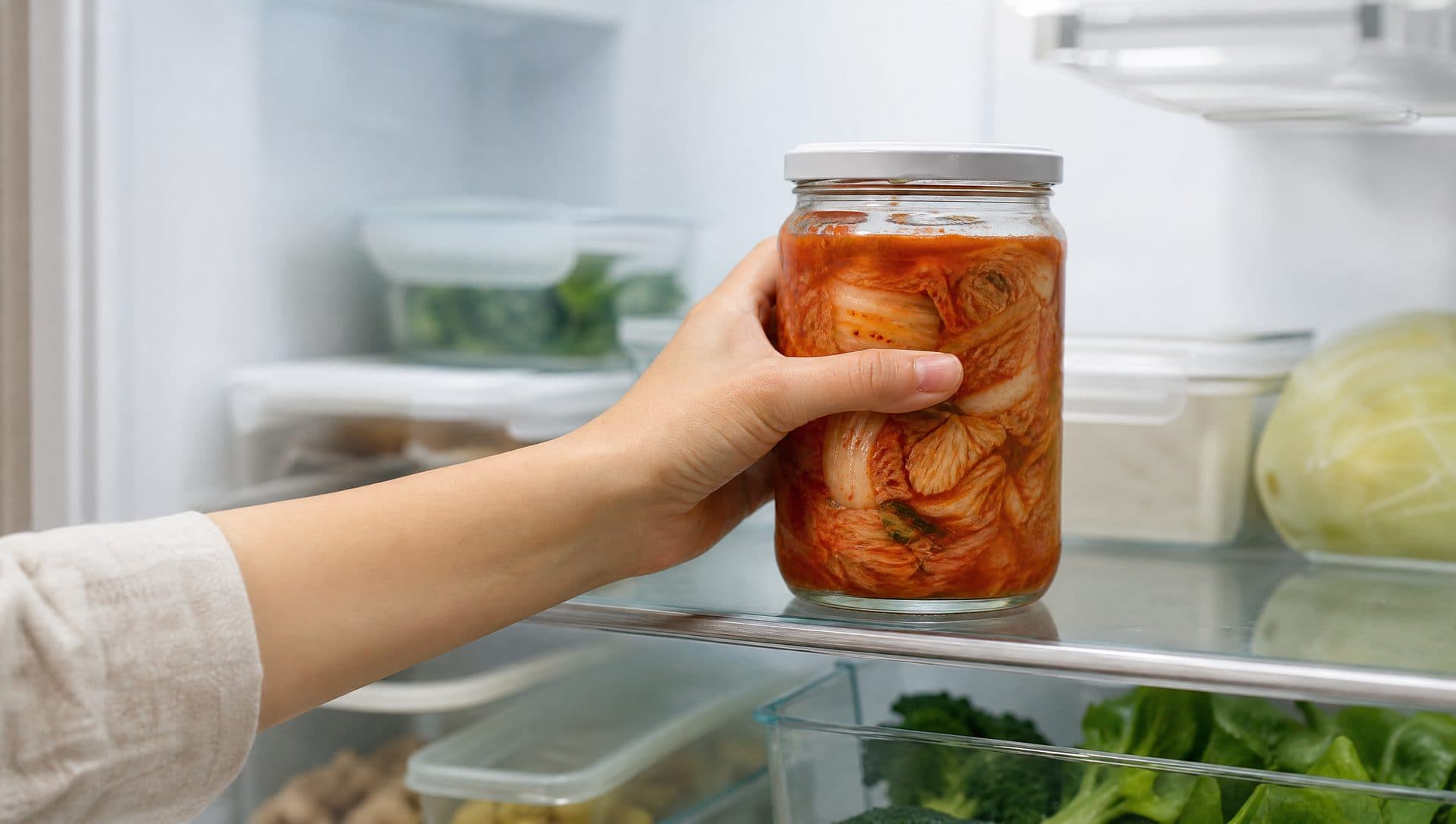
If you pack a jar this week, leave it on the counter and taste the brine each morning. The first morning it tastes sour under the salt, move it to the back of the bottom shelf and start eating it a week later.
Frequently asked questions
How long should kimchi ferment at room temperature?
One to two days at around 20°C. In the Korea University data the pH fell from 5.12 to 4.11 between day one and day two, so that is the day to watch. A warmer kitchen gets there sooner.
Can you put kimchi straight in the fridge?
Yes, but it ripens slowly and differently. In the 2012 winter kimchi study, kimchi that went straight to −1°C took 12 weeks to reach pH 4.4, against 2 weeks for kimchi given five days at 10°C first. Cold also slows the acid that clears out unwanted bacteria, so a day out helps on safety as well as flavour.
How do I know my kimchi is fermenting?
Bubbles rise when you press the surface, the brine climbs, and the smell turns from raw garlic to something sour. If none of that has happened after two days at room temperature, the room is probably cooler than you think, or the kimchi is saltier.
Does kimchi ever stop fermenting?
Not while it is alive. The World Institute of Kimchi's jar was still changing at 500 days, with new groups of bacteria and yeast taking over. Cold slows it to a crawl without stopping it.
Is it normal for the jar to overflow?
Yes, in the first days. The carbon dioxide lifts the brine. Leave a few centimetres of headroom when you pack, and press the kimchi back under the liquid when you open the jar.