
Regions6 min read
Why Jeolla baechu tastes nothing like Seoul's
Four hours apart on the same peninsula, and the jars are not the same food. The reason is climate, not preference.
This piece has not been translated into Español yet, so you are reading the English original. Translations are published after review, never automatically.
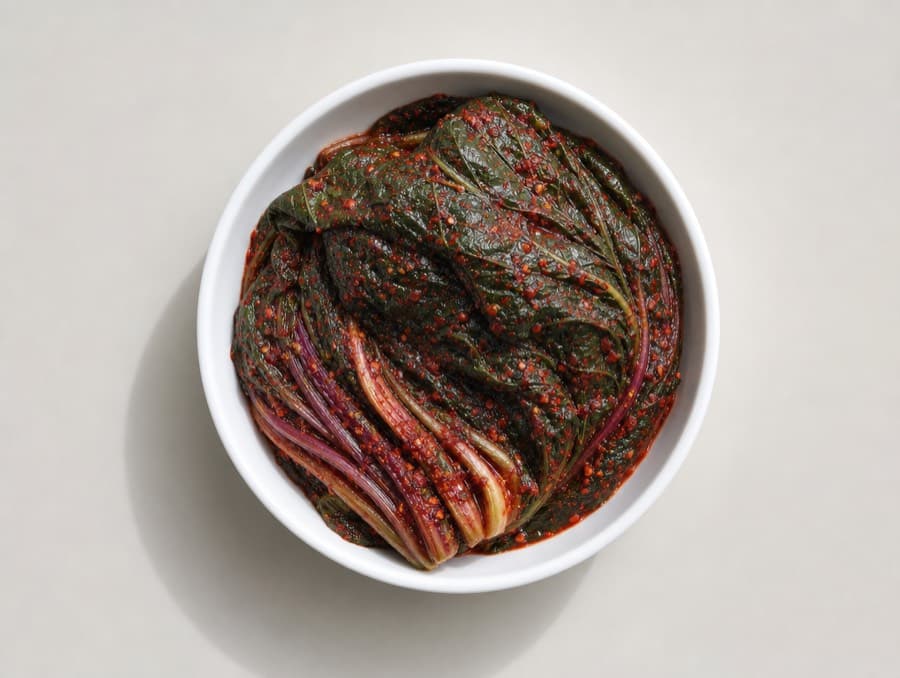
Put a jar of Jeolla baechu next to one from Seoul and the difference is visible before you taste anything. The southern jar is darker, denser, almost glossy. The northern one is lighter and wetter. They are the same vegetable, cut the same way, and four hours apart by road.
The gap is not a matter of taste. It is a matter of temperature.
Warm weather sours a jar faster
Fermentation is a temperature-driven process. A jar in a warm kitchen races; the same jar in a cold room takes its time. Before refrigeration — which is most of the history of this food — that was not a detail, it was the whole problem.
A household in the south of the peninsula, storing kimchi through a winter that barely freezes, was working against a jar that wanted to sour and soften long before spring. A household in the north, with winter doing the preserving on its behalf, was not. The two kitchens were solving different problems, and they arrived at different recipes.
What the south does about it
The Jeolla answer is to load the jar.
More salt, which slows everything. More gochugaru, which is a preservative as well as a colour. And much more 젓갈 — fermented seafood — which brings both salt and a deep savoury weight. Jeolla does not use one of these but a shelf of them: anchovy, hairtail, shrimp, croaker and yellow corvina all appear, and the choice is a household signature rather than a rule.
Geography supplies a second ingredient the region takes for granted. Jeolla sits on the peninsula's broad western plain, so grain is plentiful, and a cooked glutinous rice porridge goes into the seasoning paste as a matter of course. That porridge is not filler — it is fuel, the sugar the bacteria eat first, and it is part of why a Jeolla jar starts fast and then holds.
The result is a paste thick enough to stay where it is put on the leaf, and a jar that keeps its shape through months of mild weather. What reads today as generosity was originally a preservation strategy. It just happens that the strategy tastes extraordinary, which is why Jeolla acquired its reputation as the best table in the country rather than merely the saltiest.
Gat kimchi, made from peppery purple-stemmed mustard leaf, is the local speciality that shows the logic most clearly: an already assertive vegetable, seasoned heavily, and genuinely improved by long ageing.
What the capital region does instead
Seoul and Gyeonggi sit between the mild north and the forceful south, and the kimchi splits the difference on purpose. Fish sauce is present but restrained. The chilli is moderate. Nothing is allowed to dominate.
There is a second influence here that has nothing to do with weather. This was the seat of the court, and court cooking left its habits behind — the display kinds come from this region. 보쌈김치, a cabbage-leaf parcel packed with oyster, pear, chestnut and jujube, is not a preservation technique. It is a dish designed to be opened at a table in front of guests. 장김치, brined with soy sauce rather than salt, belongs to the same tradition.
So the capital's restraint is partly climate and partly a different set of priorities. Where Jeolla was solving for survival, Seoul had room to solve for presentation.
The map reads north to south
Follow the same logic up the peninsula and it holds.
Chungcheong, inland and without a fishing coast to draw on, uses almost no fermented seafood at all. The seasoning ratio is simply lower. What it reaches for instead is salt and chilli seeds, which give a dry, clean heat rather than the sweet depth of ground flesh — the local word for the plainest version is 짠지, and the texture of the cabbage rib is what the cook is protecting.
Gangwon substitutes twice over. Where the south has chilli, the mountains have 제피 and 산초 — prickly ash — whose numbing bite does the work gochugaru does elsewhere. Where the south has a shelf of fish sauces, Gangwon uses 서거리, salted fish gills, whose enzymes drive the fermentation directly. Add the mountain greens that go in the jar alongside, and this is the region least likely to match a foreigner's mental image of kimchi.
Gyeongsang is southern and forceful like Jeolla, but blunt where Jeolla is layered: garlic hard, chilli hard, salt hard, and anchovy sauce doing the savoury work with hairtail-gut sauce behind it. Direct, salty and deliberately aggressive.
Jeju barely freezes at all, which removes the original reason to make kimchi in bulk. Batches are small and eaten soon.
Why this matters if you are making it
If you buy a recipe labelled simply "kimchi", you have bought one region's answer to one region's weather, and you are almost certainly making it in a fridge, which is a climate neither of them had.
That is not a reason to ignore regional recipes. It is a reason to read them as arguments rather than instructions. A Jeolla recipe is arguing that the jar needs to survive warmth. If your jar lives at four degrees and gets eaten within six weeks, you can take the flavour logic and leave some of the insurance behind.