
Ingredients9 min read
The seven core ingredients of kimchi, and what each one does
The international Codex standard names seven: napa cabbage, salt, gochugaru, garlic, ginger, spring onion and radish. The standard Korean recipe adds jeotgal and a rice porridge. What each one does in the jar, from which ingredients carry the bacteria to why garlic outweighs ginger, plus the five main kinds of jeotgal and where in Korea each is used.
This piece has not been translated into Español yet, so you are reading the English original. Translations are published after review, never automatically.
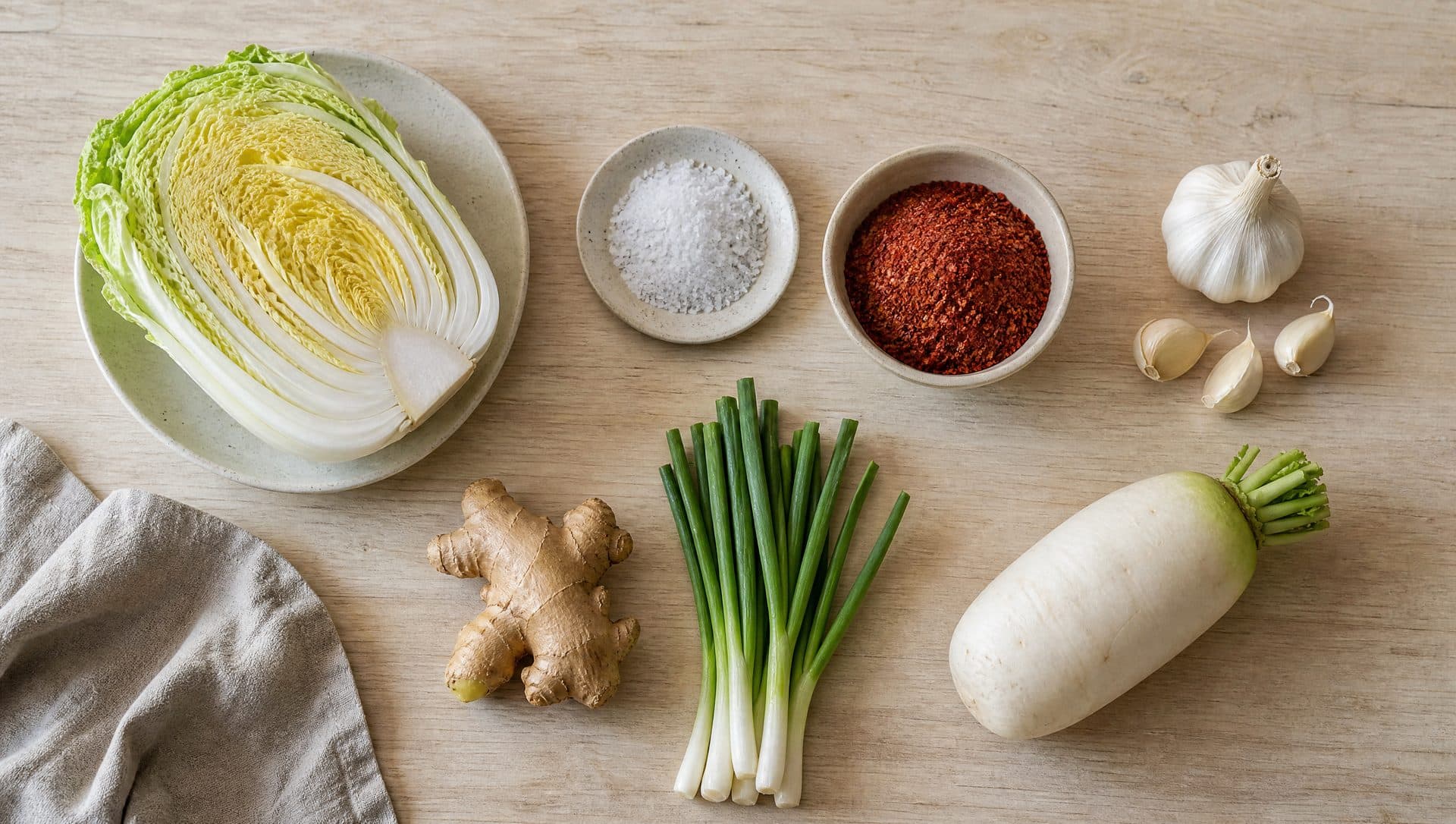
Kimchi is made from seven core ingredients: napa cabbage, salt, gochugaru (Korean chilli flakes), garlic, ginger, spring onion and Korean radish. Those are the seven the Codex standard for kimchi names. The standard Korean recipe adds two more, a salted fermented seafood called jeotgal and a thin rice porridge, and each of the nine does a different job in the jar.
A kimchi recipe reads like a long shopping list. It gets shorter once you know what each item is there for and which ones you can bend.
What is kimchi made of?
There is an official answer. In 2001 the Codex Alimentarius Commission, which sets international food standards for the FAO and WHO, adopted a standard for kimchi, CXS 223-2001. It defines kimchi as salted Chinese cabbage mixed with a seasoning made mainly of red pepper powder, garlic, ginger, "edible Allium varieties other than garlic" and radish, then fermented. Salt is listed separately as a basic ingredient. In November 2025 Codex added "kimchi cabbage" to the names the cabbage goes by, alongside Chinese cabbage and napa.
Jeotgal and rice porridge sit further down, under "other permitted ingredients", next to fruit, nuts, sesame, sugar and wheat flour paste. Jeotgal is in most napa cabbage kimchi all the same. Korean temple kimchi is the best-known exception.
| Ingredient | Korean | In the Codex standard | What it does |
|---|---|---|---|
| Napa cabbage | 배추, baechu | Basic | The body, and one of the two main sources of the bacteria |
| Salt | 소금, sogeum | Basic | Pulls water out of the leaves and decides which microbes survive |
| Gochugaru | 고춧가루 | Basic | Colour, a mild fruity heat, and a say in which bacteria grow |
| Garlic | 마늘, maneul | Basic | Pungency, and the other main source of the bacteria |
| Ginger | 생강, saenggang | Basic | A sharp aromatic note, used sparingly |
| Spring onion | 쪽파, jjokpa | Basic | A fresh green allium note through the jar |
| Korean radish | 무, mu | Basic | Body, sweetness and juice in the paste |
| Jeotgal | 젓갈 | Permitted | Savoury depth, and part of the salt |
| Rice porridge | 찹쌀풀, chapssalpul | Permitted | Makes the paste cling, and feeds the fermentation |
Where do the bacteria come from?
Home kimchi has no starter culture. The bacteria arrive on the ingredients, and a 2020 study in Food Chemistry worked out which ones matter. The researchers separated the microbes living on cabbage, garlic, ginger and red pepper and let each set ferment a batch on its own.
Only the cabbage's microbes and the garlic's microbes produced a working kimchi. The cabbage's community ended up dominated by Lactobacillus, the garlic's by Weissella. With every ingredient's microbes left alive, Leuconostoc led.
So the cabbage is not only the thing being preserved. Along with the garlic, it is where the fermentation starts.
What does the salt do?
Salt does its work before any seasoning goes on. It draws water out of the cabbage, so the ribs bend instead of snapping and the leaves do not keep leaking water into the paste later. It also makes the jar hard going for spoilage microbes while the lactic acid bacteria, which tolerate salt, carry on. The Codex standard puts finished kimchi between 1.0 and 4.0 per cent salt, and home kimchi today usually lands near 2.
Korean cooks have long preferred coarse solar sea salt, 천일염, cheonilyeom, stored for a year or more so the bitter mineral liquid drains out of it. In a 2014 study in the Korean Journal of Food Science and Technology, kimchi brined with four-year-aged solar salt and kept for five months at -1°C soured gradually and stayed firmer than batches made with one-year-aged solar salt or refined salt. Tasters preferred it. The refined-salt kimchi soured sharply.
How much salt, for how long, and how to tell when the cabbage is done are in salt, and why the first step decides everything after it.
What does gochugaru add besides heat?
Colour first. The Codex standard says kimchi should be red, and that the red should come from the pepper. Then a mild, fruity heat: Korea's national standard grades gochugaru from under 150 to over 1,000 mg/kg of capsaicinoids, and a medium bag is several times milder than cayenne.
It also changes which bacteria grow. Rural Development Administration researchers fermented kimchi with and without red pepper powder at 4°C for 12 weeks, and published the results in Scientific Reports in 2016. Weissella cibaria, one of kimchi's main lactic acid bacteria, held at about 20 million cells per millilitre in the red kimchi for the first seven weeks. In the kimchi without chilli it was not detected at all.
Leave it out on purpose and you have 백김치, baek kimchi, white kimchi, a dish of its own. Which grind to buy is in coarse, fine, and what actually changes, and what to use without it in choosing gochugaru in a US grocery.
Why so much garlic, and so little ginger?
The Rural Development Administration's standard formula, which we used in our napa cabbage kimchi method, calls for 2.0 parts garlic and 0.9 parts ginger per 100 parts cabbage. Garlic is the bigger lever. It also carried the second of the two bacterial communities that could ferment a jar alone in the 2020 study.
An older experiment shows the gap from the other side. In 1987 researchers writing in the Journal of the Korean Society of Food Science and Nutrition made kimchi with one ingredient left out at a time and fermented it at 20°C. Across the whole fermentation, the batch without garlic had the worst texture, the most off-flavour and the lowest overall eating quality. The batch without ginger kept more of its carbon dioxide and scored best for fizz and for overall eating quality.
That is one tasting panel nearly forty years ago. What it does suggest is that ginger is the one to weigh rather than eyeball, and the standard formula keeps it under half the weight of the garlic.
What do radish and spring onion add?
Radish is cut into matchsticks, 무채, muchae, and gives the paste body, sweetness and juice. Spring onion, usually the thin 쪽파, jjokpa, adds a green allium note. The Codex wording covers any onion relative except garlic, so leeks or ordinary spring onions are inside the definition.
What is jeotgal, and which kind should you use?
Jeotgal is seafood salted and left to ferment, used either whole or as the clear liquid drawn off it, 액젓, aekjeot. It brings savoury depth and part of the salt, and in the standard formula it outweighs the gochugaru, at 5 parts per 100 of cabbage. What it changes in the fermentation, and what replaces it, is in vegan kimchi: does removing fish sauce change the benefits?
Which one goes in is one of the clearest regional markers in Korean kimchi.
| Jeotgal | Korean | Made from | Region | Notes |
|---|---|---|---|---|
| Salted shrimp | 새우젓, saeujeot | Tiny shrimp, salted whole | Seoul and Gyeonggi | Light and clean. The forgiving choice for a first batch |
| Anchovy sauce | 멸치액젓, myeolchi aekjeot | The liquid from salted anchovies | Gyeongsang and Jeolla | Darker and stronger. Deepens as the kimchi ages |
| Sand lance sauce | 까나리액젓, kkanari aekjeot | The liquid from salted sand lance | Made on the west coast, around Baengnyeong Island | Lighter and less fishy than anchovy sauce |
| Salted yellow croaker | 황석어젓, hwangseogeojeot | Young yellow croaker, salted whole | Chungcheong, and kimjang in Seoul and Gyeonggi | A mild choice |
| Salted hairtail innards | 갈치속젓, galchi sokjeot | The guts of hairtail fish | The south coast, Jeolla and Gyeongsang | In Gyeongsang, used alongside anchovy sauce |
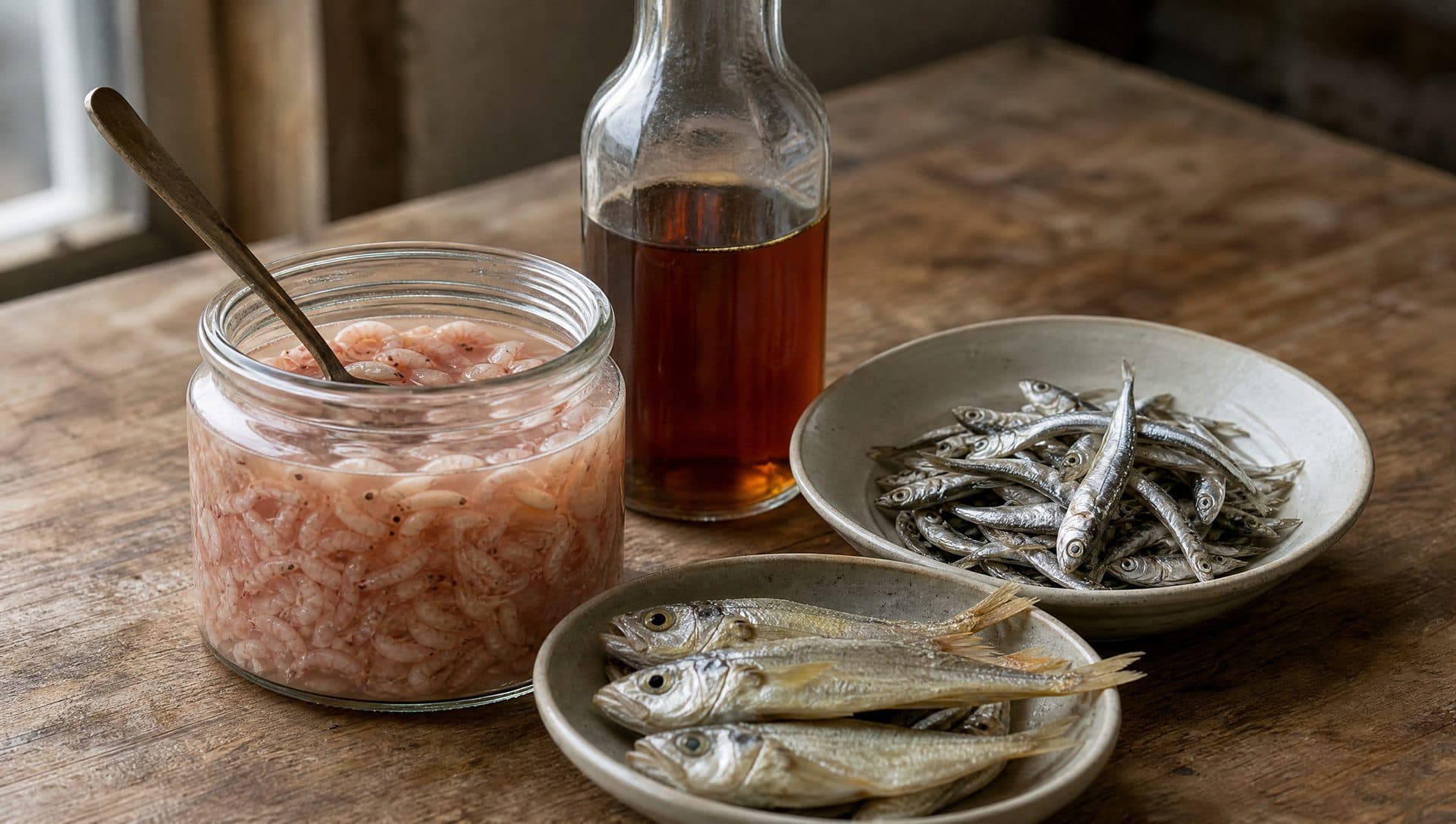
Salted shrimp is graded by the season it was caught. Shrimp salted in the fifth lunar month is 오젓, ojeot, in the sixth 육젓, yukjeot, and in autumn 추젓, chujeot. The Encyclopedia of Korean Culture names yukjeot as the best for kimjang, when the shrimp are at their plumpest. Chujeot mostly goes into side dishes.
Many households use two at once, a liquid sauce for depth and salted shrimp for a cleaner edge. For a first batch, salted shrimp alone is hard to overdo.
Why cook a rice porridge?
The porridge, glutinous rice flour simmered in water until thin and glossy, looks like the least important thing in the bowl. It makes the paste cling to the leaves instead of sliding off. It also feeds the fermentation.
In a 2018 study in Molecules, kimchi made with 10 per cent glutinous rice paste had more bacteria after one day than kimchi without it, and its pH fell faster. After 20 days it held 877 mg of glucose per 100 g against 451 mg in the control. Maltose turned up only in the porridge batch, and there was much more mannitol, a mildly sweet sugar alcohol the bacteria make.
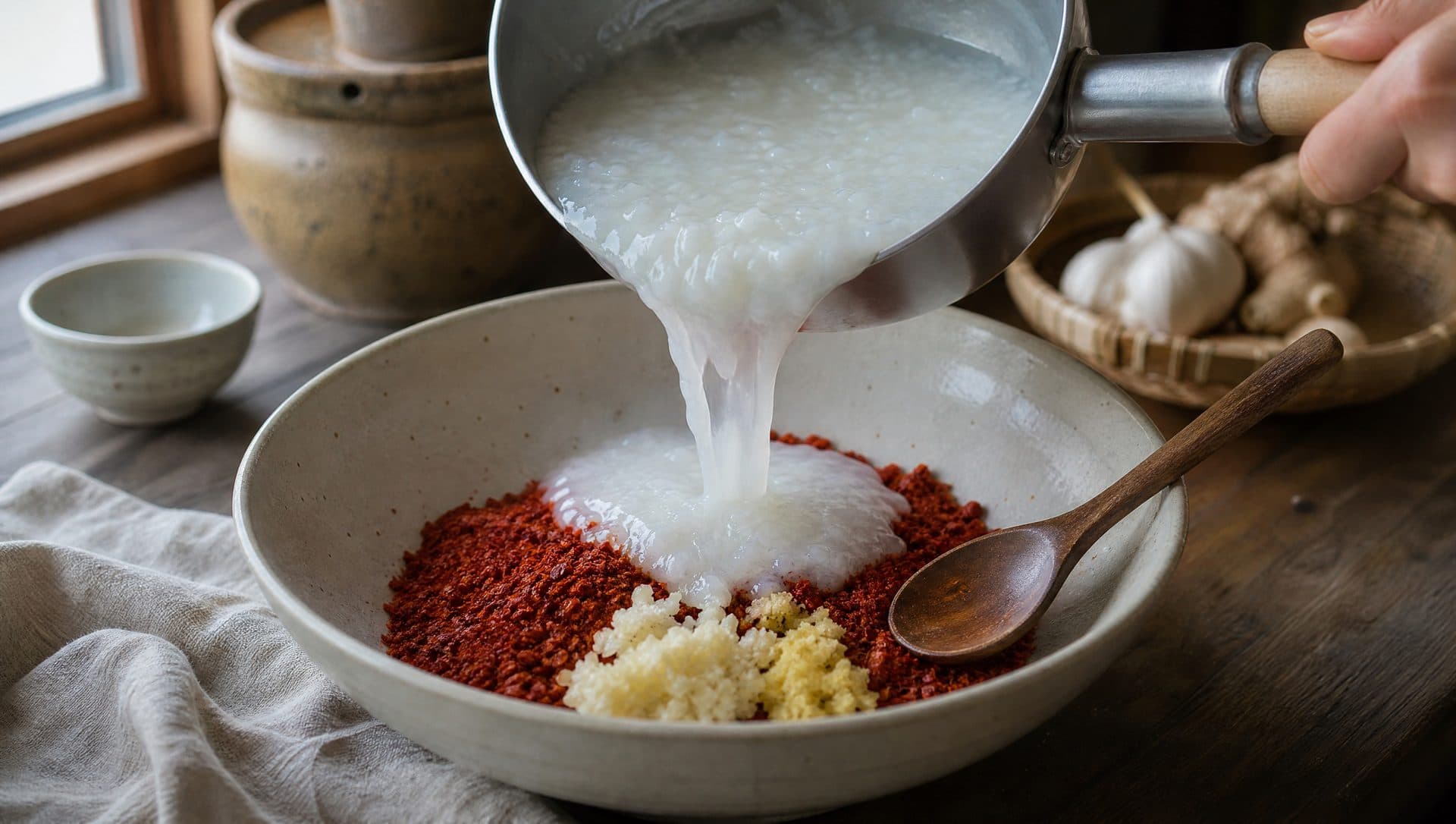
The Codex standard lists wheat flour paste as the alternative. Whichever you make, cook it thin enough to pour.
Before your next batch, weigh the cabbage first. Every other quantity is worked out from it, and the grams for two kilograms of salted cabbage are in the napa cabbage method. After that, change one ingredient at a time between batches, so you can taste what each one was doing.
Frequently asked questions
What is yangnyeom?
양념, yangnyeom, means seasoning. In kimchi it is the paste: gochugaru, garlic, ginger, jeotgal and rice porridge mixed together, with radish and spring onion folded through. The same word is used for marinades and sauces across Korean cooking.
Can you make kimchi without fish sauce?
Yes. Korean temple kimchi is made without seafood, and vegan kimchi ferments normally. Replace the salt that the jeotgal was carrying as well as its flavour, with soy sauce, salted kelp stock or a little extra salt, or the jar finishes under-seasoned.
Can you use green cabbage instead of napa?
You can ferment it with the same paste. It is not what the Codex standard calls kimchi, though, and its tightly packed leaves will not take paste between the layers the way a napa quarter does, so cut it into pieces first.
Is sugar a kimchi ingredient?
An optional one. Codex lists sugars as permitted, and the standard formula uses 0.5 parts per 100 of cabbage, about a ninth of the gochugaru. Some cooks use grated Asian pear or apple instead.