
Health8 min read
Cooked vs. raw kimchi: do you lose the probiotics?
Simmering and frying kill the live bacteria in kimchi: at 60°C the hardiest strain in one study lost nine in ten cells every 45 seconds. Which dishes keep any, what heat leaves behind from fibre and lactic acid to the dead cells themselves, what a 2024 mouse study and a 2024 capsule trial found about heat-killed kimchi bacteria, and how to eat kimchi both ways.
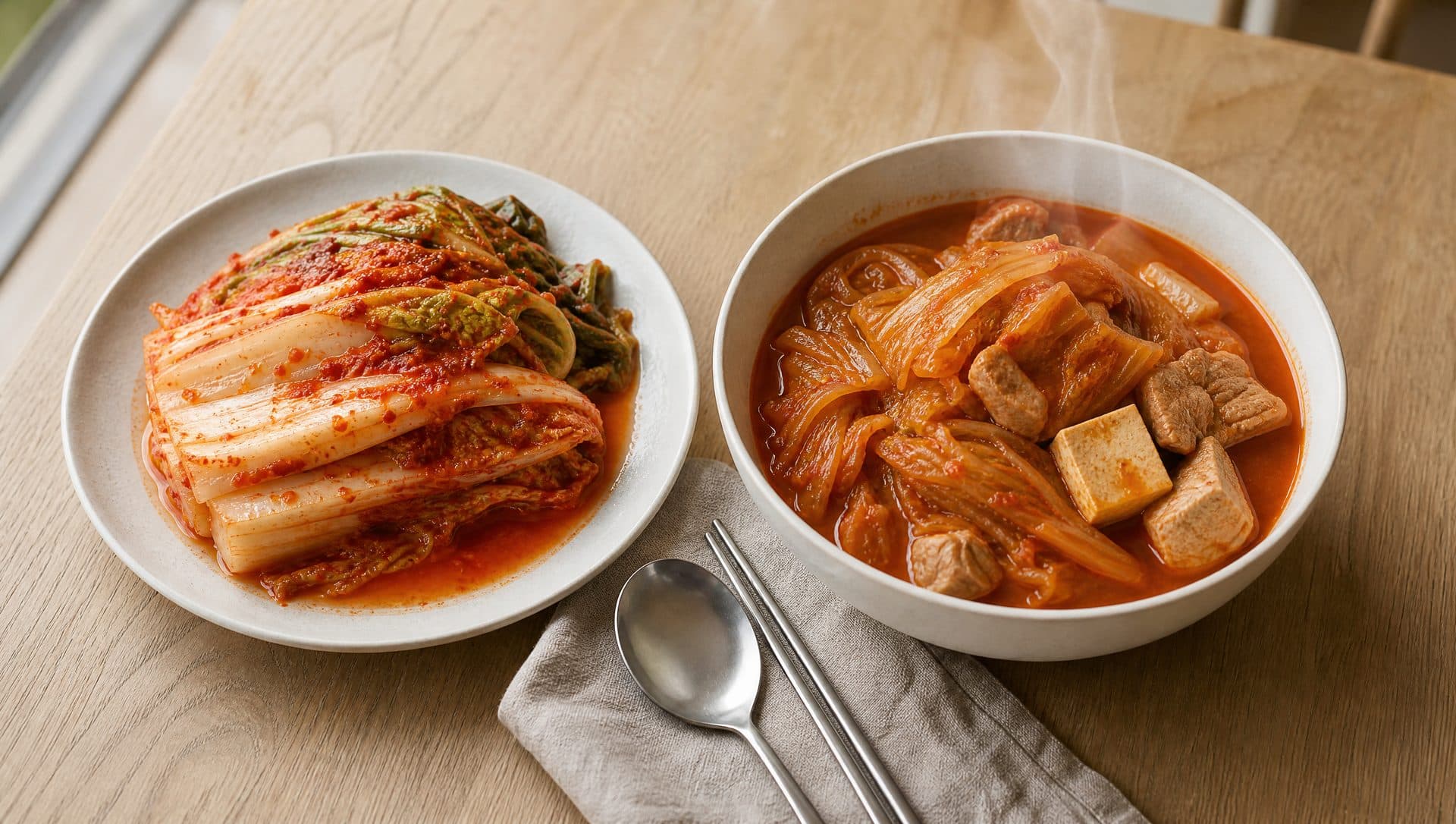
Yes. Cooking kills the live bacteria in kimchi, and a simmering stew kills essentially all of them within minutes. Heat does not take away the fibre or the lactic acid, and the bacterial cells stay in the pot, dead. Early research suggests the dead cells still have some effect. Only raw kimchi carries live cultures.
Raw vs. cooked kimchi at a glance
| Raw kimchi (ripe, chilled) | Cooked kimchi (stew, fried rice, pancakes) | |
|---|---|---|
| Live lactic acid bacteria | 13 million to 1.6 billion per gram in commercial Korean kimchi | None left after a few minutes of simmering or frying |
| Bacterial cells | Alive | Still there, but dead |
| Fibre | Yes | Yes. Heat softens the cabbage but does not remove it |
| Lactic acid | Yes | Yes. It is why a stew made with sour kimchi tastes sour |
| Vitamin C | Higher | Lower. Heat breaks some down and some moves into the broth |
| Antioxidant activity | Present | Unchanged by steaming in a 2024 mouse study |
| Texture and flavour | Crisp, sharp, often fizzy | Soft and rounder, with the sourness spread through the dish |
How hot does kimchi have to get before the bacteria die?
Not very hot. The bacteria that ferment kimchi are lactic acid bacteria, mainly Leuconostoc, Weissella and Lactobacillus, and none of them form the heat-resistant spores that let some other bacteria survive boiling.
Food scientists measure that sensitivity as a D-value: the time at a given temperature that kills nine in every ten cells. A 2016 study from Wageningen University in Applied and Environmental Microbiology measured it for 20 strains of Lactobacillus plantarum, the species that takes over as kimchi sours. It has since been renamed Lactiplantibacillus plantarum, which is the name you will see on newer papers.
| Temperature | Time to kill nine in ten cells (range across 20 strains) |
|---|---|
| 55°C (131°F) | 0.8 to 19 minutes |
| 58°C (136°F) | 13 seconds to 3.9 minutes |
| 60°C (140°F) | 3 to 45 seconds |
| 63°C (145°F) | 2 to 19 seconds |
Ripe kimchi holds up to about a billion bacteria per gram. Getting from a billion to one takes nine of those tenfold steps. At 60°C the toughest strain in the study goes through thirteen of them in ten minutes. A stew simmers near 100°C (212°F), and kimchi fried rice is cooked in an oiled pan hotter than that, so none of the lactic acid bacteria come out alive.
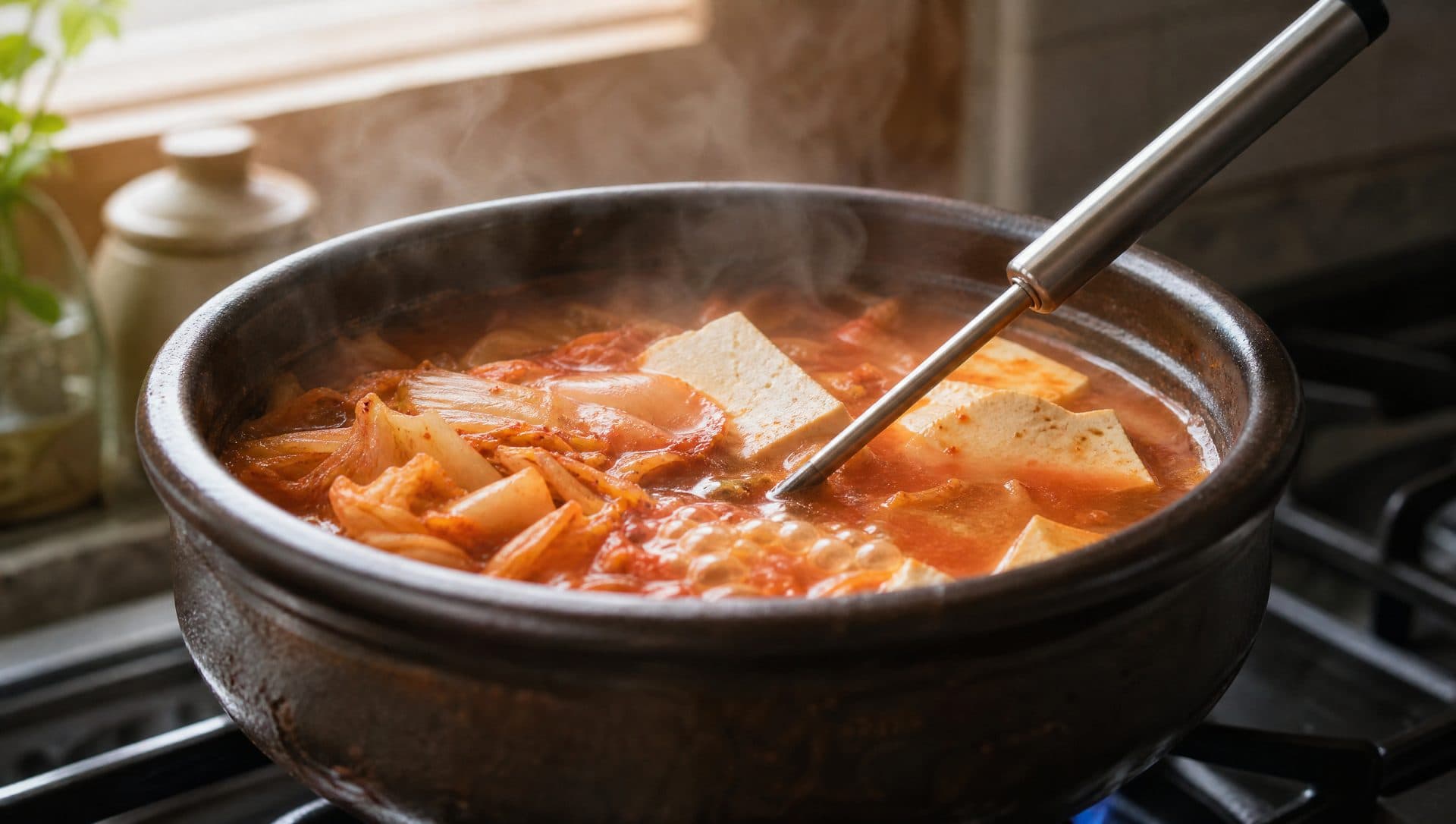
Two caveats. The strains were heated in laboratory broth, not in a pot of kimchi. And at 55°C the hardiest strain needed 19 minutes for each tenfold drop, so food that is warm rather than hot can leave a share alive. Nobody has measured how much survives in a kimchi toastie, or in kimchi stirred into rice that has cooled to eating temperature.
Which kimchi dishes still have live bacteria?
Once the heat is properly on, almost none.
| Dish | How the kimchi is heated | Live bacteria left |
|---|---|---|
| Kimchi stew (김치찌개, kimchi jjigae) | Simmered in broth until soft | None |
| Kimchi fried rice (김치볶음밥, kimchi bokkeumbap) | Stir-fried in a hot pan | None |
| Kimchi pancake (김치전, kimchi jeon) | Cooked through in batter | None |
| Kimchi toastie or quesadilla | Warmed inside bread or a tortilla | Unknown. It depends on how hot the middle gets |
| Jarred kimchi sold at room temperature | Usually pasteurised before sale | Usually none |
| Raw kimchi added after cooking | Not heated | As many as the jar had |
The last row is the useful one. A cooked dish and a spoonful of raw kimchi are two separate things, and a Korean table usually serves both: the stew in the middle and a small dish of kimchi beside it as 반찬, banchan. The pasteurised jars are covered in kimchi myths, debunked.
Does cooked kimchi still do anything for the gut?
Possibly, and this is where the research is newest.
In 2021 the International Scientific Association for Probiotics and Prebiotics set out a definition of a postbiotic: a preparation of dead microorganisms, or parts of them, that has been shown to benefit the person who takes it. Cooked kimchi has the ingredients for that, in the form of dead lactic acid bacteria, their cell walls and what they produced while alive. What it lacks is the demonstrated benefit. It is a candidate, not a postbiotic.
Two lines of research have tested the idea.
A 2024 study in the Journal of Ethnic Foods fed mice a diet containing 10 per cent freeze-dried kimchi for 28 days, either raw or steamed. Steaming killed the microorganisms but did not change the kimchi's antioxidant activity. Both groups ended up with more lactic acid bacteria in their faeces, more lymphocytes in the spleen, more IgA antibody in the gut and less of a marker of oxidative damage, and the cooked group did about as well as the raw one. It is a mouse study, and a tenth of the diet as dried kimchi is a dose far above a side dish.
In people, the tests so far have used a single isolated strain rather than a cooked dish. In a 2024 randomised, double-blind trial published in Nutrients, 100 Korean adults took either a placebo or 500 billion heat-killed cells of L. plantarum nF1, a strain isolated from kimchi, once a day for eight weeks. Natural killer cell activity, the main measure, did not differ from placebo across the whole group. Interleukin-12, an immune signalling molecule, did rise relative to placebo, and among 23 people who started with low secretory IgA, natural killer activity rose in those taking the capsule. Five of the eleven authors were employed by IMMUNOBIOTECH, a Korean biotech company.
That capsule is a lot of bacteria. At the highest count in the table at the top of this page, 500 billion cells is what you would find in about 300 g, six servings. At the lowest, it is more than 38 kg.
So cooked kimchi is not inert. Dead kimchi bacteria have shown effects in mice and, concentrated into capsules, in people. We could not find a study that gave people cooked kimchi and measured the result.
What else does heat change?
Cooking softens the cabbage but leaves its fibre, and the lactic acid stays too. The acid is why Korean cooks reach for old, sour kimchi when they make stew. Aged kimchi, 묵은지, mukeunji, is sold in Korea for exactly that purpose, and there is more on cooking with it in four things to do with sour kimchi.
Vitamin C is the casualty. It breaks down with heat and dissolves in water, so a long simmer destroys some and moves some into the broth. If you eat the broth, you get back part of what left the cabbage.
Salt moves the same way. The sodium in the kimchi spreads into the stew, so if you are counting it, the broth counts. Commercial napa cabbage kimchi in Korea averages about 619 mg per 100 g, and the rest of the numbers are in kimchi health benefits.
How do you get both?
Keep cooking kimchi and eating kimchi apart, at least in your head. Older, sourer kimchi goes in the pot, where the bacteria were going to die anyway and the acid does the most for the flavour. Ripe kimchi straight from the fridge goes on the plate.
Add the raw kimchi after the heat, never into a pot that is still on the stove. A spoonful on fried rice once it leaves the pan works. So does a small dish beside the stew.
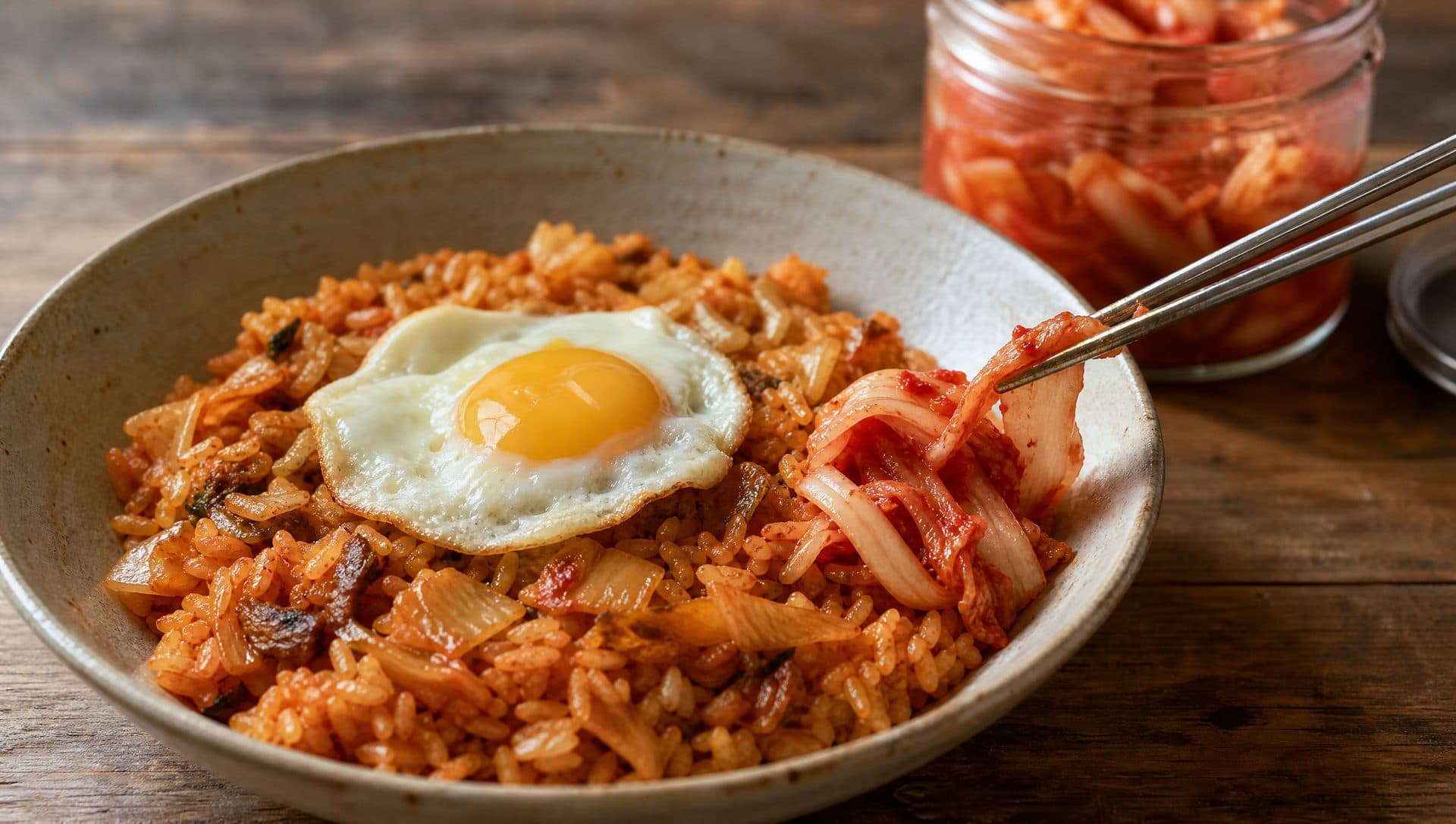
If you buy kimchi for the bacteria, buy it from the chilled section. A jar on a room-temperature shelf has usually been heat-treated already, which does to it what the pot does.
The next time you make kimchi fried rice, hold back a spoonful of kimchi before it goes into the pan, and put it on top at the table.
Frequently asked questions
Does kimchi jjigae have probiotics?
No live ones. The stew simmers close to boiling, and the lactic acid bacteria in kimchi die within seconds to minutes at 60°C. The dead cells are still in the broth. A small dish of raw kimchi on the side supplies live ones.
Is cooked kimchi still good for you?
It keeps its fibre, lactic acid and antioxidant activity, and in a 2024 mouse study steamed kimchi did about as well as raw kimchi on gut bacteria and immune markers. It loses its live bacteria and some vitamin C. It also carries the kimchi's salt into the broth.
At what temperature do the probiotics in kimchi die?
Death speeds up sharply between 55°C and 63°C (131°F and 145°F). In a 2016 study of 20 strains of Lactobacillus plantarum, the time to kill nine in ten cells was up to 19 minutes at 55°C and no more than 45 seconds at 60°C. Simmering and frying are well above both.
Does microwaving kimchi kill the probiotics?
If it gets hot, yes. A microwave kills bacteria the same way a pan does, with heat. Kimchi brought only to room temperature loses nothing, since that is a temperature it ferments at.
Is store-bought kimchi cooked?
Not if it is sold chilled. Jars kept at room temperature have usually been pasteurised, which kills the bacteria the same way cooking does. Look for kimchi on a refrigerated shelf. A jar that hisses when you open it is still fermenting.