
Types8 min read
Kkakdugi: the crunchy radish kimchi guide
Korean radish cut into 2 cm cubes, salted, then tossed in chilli, garlic, ginger and salted shrimp. The two published Korean home methods, 4 per cent salt and a rinse or 2 per cent and none, the seasoning by weight, why the chilli goes on first, how fast it ripens at each fridge temperature, and why it comes with seolleongtang.
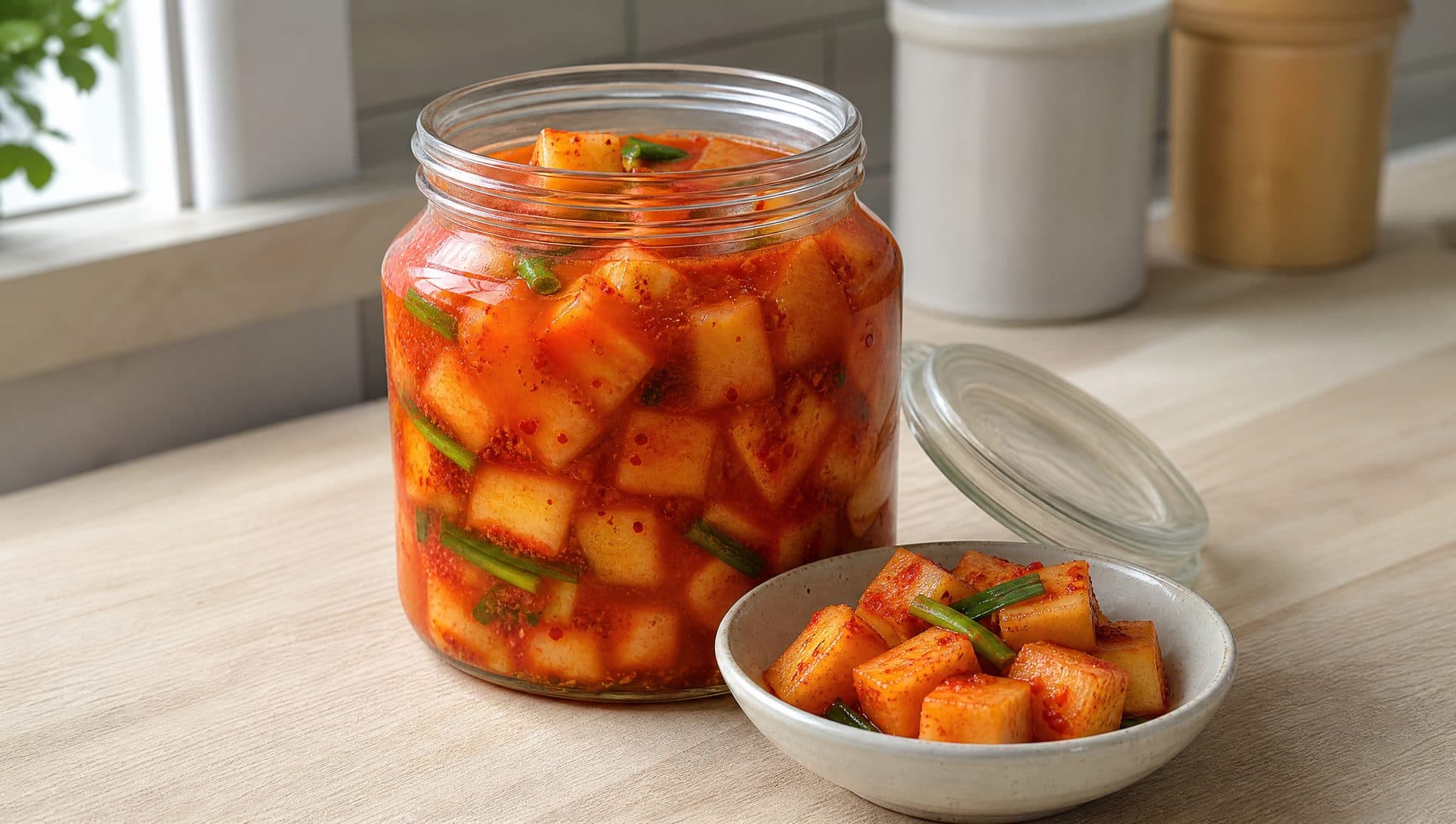
Kkakdugi (깍두기) is Korean radish cut into cubes about 2 cm across, salted for an hour or two, then tossed in gochugaru, garlic, ginger, salted shrimp and spring onion. It is the simplest kimchi to make at home, it holds its crunch longer than cabbage kimchi, and November, when the autumn radish comes out of the ground, is the month to make it.
What makes kkakdugi different from other radish kimchi?
Mostly the knife. Korea makes several kimchi from the same large white radish, 무 (mu), and the cut is what separates them. Kkakdugi is cubes, and apart from the seasoning nothing else goes in the jar.
| Kimchi | Korean | How the radish is cut | What else goes in |
|---|---|---|---|
| Kkakdugi | 깍두기 | Cubes, 2 to 2.5 cm | Seasoning only |
| Gul kkakdugi | 굴깍두기 | Smaller pieces, about a finger joint | Plenty of raw oysters |
| Seokbakji | 섞박지 | Large pieces, about 5 cm, like the cabbage | Napa cabbage, mustard leaf, water dropwort |
| Chonggak kimchi | 총각김치 | Not cut. Small radishes kept whole | Their own leafy tops |
| Dongchimi | 동치미 | Whole or in big pieces | A clear brine, no chilli flakes |
The cubes are older than the name. The Encyclopedia of Korean Culture identifies Siui jeonseo, a cookbook thought to date from the late 1800s, as the first Joseon cookbook with a kkakdugi recipe, filed there as jeotmu (젓무), radish with salted fish. At court it went by songsong (송송). By 1913 a cookbook called Yorijebeop listed five kinds, among them cucumber, oyster and chicken versions and suk kkakdugi, made with cooked radish for older people who found raw radish hard to chew. The story of the king's daughter said to have invented it is in our ten types of kimchi every beginner should know.
Why make kkakdugi in November?
Because autumn radish is the kimjang radish. Korea's Rural Development Administration tells home growers who want to harvest in mid to late November to sow radish between mid-August and early September, and to lift it before the temperature drops below freezing. Radish that grows into cool autumn weather comes out firm and sweet, and it is the one Korean households build their winter kimchi around.
Look for Korean radish rather than the long Japanese daikon. It is shorter and stouter, pale green at the shoulder where the leaves were, and a good one feels heavy for its size.
Radishes do not all behave the same in salt, either. A 2001 study in the Journal of the Korean Society of Food Science and Nutrition salted 2 cm cubes from five autumn varieties in the same 10 per cent brine at 15°C. Bringing the cubes up to 3 per cent salt took two hours for one variety and five for another, and the slowest to salt was also the hardest. Whatever radish you buy, the time in a recipe is where you start tasting, not when you stop.
How big should the cubes be?
The encyclopedia describes the pieces as the size of a small chestnut, and its method cuts them 2.5 cm wide and 1.5 cm thick, so not quite a cube. The Rural Development Administration's home method and the researchers above both use 2 cm.
Size is a trade-off. Smaller pieces take salt and seasoning faster and are ready sooner. Bigger ones keep their bite longer, which suits a jar you plan to work through over a month.
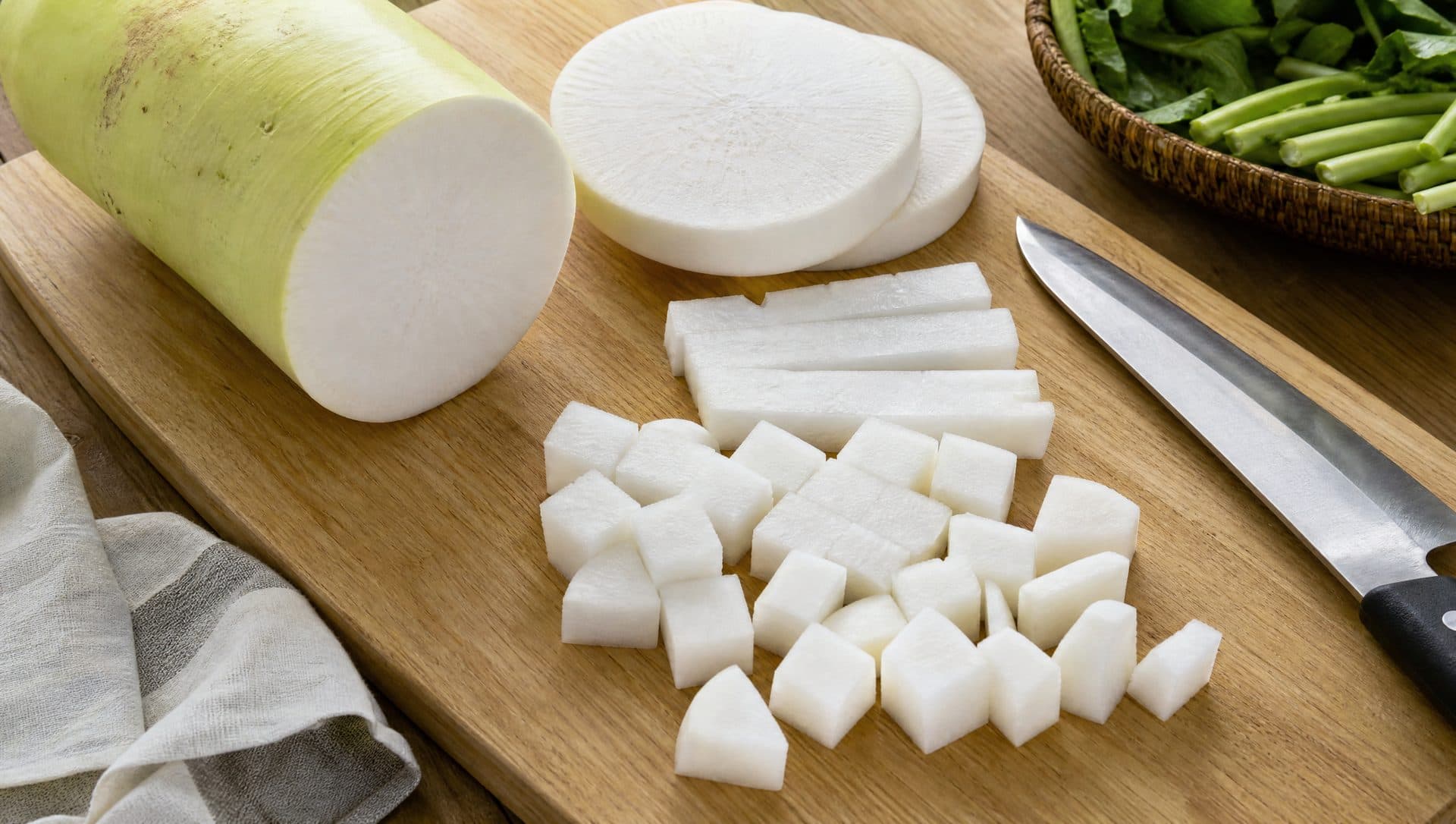
Wash and trim the radish, and peel it only where the skin is blemished. Cut it across into rounds 2 cm thick, cut each round into 2 cm strips, then cut across the strips. The odd shapes from the curved edges go in the jar with the rest.
How much salt, and for how long?
Two Korean institutions publish home methods, and they disagree on how much salt goes on and whether it gets rinsed off. Both make good kkakdugi.
| Method | Salt | Time | Then |
|---|---|---|---|
| Rural Development Administration (Nongsaro) | 4% of the radish weight, sprinkled | About 2 hours | Rinse in water and drain |
| World Institute of Kimchi, home batch | About 2%, sprinkled | Not fixed | Mix in the seasoning, no rinsing or draining |
| World Institute of Kimchi, brine test | 10% brine at 15°C | 25 minutes | Drain 10 to 30 minutes |
The Nongsaro method warns that salting past two hours softens the radish and costs it its bite. The World Institute of Kimchi notes that factories drain brined cubes for 10 to 30 minutes, that 30 is plenty, and that longer than that dries out the surface.
The seasoning amounts below come from the same Nongsaro method, so for a first batch use its salting too. Toss the cubes every half hour so the salt reaches all of them.
What goes in the kkakdugi seasoning?
Nongsaro gives every ingredient as a share of the salted radish's weight.
| Ingredient | Share of salted radish | For 2 kg |
|---|---|---|
| Gochugaru | 3% | 60 g |
| Garlic, minced | 3% | 60 g |
| Ginger, minced | 1.5% | 30 g |
| Jeotgal | 4% | 80 g |
| Glutinous rice paste | 5% | 100 g |
| Sugar | 2% | 40 g |
| Sesame seeds | 1% | 20 g |
| Spring onion and mustard leaf | A small handful, cut to the length of a cube |
For the jeotgal, use salted shrimp, 새우젓 (saeujeot), chopped fine. It is the one the encyclopedia's recipe names. The rice paste is cooked and cooled exactly as for cabbage kimchi, and how to make classic napa cabbage kimchi explains why it is there.
Order matters more than people expect. The encyclopedia's method tosses the drained cubes with gochugaru on its own first, until every cube is red, and only then adds the garlic, ginger, spring onion and shrimp. Colouring first is how the cubes get their even, deep red.
How long does kkakdugi take to ferment?
A 1998 study of kkakdugi fermentation temperature, by Jang, Kim and Heo in the same journal, followed batches for 57 days and recommended 36 hours at 20°C, then 4°C. Over that time lactic acid rose to between 6 and 31 times its starting level. Malic acid, 55.1 per cent of the non-volatile acids at the start, fell sharply by the time the kkakdugi was at its best. Mannitol, a mildly sweet compound some lactic acid bacteria make, went up, unlike the other sugars.
After the warm start, fridge temperature decides the pace. A 2002 study timed how long kkakdugi took to reach 0.6 per cent acidity: 6 days at 15°C, 7 at 10°C, 18 at 5°C and 30 at 0°C. The jump between 10°C and 5°C is the one to notice, and kimchi fermentation explained, day by day has the rest of that curve.
Why is kkakdugi served with seolleongtang?
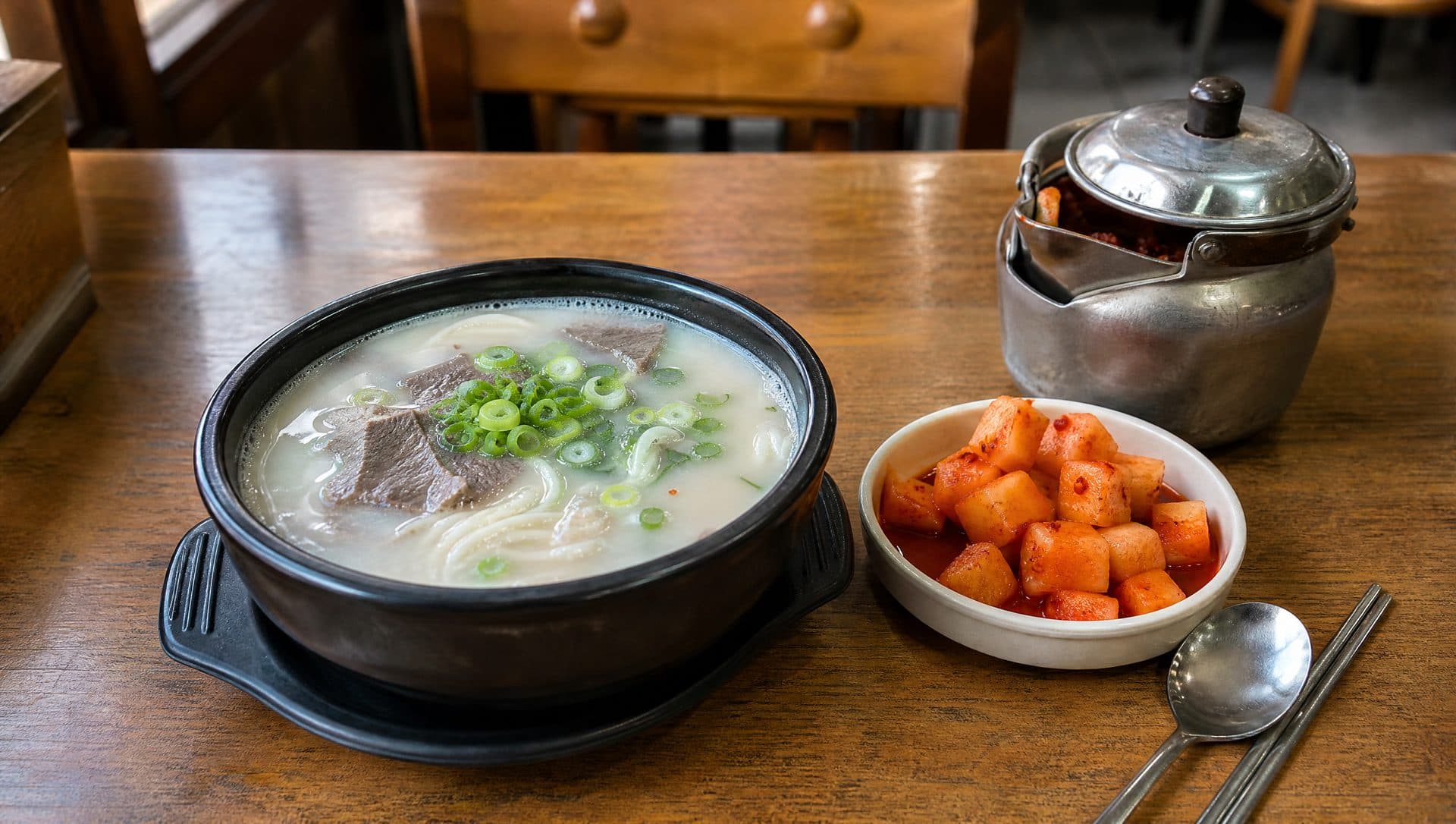
Seolleongtang (설렁탕) is a milky ox-bone soup, mild and rich, and it needs something sour and crunchy beside it. The Michelin Guide's Korean edition said so plainly in a 2020 feature on the soup: kimchi completes seolleongtang, and kkakdugi or baechu kimchi is what matters.
Some Seoul restaurants put the kkakdugi brine on the table in a kettle of its own. At one, the Michelin piece notes, diners pour it into the bowl when the broth starts to feel heavy, while others keep the soup plain and eat the cubes on the side. Either way, do not pour the brine from your jar away when the cubes are finished. Kimchi juice: never pour it out has what else it is good for.
A first batch, step by step
| Step | Time | What you are doing |
|---|---|---|
| Cut | 15 min | 2 kg trimmed radish into 2 cm cubes |
| Salt | About 2 hours | 80 g salt, tossed every half hour |
| Rinse and drain | 30 min | One rinse in cold water, then a colander |
| Colour | 5 min | 60 g gochugaru, tossed until every cube is red |
| Season | 10 min | Garlic, ginger, chopped saeujeot, rice paste, sugar, sesame, spring onion |
| Room temperature | About 36 hours at 20°C | Pressed into a jar, lid on, with headroom |
| Fridge | Weeks | Ready when a cube tastes tangy rather than just salty |
This week, buy one Korean radish. Weigh it after trimming and take 4 per cent of that weight in salt. That is the only number you need to start.
Frequently asked questions
Is kkakdugi the same as kimchi?
Kkakdugi is one kind of kimchi. On its own, the word kimchi usually means baechu kimchi (배추김치), made from napa cabbage, which is most of the kimchi eaten in Korea. Kkakdugi is the radish kind, made with much the same seasoning, and it keeps its crunch longer.
Can I use daikon instead of Korean radish?
Yes. Since radish varieties take salt at different speeds, start tasting a cube after the first hour instead of waiting for the two-hour mark, and rinse as soon as the cubes taste seasoned all the way through.
Do you rinse the radish after salting?
It depends how much salt went on. At 4 per cent, the Rural Development Administration method, rinse once and drain. At about 2 per cent, the World Institute of Kimchi's home method, mix the seasoning straight in.
Why did my kkakdugi go soft?
Usually the cubes sat in salt too long, or the jar stayed warm too long before the fridge. The radish plays a part as well. A 1999 study in the Korean Journal of Food Science and Technology measured polygalacturonase, an enzyme that breaks down the pectin holding plant cells together, across kimchi ingredients and found the most in salted anchovy and Korean radish. Even a well-made jar softens over months.
What is the difference between kkakdugi and seokbakji?
Kkakdugi is radish alone, cut into cubes. Seokbakji mixes large pieces of radish with napa cabbage, usually with mustard leaf and water dropwort, and it is seasoned with salted fish liquid.