
Basics10 min read
How long does kimchi last? Storage, spoilage signs and best-by myths
Kept cold and under its brine, kimchi lasts for months and is eaten a year on. It does not spoil on a schedule, it sours. What the date on the pack means, why the white film is yeast and not mould, and the few signs that actually mean the jar goes in the bin.
This piece has not been translated into Español yet, so you are reading the English original. Translations are published after review, never automatically.
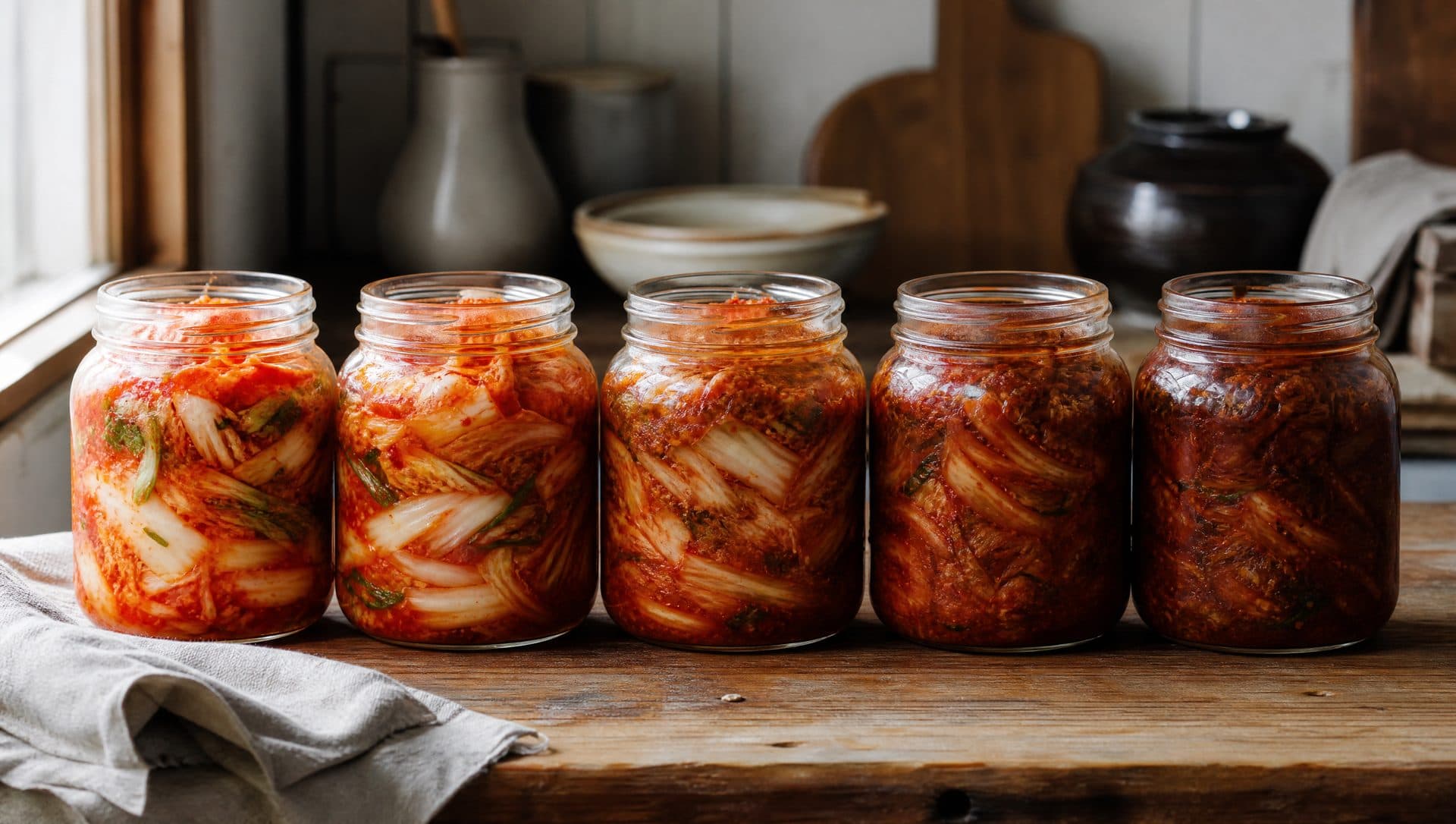
Kimchi (김치) kept cold and under its brine lasts for months, and Korean households routinely eat it a year on. It does not spoil on a schedule. It moves from fresh to sour to very sour, and each stage is still food. The real warning signs are fuzzy coloured mould, slime, or a smell that reads as rotten rather than sharp.
Most of the kimchi thrown away in Western kitchens was thrown away for being sour, and sour is what it is supposed to become.
How long does kimchi last, by where you keep it?
Kimchi has no single shelf life. It has a fermentation speed, and temperature sets that speed. The table is a working guide for napa cabbage kimchi at ordinary salt levels; lighter styles such as cucumber or young radish kimchi move faster at every temperature.
| Where it is | What happens | Reasonable eating window |
|---|---|---|
| Room temperature, around 20–25°C | Ripens in about a day in summer, two or three days in cooler weather. Keeps souring fast after that | 1–3 days for ripening, then move it cold |
| Ordinary refrigerator, 0–4°C | Fermentation slows but does not stop. Sourness climbs steadily for weeks | Best raw in the first 2–4 weeks; good in cooked dishes for months after |
| Kimchi refrigerator, around −1°C | Held near the freezing point of the brine, kimchi stays close to one stage for a long time | 6 months and beyond with little change |
| Unopened packaged kimchi, refrigerated as labelled | Still fermenting inside the pack. The use-by date is the maker's guarantee of the product they sold you | Until the printed date for the flavour on the label; sourer but sound after it |
| Freezer | Ice crystals break the cell walls, so the crunch is gone on thawing | Fine for stew or fried rice, not for eating raw |
The Pusan National University Kimchi Research Institute puts the numbers on the warm end: in summer, kimchi at a standard 3.5% salt level ripens in about a day, and at 5% salt in about two. In kimjang weather of 7–14°C the same kimchi takes five to twelve days. Their view of the best-tasting window is two to three weeks at 5–10°C, which is roughly the temperature of a traditional buried jar and a good deal warmer than a modern fridge.
Why kimchi does not go off the way milk does
Milk spoils because bacteria you do not want grow in it. Kimchi is different in kind: it is already full of bacteria, and they are the ones you want. Lactic acid bacteria take the sugars in the cabbage and radish and turn them into lactic acid, which drops the pH into the low fours. Very few pathogens tolerate that.
The Gyeonggi Province Institute of Health and Environment tested exactly this in a study published in 2021. They took two brands of commercial napa cabbage kimchi, deliberately inoculated them with Salmonella, Shigella, Listeria monocytogenes and E. coli, and counted what survived. At 25°C, Salmonella was dead within one to two days and the other three within three to six, while the lactic acid bacteria hit their peak on day one and the pH settled between 3.93 and 4.33.
The same experiment at 4°C told a slower story. Salmonella took 10 to 16 days to die off, Shigella 23 days, E. coli 27 days, and Listeria was still detectable at 30 days. The acid does the protecting, and cold delays the acid. That is why the first day or two matter more than the next six months.
What does the date on the packet actually mean?
Since 2023 Korean food labels carry a 소비기한 (sobigihan, use-by date) in place of the old sell-by date. Legally it is the period the product is safe to eat if you follow the storage instruction printed beside it, which for kimchi is almost always refrigeration at 0–10°C.
Two things follow. The date assumes the pack was kept cold the whole time, so a bag that spent an afternoon in a hot car is well ahead of its label. And the date is a promise about the product as sold, not a point at which the contents become dangerous. Kimchi a month past its date, kept cold, is sourer than the maker intended and otherwise the same food. Koreans call kimchi in that state 묵은지 (mugeunji) and buy it on purpose for stew.
A sealed pack that has ballooned is full of carbon dioxide from fermentation and can be opened over the sink. A pack with visible mould inside is a different matter, whatever the date says.
How do you tell if kimchi has gone bad?
Nearly everything that looks alarming in a jar of kimchi is normal. There are a few things that are not.
| What you see | What it is | What to do |
|---|---|---|
| Sharper smell, softer leaves, darker red | Ordinary ageing | Eat it, or cook with it |
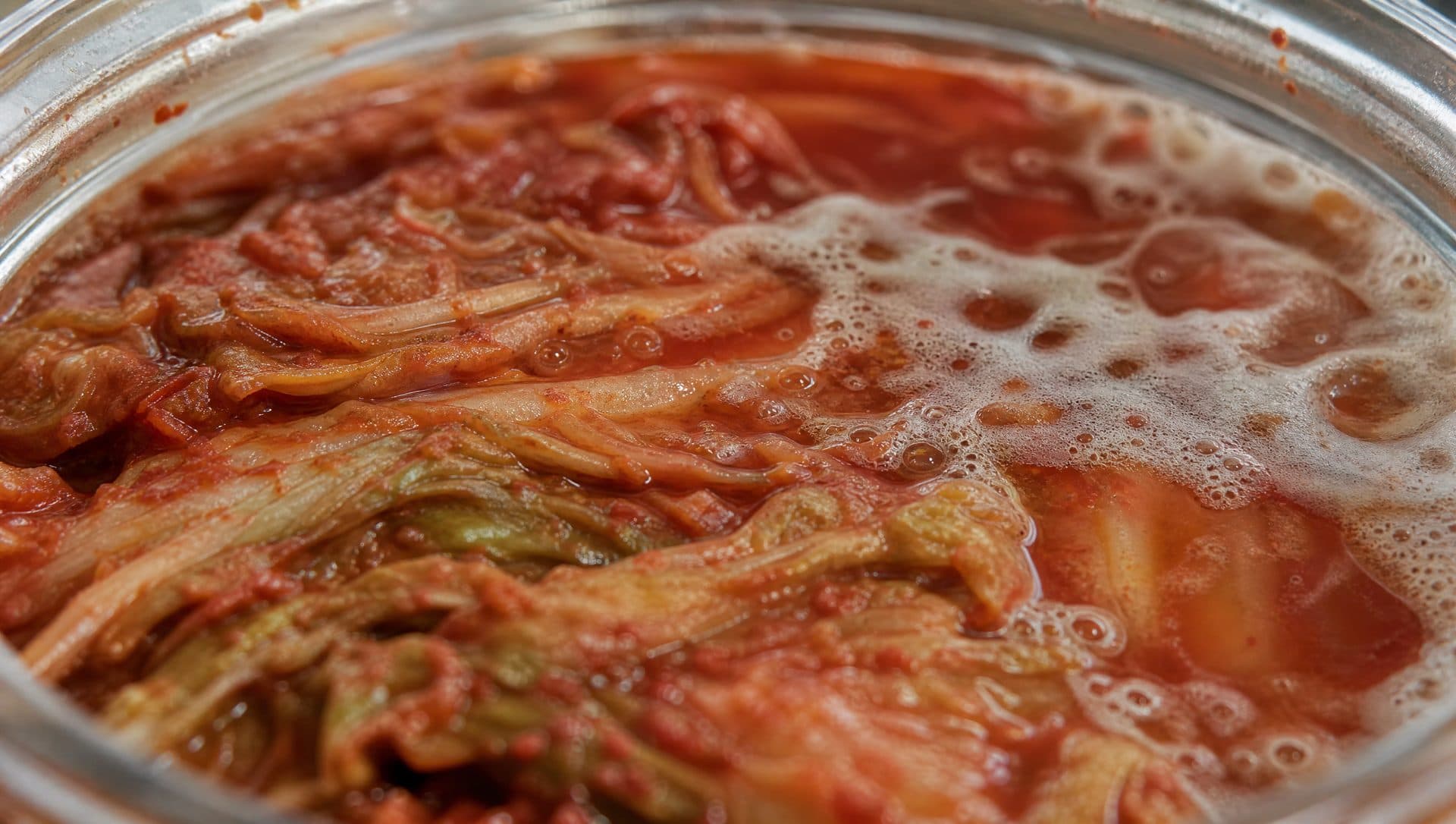
| Fizzing, a popped lid, brine climbing the jar | Carbon dioxide from active fermentation | Open over a sink, press the contents back under the brine |
| A thin white film or white specks on the surface | Film yeast, called 골마지 (golmaji) | Skim it, rinse the top layer, and cook that portion |
| Fuzzy growth in black, green, blue or pink | Mould | Discard the jar |
| Slimy, ropy brine throughout, not just at the top | Spoilage bacteria have taken over | Discard |
| A smell that is rotten, sulphurous or ammonia-like rather than sour | Spoilage | Discard |
The white film is the one that gets good kimchi binned. In 2018 the World Institute of Kimchi sequenced the organisms responsible from napa cabbage, mustard leaf, young radish and white kimchi and found five yeasts, among them Hanseniaspora uvarum, Pichia kluyveri and Yarrowia lipolytica, none of which carried toxin genes. Golmaji appears late in fermentation, when the lactic acid bacteria have slowed and oxygen reaches the surface. The institute's advice is to remove it, rinse the affected kimchi and heat it before eating, which is why a jar with a white top usually ends its life as jjigae.
Coloured, fuzzy mould is a different organism and a different decision. Mould sends threads below the surface you can see, so skimming does not solve it. Throw the jar out.
Does leaving kimchi out overnight ruin it?
No. For fresh kimchi it is closer to the opposite.
The Gyeonggi study's practical conclusion was that freshly made or freshly bought kimchi is better left at room temperature for about a day before refrigerating, because that day at 25°C is when the lactic acid bacteria multiply fastest and the protective acid builds up. A 2012 study in the Korean Journal of Food Science and Nutrition reached a similar place by a different route: kimchi fermented five days at 10°C and then held at −2.5°C reached its optimum (pH 4.4, 0.6% acidity) in two weeks and scored best in tasting at three months, while kimchi chilled to −1°C straight from the salting bench took eight weeks to get to pH 4.6 and never built the same bacterial population.
What a night on the counter does change is the timetable. Kimchi that has been in the fridge for a month and is left out overnight will taste noticeably sourer in the morning, because a warm night is worth a couple of cold weeks. It is not spoiled. It has aged.
The situation to avoid is cycling: warm, cold, warm, cold, with the lid off each time. Every warm spell restarts fast fermentation and every opening lets air onto the surface, which is the combination that grows golmaji.
How should you store kimchi so it lasts?
Cold, submerged and sealed. Each does a separate job.
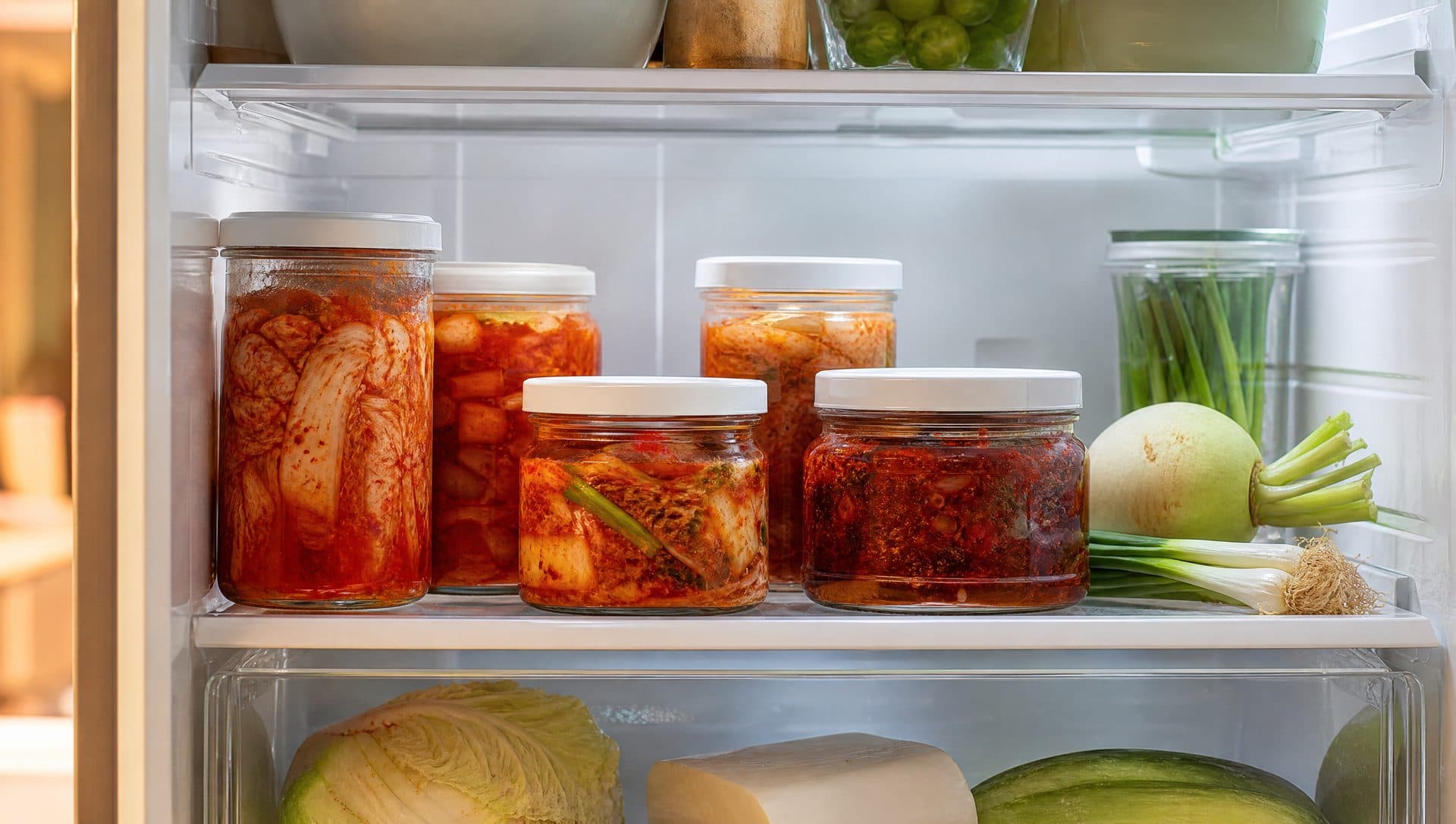
Cold slows the acid. An ordinary fridge at 0–4°C is fine, and the back of the bottom shelf beats the door. A dedicated 김치냉장고 (kimchi refrigerator) holds around −1°C, just above the point at which the brine freezes, and that is the whole reason the appliance exists: at that temperature kimchi can sit for six months in nearly the same state.
Submerged keeps the yeast off. Golmaji and mould both need oxygen. Press the leaves down until the brine covers them, and if there is not enough brine, lay a clean outer cabbage leaf or a sheet of cling film directly on the surface. This is the World Institute of Kimchi's own recommendation for preventing the white film.
Sealed keeps the fridge out. A tight lid holds the aroma in and other people's food out, and a little headspace stops the lid popping in the first week.
Two habits matter more than the container. Use a clean, dry utensil every time, because a smear of rice or oil on the surface is where the first mould grows. And decant a week's worth into a small jar so the main store is opened rarely.
Frequently asked questions
Can you eat kimchi after the expiration date?
Yes, if it has been kept cold and shows none of the spoilage signs above. The date on Korean packs is a use-by date under the labelled storage condition; past it, refrigerated kimchi is sourer, not unsafe. Very sour kimchi is the standard ingredient for kimchi jjigae, which is what to do with it.
How long does kimchi last in the fridge once opened?
Months. Opening it does not reset anything; what matters is that it goes back cold, under its brine, with a clean utensil. Expect the best raw eating in the first few weeks and the best cooking after that.
How long can kimchi sit out at room temperature?
Fresh kimchi benefits from about a day out before refrigeration. Older kimchi left out for a night will be sourer but fine. Weeks at room temperature in summer will take it past the point most people want to eat, though it is still preserved by its own acid rather than spoiled.
Is white stuff on kimchi mould?
Usually not. A thin white film or white specks is film yeast, which the World Institute of Kimchi found carries no toxin genes. Skim it, rinse the top layer and cook that portion. Fuzzy growth in any colour is mould, and the jar should be thrown away.
Can you freeze kimchi?
You can, and it stays safe, but the texture does not survive it. Frozen and thawed kimchi is soft and best used in stew, fried rice or pancakes rather than eaten from the jar.