
Seasons5 min read
What to make in July, when cabbage is out of season
Summer napa is loose, watery and expensive. Korean kitchens answer by changing the vegetable, not the technique.
This piece has not been translated into Español yet, so you are reading the English original. Translations are published after review, never automatically.
Napa cabbage in July is a bad deal. It grows loose rather than dense, the leaves hold more water, the price is up, and a jar made from it goes soft in days instead of weeks. You can force it, and people do. It is not worth it.
The Korean answer is not to make worse cabbage kimchi in summer. It is to make something else, using the same technique on whatever the season is actually producing well. Kimchi is a method, not an ingredient — the summer versions are the clearest demonstration of that.
Yeolmu: young radish greens
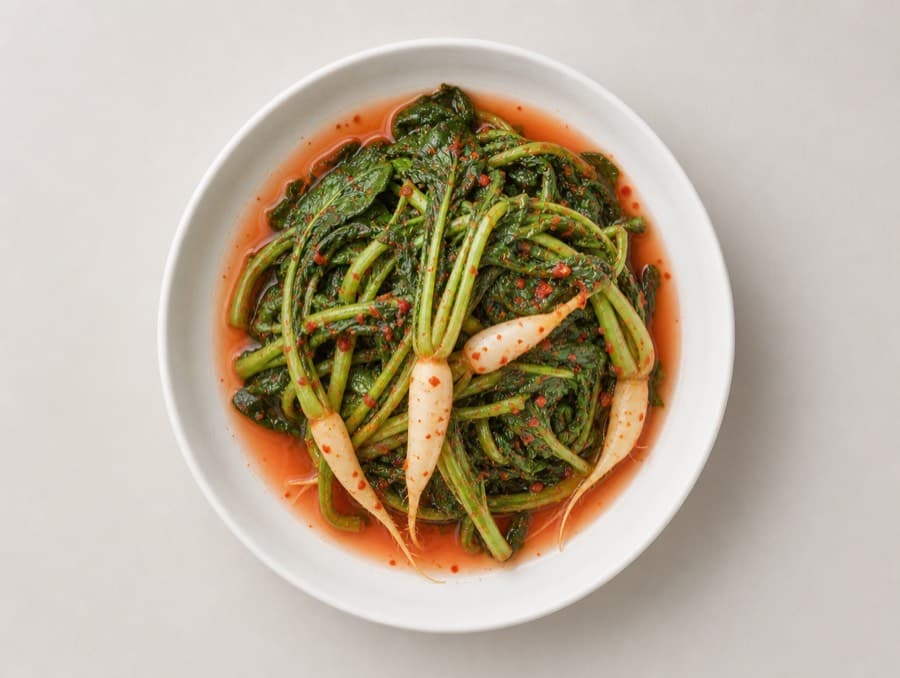
열무김치 is the summer staple. Young summer radishes are pulled before the root has bulked up, so the greens outweigh the small white root, and the whole thing goes in together.
The brine is thin — almost watery — rather than a thick paste. That is deliberate. Summer ferments fast, and a light dressing gives you a jar that is pleasant across a much wider window than a heavily seasoned one would be.
The reason to make it is what you do with the liquid. Pour the cold brine over cold noodles and you have 열무국수, which is dinner in July with no stove involved at all. The brine is the dish as much as the greens are.
Handle the greens gently. Bruised leaves go bitter, and unlike cabbage they will not forgive rough treatment during salting.
Oi-sobagi: cucumber, with a deadline
오이소박이 is cucumber cut into a cross — deep enough to open, not deep enough to fall apart — and stuffed with a filling of garlic chives in seasoning.
This is the one kimchi on any list that you should not age. Cucumber holds its snap for a few days and then goes slack, so it is made in small batches and eaten almost immediately. Treat it as a fresh pickle that happens to use kimchi seasoning, and make it on a Sunday for the week rather than for the season.
Use firm, small, thin-skinned cucumbers. Salt them briefly — much more briefly than cabbage — and stop while they still squeak.
Geotjeori: skip the fermentation entirely
겉절이 is kimchi seasoning applied to fresh vegetables and eaten the same day. No waiting, no jar, no sourness at all.
In summer this stops being a shortcut and starts being the right answer. It crunches like a salad, tastes of raw garlic and sweet pear and clean salt, and it is what gets piled onto grilled pork belly while it still snaps. Any leafy vegetable will take it — young cabbage, lettuce, perilla leaves.
If you have ever wondered what kimchi tastes like before fermentation does its work, this is that, on purpose.
The rule underneath all three
Summer kimchi is made small, dressed light, and eaten soon. Winter kimchi is made large, dressed heavily, and eaten slowly. The technique does not change. The scale and the seasoning load change, because the weather changed.
Once that clicks, the seasonal calendar stops being a set of rules to memorise and becomes obvious. Autumn radishes are dense and sweet, so autumn is for 총각김치 and 깍두기. Winter cabbage is tight and cold-sweetened, so November is kimjang. Summer produces watery, fast-growing vegetables, so summer is for thin brines and short jars.
Nobody in Korea is making cabbage kimchi in July because it is stubborn. They are making yeolmu, and pouring the brine over noodles.