
Culture8 min read
Kimjang: Korea's UNESCO-listed communal kimchi-making tradition
A household makes its winter kimchi in one batch in late autumn, and the neighbours help. The half year of preparation behind it, the 4°C rule that sets the date, what happens on the day, why UNESCO cited the sharing, and what the 2026 Korean survey says about who still does it.
This piece has not been translated into Español yet, so you are reading the English original. Translations are published after review, never automatically.
Kimjang (김장) is the making of a household's winter kimchi in one large batch in late autumn, with relatives or neighbours sharing the work and taking some of it home. UNESCO listed it in 2013 as "Kimjang, making and sharing kimchi in the Republic of Korea". This year 69.3 per cent of Korean households plan theirs for mid-November to early December.
The day itself is easy to picture: basins of salted cabbage, a mound of red filling, a row of people in rubber gloves. Harder to see is the rest of the year that goes into it. Where the custom came from is told in our history of kimchi. This piece is about how kimjang works, and how much of it is left.
Why does kimjang start in spring?
UNESCO's description of kimjang reads like a calendar. In spring, households buy shrimp, anchovies and other seafood and salt them down to ferment. In summer they buy sea salt for the brine. In late summer the red chillies are dried and ground. Only in late autumn does all of it meet the cabbage. The Encyclopedia of Korean Culture (한국민족문화대백과사전) puts the whole cycle at more than half a year.
| When | What gets done | What it is for |
|---|---|---|
| Spring | Shrimp, anchovies and other seafood are salted | Jeotgal (젓갈), the fermented seafood in the seasoning |
| Summer | Sea salt is bought | The brine for the cabbage |
| Late summer | Red chillies are dried and ground | Gochugaru (고춧가루) |
| Mid-August to early September | Autumn radish is sown | The radish in the filling |
| Late autumn | Kimjang | The winter's kimchi |
The radish window is the Rural Development Administration's advice for a mid to late November harvest. Shrimp salted in the sixth lunar month, 육젓 (yukjeot), is the grade the encyclopedia names as best for kimjang, so the jeotgal is bought months before the cabbage, and the chilli is usually the dearer sun-dried kind.
When is kimjang season?
Traditionally it falls around 입동 (Ipdong), the solar term in early November that opens winter. The Encyclopedia of Korean Culture has it starting about a week earlier in the mountains, a week later in Seoul, and in mid-December in the southern provinces of Gyeongsang and Jeolla.
The working rule is a temperature. Korea's weather service set the right moment as the point when the daily mean holds at 4°C (39°F) or below and the daily low reaches 0°C (32°F). Make kimchi in warmer weather and it ripens too fast. Leave it too late and the cabbage and radish freeze in the field. The Korea Meteorological Administration stopped issuing kimjang dates in 2016, along with its cherry blossom and autumn leaf forecasts, and private forecasters took the job over. UNESCO's description records the same habit from the kitchen side: the people making kimjang watch the forecast to choose their day.
The cold is what lets a November batch last until spring. In the 1984 experiment in our troubleshooting guide, low-salt kimchi was ripe in two or three days at 20°C and took 35 days or more at 5°C.
The 2026 season runs north to south, as it always has. The Korea Rural Economic Institute (KREI), which surveys households before every kimjang, found 69.3 per cent planning theirs between mid-November and early December, 1.5 points more than last year.
| Region | Busiest kimjang weeks in 2026 |
|---|---|
| Seoul, Gyeonggi, Gangwon, Chungcheong | Mid-November |
| Gyeongsang | Late November |
| Jeolla and Jeju | Early December |
What happens on kimjang day?
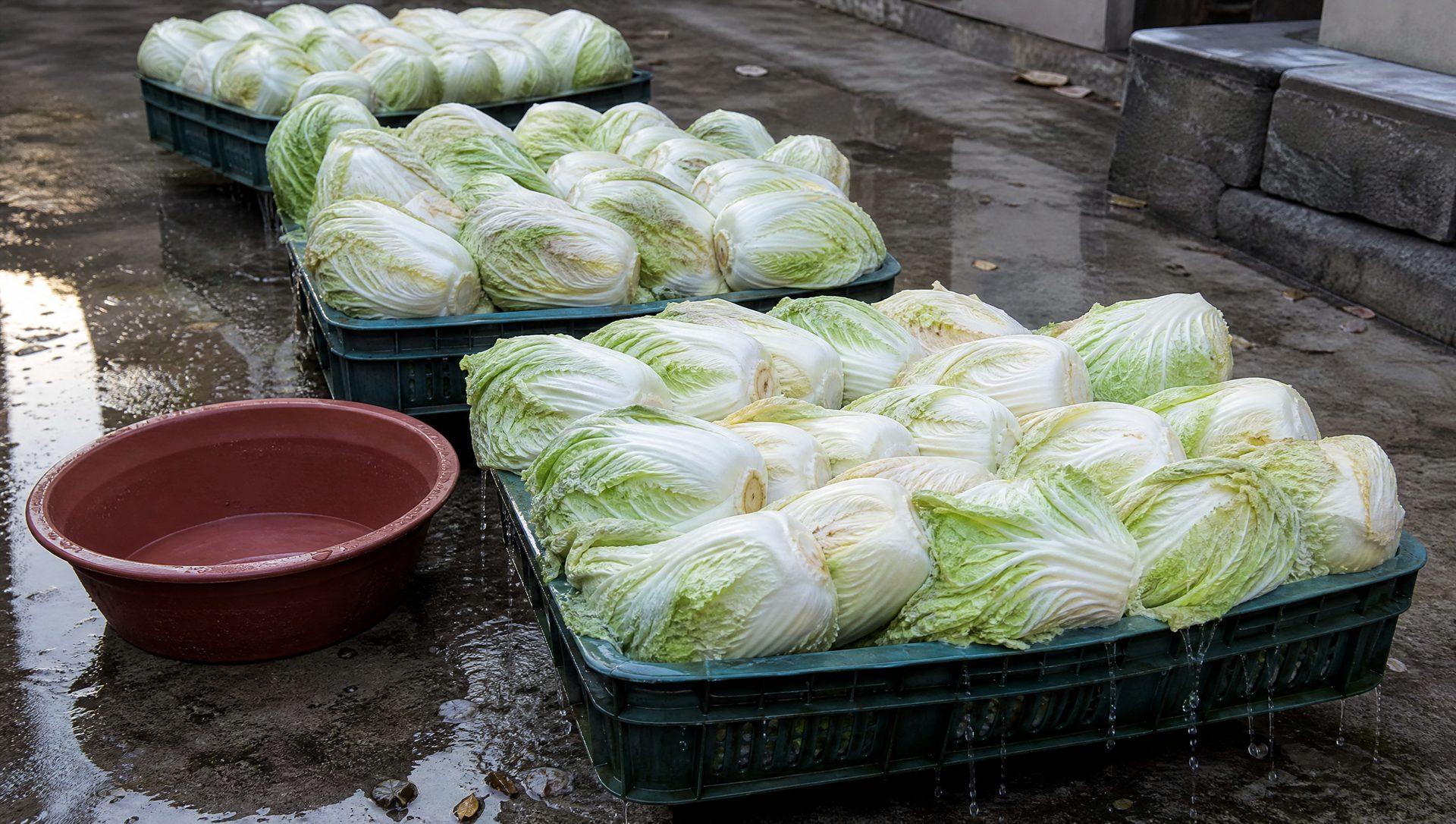
Start with the scale. A family used to make one or two 접 (jeop) of cabbage, a count of 100 heads, according to the National Archives of Korea. The Encyclopedia of Korean Culture reckons that washing the cabbage, cutting the radish and mixing the seasoning took one household two to three days. Nobody did it alone. Neighbours went from house to house and helped at each kimjang in turn.
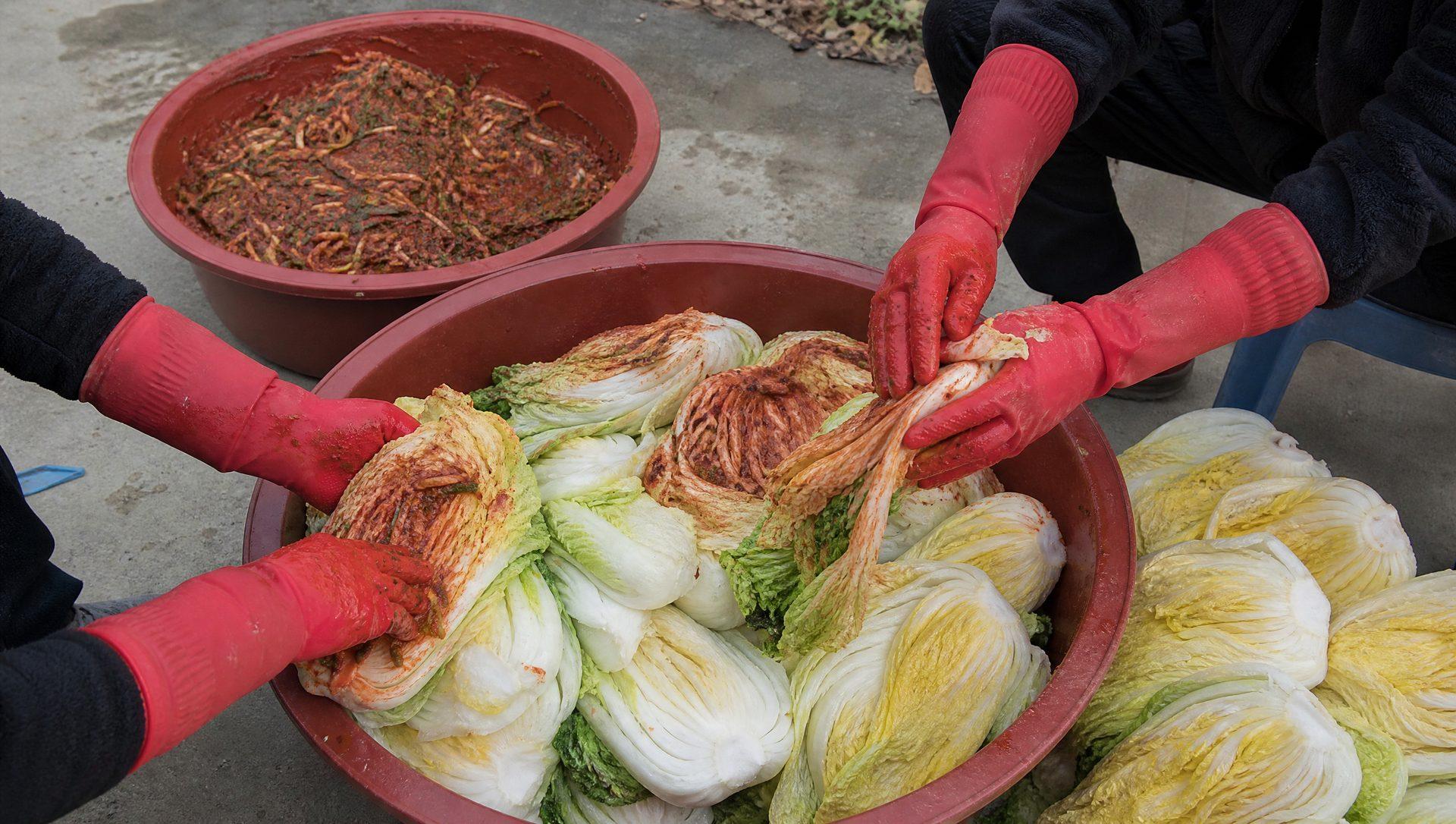
The cabbages are halved and left in brine overnight, then rinsed and drained. The filling, 소 (so), is mixed in wide basins: shredded radish, gochugaru, garlic, ginger, spring onion, mustard leaf and water dropwort, 미나리 (minari), bound with jeotgal. Each half head is opened leaf by leaf and the filling pushed in between, then an outer leaf is folded round to hold it shut. The steps are the same as for an ordinary batch of napa cabbage kimchi. Only the number of hands changes.
Then the jars. Before refrigerators, the kimchi went into earthenware jars that were buried in the ground or stacked in a storeroom under thick straw mats so they would not freeze. Most kimjang now goes into plastic tubs and a kimchi refrigerator, and our container guide covers what each material does to the ferment.
The helpers are fed. The custom the encyclopedia records is boiled pork wrapped in the pale inner leaves of the cabbage with a little of the fresh filling. Raw oysters, in season at the same time, often join it, which is why the meal is among kimchi's classic pairings. When the work was over, the helpers went home with salted cabbage, leftover filling or some of the new kimchi.
Why did UNESCO list kimjang rather than kimchi?
The committee was recognising a practice. When it inscribed kimjang at its December 2013 session in Baku, the reasons it gave were social: the custom is handed down in everyday family life, it lets Koreans practise sharing among neighbours, and it builds solidarity and a sense of belonging. The description treats each family's methods and ingredients as family heritage, typically passed from a mother-in-law to her newly married daughter-in-law, and notes that skills and ideas travel between households along with the kimchi they exchange.
The sharing was never only between equals. The Encyclopedia of Korean Culture records that women from poorer households worked at other families' kimjang and were paid in cabbage and seasoning to make their own.
Korea's nomination also made promises: kimjang in school curricula, laws to promote it, and measures to limit the industrialisation of kimchi-making. The law, at least, arrived. Since a 2020 amendment to the Kimchi Industry Promotion Act, 22 November has been Kimchi Day, the only statutory day in Korea dedicated to a food, set up in part to carry kimjang culture forward. Virginia's General Assembly adopted the same date in 2022. North Korea's kimchi-making has a UNESCO listing of its own, added in 2015.
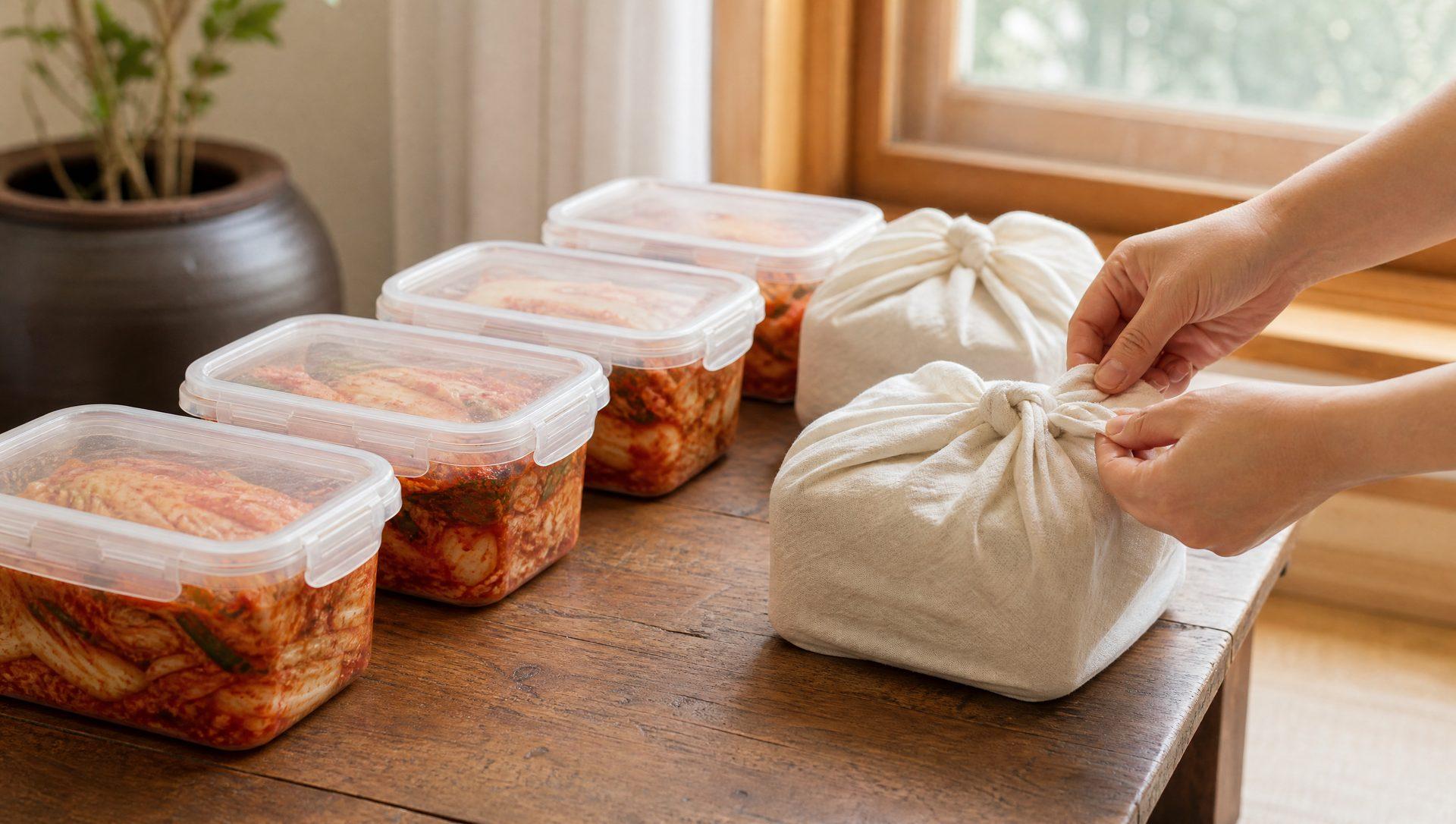
Some of the sharing is now organised. The government's 2026 kimjang plan, announced on 3 November by the agriculture and fisheries ministries, carries a campaign called 한 포기 더, "one more head": salt one extra head of cabbage and give it away. Local governments and the farmers' cooperative Nonghyup are running group kimjang days, and the kimchi goes to households that cannot make their own.
Do Koreans still make kimjang?
Most do, though fewer each year. KREI's 2026 survey, published this month:
| Share of households | |
|---|---|
| Kimjang about the same size as last year | 67.8% |
| Smaller than last year | 16.1% |
| Larger than last year | 13.8% |
| Make their own kimchi or get it from family and friends | 58.6% (64.1% in 2025) |
| Buy commercial kimchi | 41.4% (35.9% in 2025) |
The biggest reason for cutting back was eating less kimchi at home, given by 42.9 per cent of those making less. Others still had kimchi left over (16.3 per cent) or found buying easier (14.3 per cent). Households that keep making their own give the usual reasons: the family's taste, and trusting what went in.
The work has shrunk along with the batch. KREI's surveys have found that more than half of the households making their own now buy their cabbage already salted, which removes the overnight brining and most of the lifting. This year should at least cost less. The government forecasts the autumn cabbage crop up 18.5 per cent on last year and radish up 11.1 per cent, and KREI expects lower prices through December as a result.
A kimjang does not need a hundred heads or a courtyard. Two heads of napa cabbage and one friend make a small one, and it runs in the same order: brine the cabbage tonight, mix the filling together tomorrow, and send your helper home with a full container. The full method has the weights.
Frequently asked questions
When is kimjang in 2026?
Mostly between mid-November and early December. In KREI's 2026 survey 69.3 per cent of households planned to make their kimchi in that window. Seoul and central Korea are busiest in mid-November, Gyeongsang in late November, and Jeolla and Jeju in early December.
How much kimchi did a family make at kimjang?
Traditionally one or two 접 of cabbage, 100 to 200 heads, enough to see a household through a winter in which kimchi was eaten at every meal. Most households now make far less, and more than half of those who still make it buy the cabbage ready-salted.
Is kimjang only a South Korean tradition?
No. UNESCO added the kimchi-making tradition of North Korea to its list separately in 2015, with the same emphasis on families and villages working together.
What is Kimchi Day?
22 November. South Korea made it a statutory day in 2020 to promote kimchi and pass on kimjang culture, and Virginia adopted the same date in 2022.