
Health8 min read
Vegan kimchi: does removing fish sauce change the benefits?
Most kimchi is seasoned with anchovy sauce or salted shrimp. Take it out and the same lactic acid bacteria still ferment the jar, the vegetables and fibre are untouched, and what goes is some savoury depth, some salt and the fish allergens. What the studies found, what replaces jeotgal, and how to read a label.
This piece has not been translated into Español yet, so you are reading the English original. Translations are published after review, never automatically.
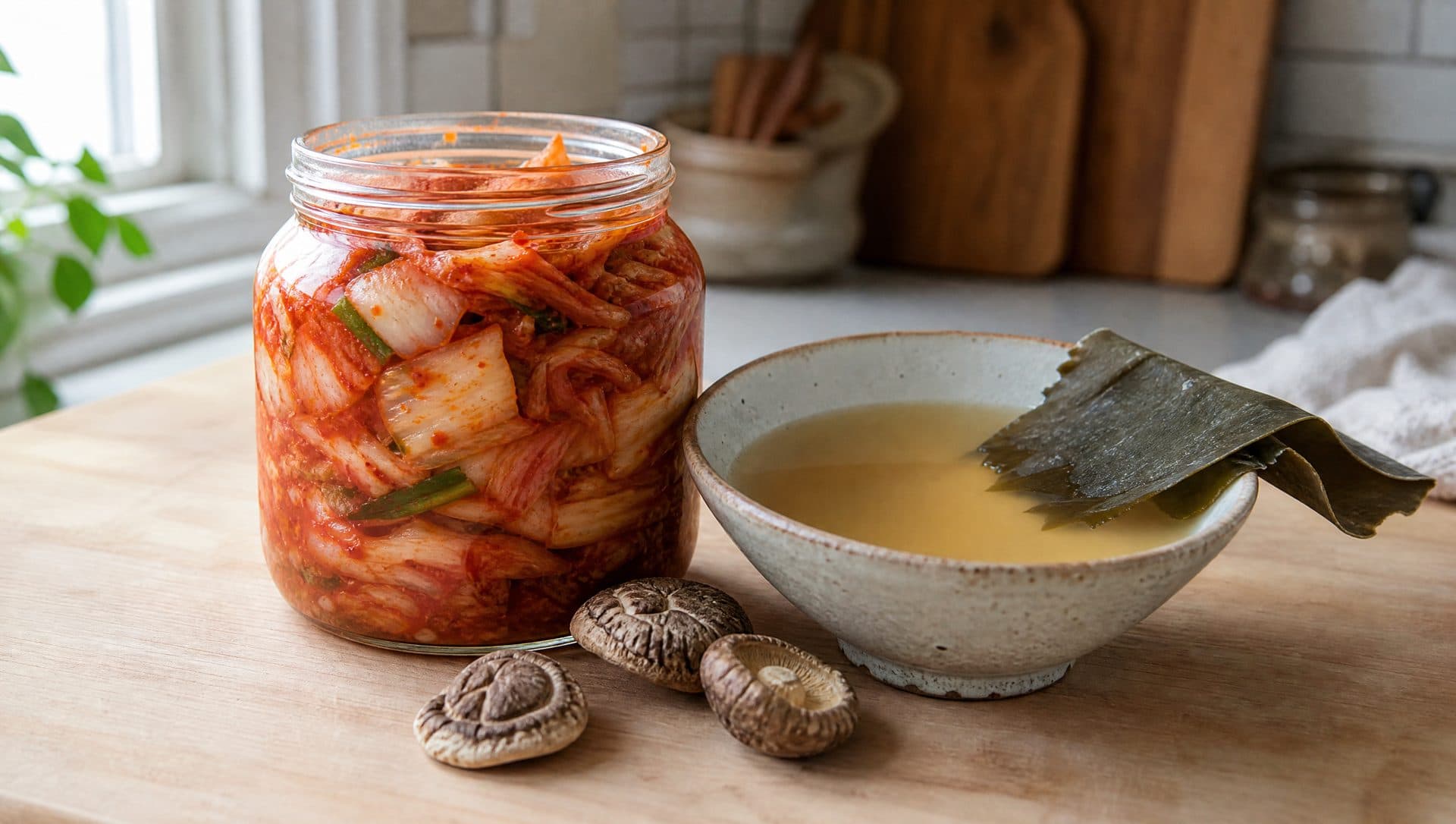
Most kimchi is not vegan, but it can be, and taking out the fish sauce changes less than you might expect. Classic napa cabbage kimchi is seasoned with fermented seafood, usually anchovy sauce or salted shrimp. Without it, the same lactic acid bacteria still ferment the jar, the fibre and vegetables are unchanged, and what you lose is some savoury depth and some salt.
Is kimchi vegan?
Usually not. The seasoning paste for cabbage kimchi normally includes 젓갈, jeotgal, the salted and fermented seafood that Korean cooking uses the way other cuisines use stock cubes. In practice that means anchovy sauce (멸치액젓, myeolchi aekjeot), salted shrimp (새우젓, saeujeot), or both. Winter batches sometimes carry fresh oysters or other seafood mixed through the radish.
The Rural Development Administration's standard seasoning formula, which we used in our home kimchi method, puts jeotgal at 5 parts per 100 parts cabbage by weight. That is more than the gochugaru. It is not a garnish that can be quietly skipped.
Korean temple cooking has always made kimchi without it, so vegan kimchi is not an invention for export. It was just never the default.
What does fish sauce actually do in kimchi?
Three things, and only one of them is flavour.
The first is salt. Jeotgal is very salty, so it carries part of the seasoning's salinity, which is part of what steers the fermentation toward lactic acid bacteria and away from everything else.
The second is savouriness. Fermented seafood is rich in free amino acids, glutamic acid above all, which is what reads on the tongue as umami. A 2018 study in Food Chemistry by Jung and colleagues fermented kimchi with and without salted shrimp and anchovy sauce and measured the results by NMR. The batches with jeotgal had more amino acids and more GABA throughout.
The third is food for the fermentation. The same study found that acetate, lactate and mannitol built up faster when jeotgal was present. The bacteria still live mainly on the vegetables' sugars, but the authors read the result as jeotgal speeding up the production of those compounds rather than just adding flavour on top.
Does vegan kimchi have the same bacteria?
Broadly, yes. The groups that make kimchi sour are the same with or without fish.
In 2018 a team at Brown University led by Peter Belenky sequenced the bacteria in a commercial producer's kimchi, made in a traditional version and a vegan one that swapped miso in for the seafood. By the end of fermentation the two communities were nearly the same, dominated in both by Lactobacillus and Leuconostoc (Zabat et al., Food Microbiology). The bacteria in the fish sauce and the miso did not take over. They are adapted to far saltier conditions than kimchi, and they dropped out early.
The Korean study is more fine-grained and finds a difference at the level of species rather than genus.
| Without jeotgal | With anchovy sauce | With salted shrimp | |
|---|---|---|---|
| Leading species | Leuconostoc gasicomitatum | Weissella koreensis | Lactobacillus sakei |
| Amino acids and GABA | Lower | Higher | Higher |
| Acid build-up | Slower | Faster | Faster |
Source: Jung et al., Food Chemistry, 2018.
All three leading species are lactic acid bacteria that belong in normal kimchi. None is a sign of a problem. What changes is which of them runs the jar, and that is part of why a vegan batch tastes a little different even when everything else is the same.
Does removing fish sauce change the health benefits?
Mostly it does not, because most of what the research credits kimchi with comes from the vegetables and the fermentation, not the seafood. We went through that evidence in detail in what the evidence says about kimchi and health.
| Traditional kimchi | Vegan kimchi | |
|---|---|---|
| Fibre and vegetables | Same | Same |
| Live lactic acid bacteria | Yes, if unpasteurised | Yes, if unpasteurised |
| Free amino acids and GABA | Higher | Lower, depending on the substitute |
| Salt | Includes the jeotgal's share | Depends on how the salt was replaced |
| Fish and shellfish allergens | Present | Absent |
The allergen line is the one that matters most for some readers. Anyone with a fish or shellfish allergy cannot eat ordinary kimchi, and for them the vegan version is the only version.
No trial has compared the two kinds head to head in people. The GABA difference is real, but nobody has shown it matters at the amounts in a serving.
Is vegan kimchi lower in salt?
Not automatically. Taking out the jeotgal takes out some salt, but a well-made vegan kimchi puts that salt back, through soy sauce, salted kelp stock or extra salt in the paste. If it does not, the jar ferments under-salted and softens early.
It can come out lower when a salty seafood is replaced by something that brings umami without much salt. A 2021 study from the World Institute of Kimchi, published in Foods, made kimchi with a hot-water tomato extract in place of anchovy sauce. That batch finished at about 1.1 per cent salt against 1.9 per cent for the anchovy version, with more glutamic acid. It is a lab formulation, not something you can buy.
On safety, the one direct comparison is encouraging. A 2023 study in Heliyon added Yersinia enterocolitica, a food-poisoning bacterium, to kimchi made with and without anchovy and salted shrimp, and stored it at 0°C and 6°C for 24 days. The pathogen died off faster in the vegan kimchi. The studies do not agree on which version sours faster overall, so treat vegan kimchi the same way as any other: keep it cold and under its brine.
What replaces fish sauce in vegan kimchi?
The substitutes Korean cooks reach for all do the same job in different proportions: supply glutamate, and supply salt.
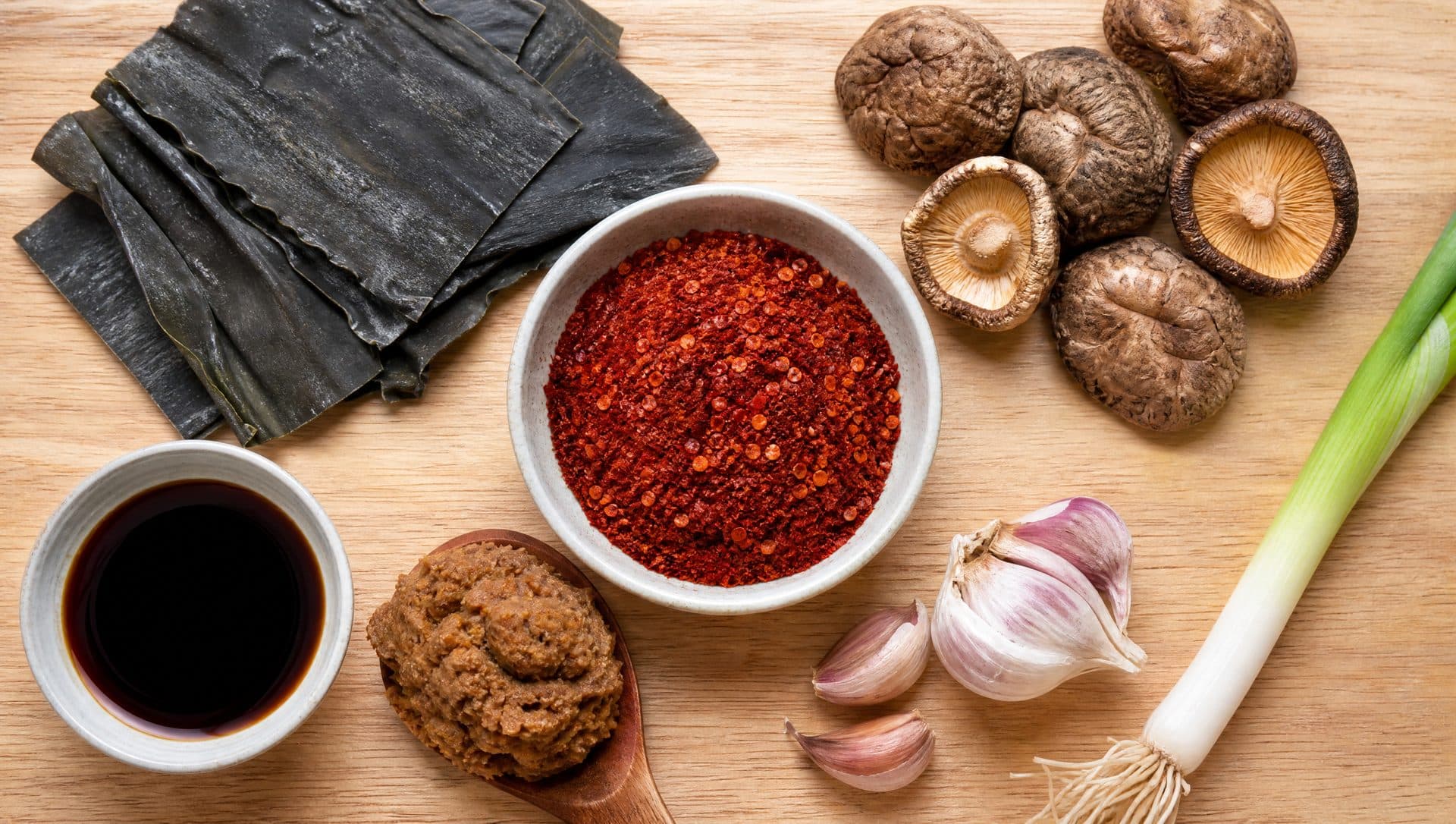
- Kelp stock (다시마, dasima). Rich in glutamate and nearly salt-free. Temple kitchens make it thick and use it as the liquid for the rice porridge.
- Soy sauce, preferably Korean soup soy sauce (국간장, gukganjang), which is saltier and lighter in colour than the Japanese kind. It carries salt and fermented depth together.
- Fermented soybean paste. 된장, doenjang, or miso in small amounts. Both are strongly flavoured, so a spoonful goes a long way.
- Dried shiitake, soaked and the liquid added to the stock. Mushrooms add a second kind of savouriness that stacks with the kelp.
Whatever combination you use, taste the finished paste before it goes on the cabbage. It should be distinctly saltier than you would want to eat by the spoonful, because the cabbage and the brine will dilute it.
Is temple kimchi the same as vegan kimchi?
No. Temple kimchi is stricter. Korean Buddhist cooking leaves out the 오신채, osinchae, five pungent plants that monks avoid, which include garlic, spring onion and chives. So temple kimchi has no seafood and also none of the alliums that give ordinary kimchi its sharpness.
It leans on kelp stock, soy sauce and soybean paste instead, and tastes cleaner and milder. Most vegan kimchi keeps the garlic and spring onion, so it stays much closer to the ordinary jar.
How do you know if a shop-bought kimchi is vegan?
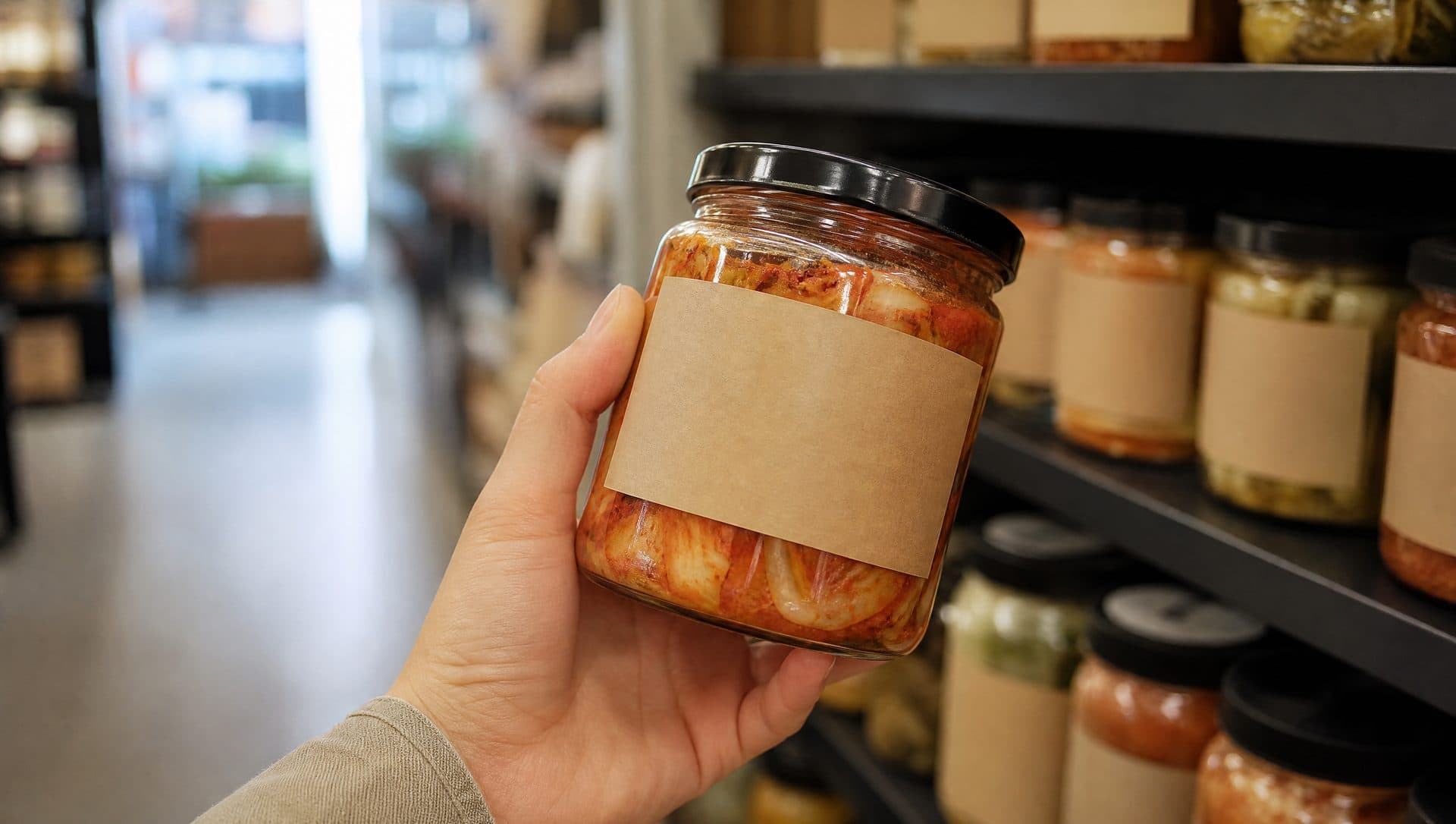
Read the ingredient list, not the front of the pack. Look for fish sauce, anchovy, shrimp, oyster and any named fish. In the United States fish and crustacean shellfish are major allergens, so a jar that contains them has to say so, usually in a line beginning "Contains". If that line names fish or shrimp, the jar is not vegan whatever the front says.
We compared how the two main fermented cabbages differ on this, and on salt, in kimchi vs. sauerkraut.
If you make your own, start with the recipe you already use and change only the jeotgal: swap in kelp stock and a spoonful of soup soy sauce, taste the paste for salt, and let the jar ferment exactly as long as usual. Compare it with your normal batch after a week in the fridge.
Frequently asked questions
Is all kimchi made with fish sauce?
No, but most napa cabbage kimchi is made with fish sauce, salted shrimp or both. Some regional and seasonal kimchis use less or none, and Korean temple kimchi uses no seafood at all. Unless a jar or recipe says otherwise, assume it contains seafood.
Does vegan kimchi still have probiotics?
Yes, as long as it is unpasteurised. The lactic acid bacteria that ferment kimchi come from the vegetables and the kitchen, not from the fish sauce, and a 2018 study found vegan and traditional kimchi ended fermentation with nearly the same bacterial community.
Does vegan kimchi taste different?
A little less deep and savoury, without the faint marine note aged kimchi picks up. Kelp stock and soup soy sauce close most of that gap, and in stews or fried rice it is hard to pick out.
Can I use vegan kimchi in kimchi jjigae?
Yes. Make the stew with kelp and mushroom stock rather than anchovy stock or pork, and use well-soured vegan kimchi. The sourness is what holds 김치찌개, kimchi jjigae, together, and vegan kimchi sours the same way.