
Fermenting8 min read
Mold, white film or bubbles: what's normal on kimchi and what's not
Bubbles can come from fermentation, white film may be golmaji yeast, and dark specks may be pepper spot. None establishes safety by appearance alone. What the research actually tested, when golmaji guidance applies, and why mould or uncertain growth means discarding the whole jar.
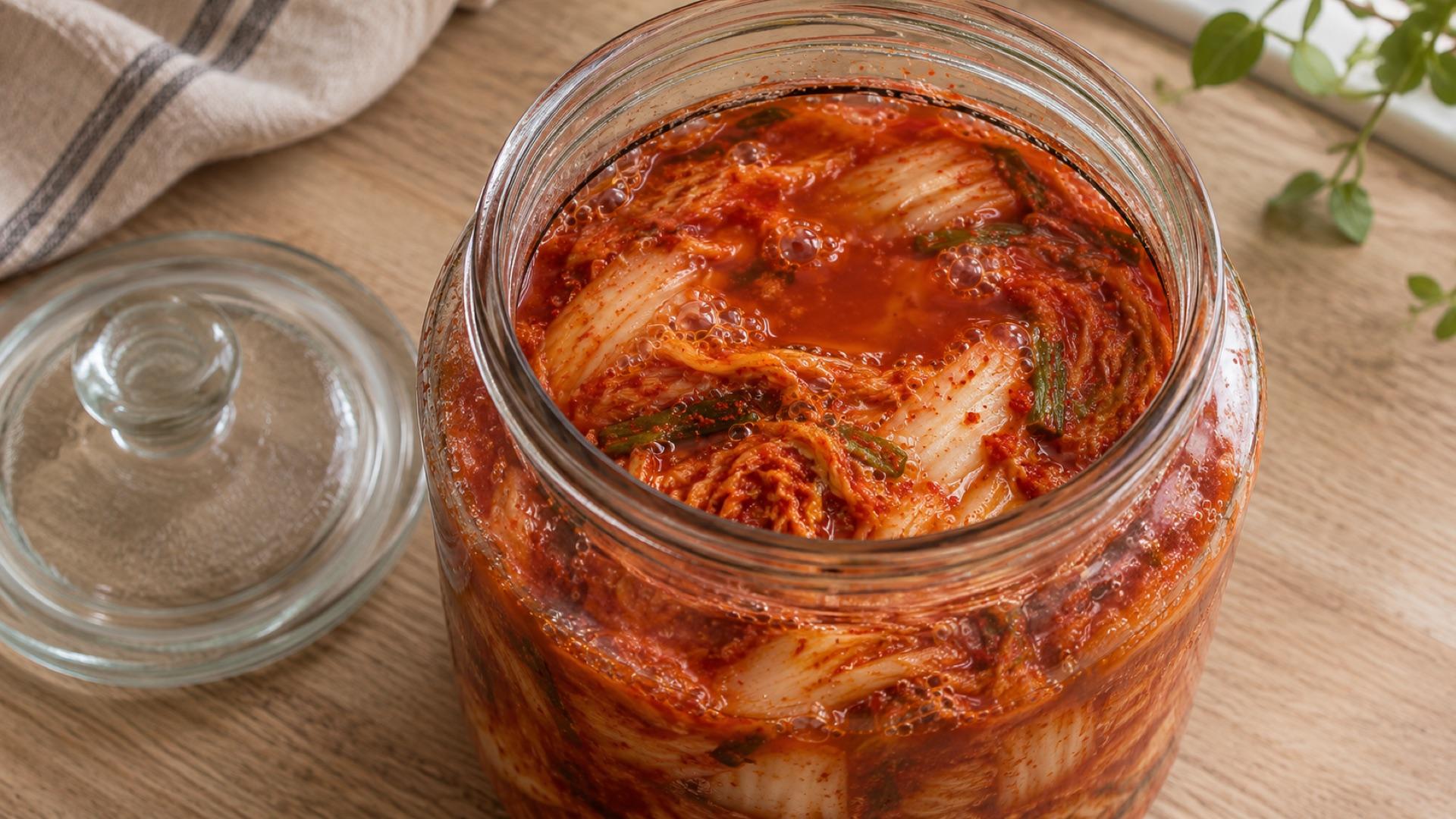
This piece has not been translated into Español yet, so you are reading the English original. Translations are published after review, never automatically.
Bubbles in kimchi (김치) can come from fermentation, but bubbles, a swollen pack or the absence of fuzz do not establish that a jar is safe. A white film may be golmaji yeast, and tiny dark specks may be pepper spot in the cabbage. Do not identify unknown growth or decide safety from colour, shape or a photograph alone. If there is mould, unexplained growth you cannot confidently identify, widespread slime or a rotten smell, discard the whole jar and brine. Do not taste it to check.
Correction, 17 November 2026: the original opening and table described several appearances as normal or safe without enough qualification. They have been revised to distinguish identified golmaji and pepper spot from unknown growth, and to make clear that appearance alone cannot establish safety.
The table describes possible explanations, not a visual safety test. Advice for identified golmaji does not apply to suspected mould or an uncertain jar.
What is normal on kimchi and what is not?
| What you see | Possible explanation | What to do |
|---|---|---|
| Bubbles, a domed lid or a swollen pack | Gas from fermentation; appearance alone does not establish the cause or safety | Follow the product's storage and packaging guidance. Do not treat swelling as proof that a pack is safe; seek the manufacturer's advice if it is unexpected |
| Tiny dark specks on the white cabbage ribs | Pepper spot is one possible explanation | Identified pepper spot is a non-infectious cabbage disorder. Do not assume every dark spot is pepper spot; discard if growth or spoilage is suspected or uncertain |
| A flat white film or round white spots | Golmaji yeast is one possible explanation | If confidently identified as golmaji and there is no other suspected spoilage, WiKim advises removing it, rinsing the affected kimchi and heating it. If uncertain, discard the whole jar and brine |
| Fuzzy, raised, thread-like or otherwise suspicious growth | Suspected mould | Discard the whole jar and brine; do not scrape it off and eat the rest |
| Widespread slime or a rotten smell | Spoilage | Discard the whole jar and brine. Do not taste it to decide |
Why does kimchi bubble?
The gas is carbon dioxide. Leuconostoc mesenteroides, the bacterium that leads the early part of the ferment, is heterofermentative, meaning it turns sugar into lactic acid and several other things at once, carbon dioxide among them. Some of the gas dissolves into the brine, which is why young kimchi prickles on the tongue. The rest collects between the leaves and pushes up on the lid.
For kimchi makers it is a packaging problem. A US patent held by CJ CheilJedang, the company behind Bibigo kimchi, describes the gas given off while kimchi is being shipped as a cause of packs inflating, splitting and leaking, and sets out a Leuconostoc strain selected to make less of it. That explains one cause of swelling, but it does not establish why a particular pack has swollen or whether it was stored safely. Follow the manufacturer's instructions; unexpected swelling, leakage or damage calls for advice from the manufacturer, not a taste test.
Bubbles can be a sign of fermentation. They do not establish safety, and when they stop it is usually because the easy sugars have been used up. Why your kimchi stopped bubbling covers the jar that has gone quiet.
Is the white film on kimchi mould?
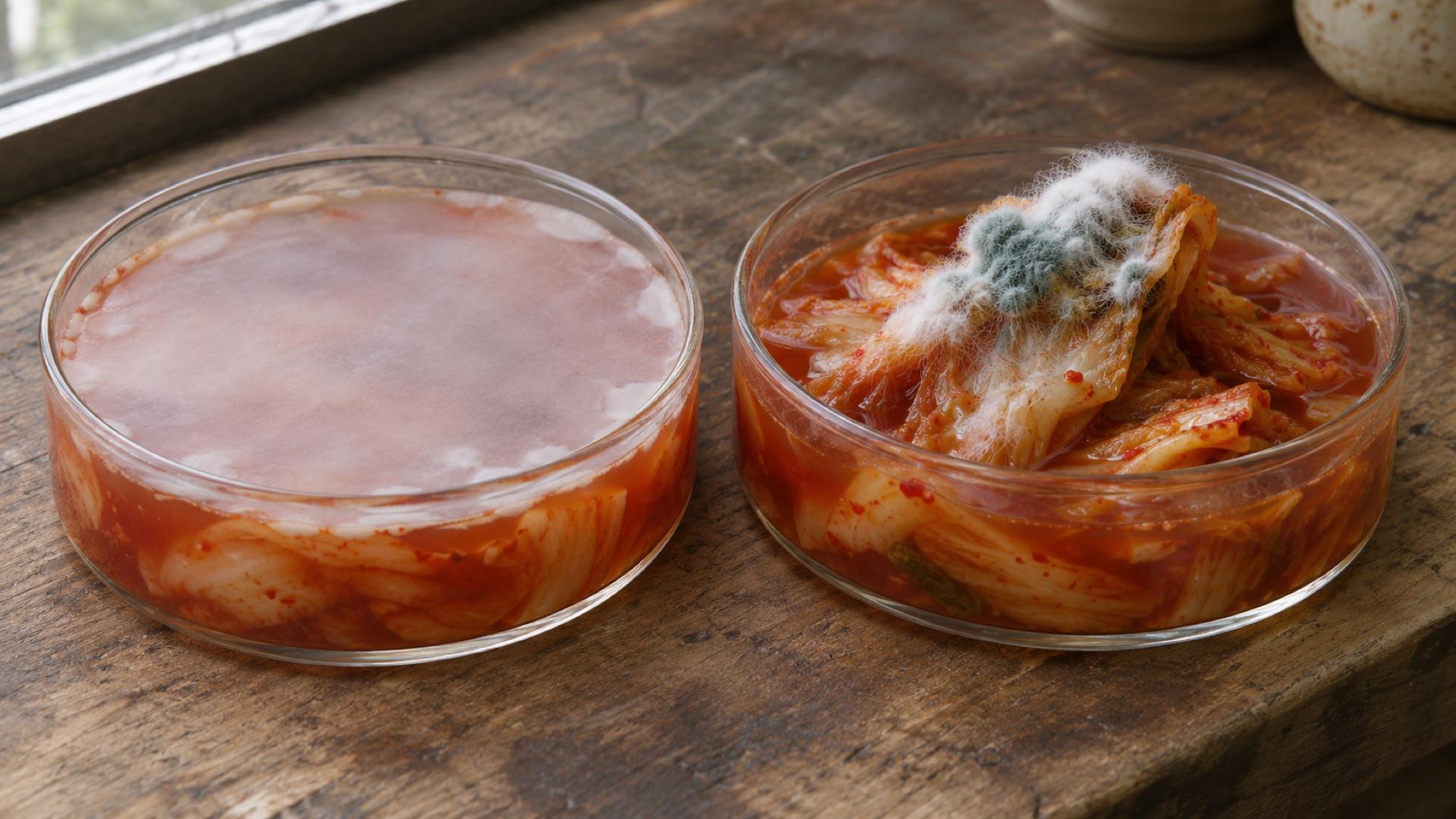
A white film can be 골마지 (golmaji), a surface growth of yeast often called kahm yeast in English-language fermenting guides. That does not mean every white patch or film is harmless yeast. If you cannot confidently identify the growth, discard the whole jar and brine rather than trying to rescue it. Golmaji often appears late in fermentation, once the lactic acid bacteria have slowed and the surface of the kimchi has been in contact with air.
The World Institute of Kimchi has studied specific yeasts that cause golmaji. The first study, in 2018, sequenced the genomes of five film yeasts and found no known toxin genes; our storage guide has the details. In 2022 the institute and a toxicology laboratory at Konkuk University went further. They took three of the main film yeasts, Kazachstania servazzii, Candida sake and Pichia kudriavzevii, and exposed human intestinal and liver cells to them. Then they fed them to rats, in a single dose and daily for 14 days, at up to 500 million cells a day. No rat died or showed signs of toxicity, and their livers showed no damage under the microscope. The 2022 paper in Food Microbiology found no toxic response under those experimental conditions. It was a study of selected yeast strains in cells and rats, not a test proving an unknown jar or every white growth safe for people.
The yeasts do cost you something. They soften the leaves and give the top of the jar a stale, flat smell, and a 2025 paper from Kyung Hee University in the Journal of Microbiology and Biotechnology lists off-odours, softening and swollen packs among its effects. For kimchi with identified golmaji, WiKim advises removing the yeast growth, rinsing the affected kimchi and heating it before eating. This is not advice to salvage mouldy kimchi or a jar with uncertain growth or other signs of spoilage. Cooking does not serve as a safety test for such a jar.
How do you tell film yeast from mould?
Shape and colour can give clues, but they cannot establish safety on their own. Golmaji often forms white spots that spread into a film, while mould may appear fuzzy or thread-like. Do not use a picture or the absence of visible fuzz to rule out mould or other contamination.
Mould grows threads into food and can produce visible stalks and spores above it. What you see is only part of the growth. If you suspect mould, or cannot confidently identify unexplained growth, discard the whole jar and brine. Do not taste it, scrape off the surface or cook it as a way to decide it is safe.
Temperature decides how soon the film turns up. At Chiba University in Japan, researchers made three kinds of kimchi and kept them at 4, 10, 15 and 25°C. At 4°C no white colonies appeared for 35 days, and at every warmer temperature they came sooner. The film came from two Kazachstania yeasts, and when the team added them to fresh kimchi they formed colonies at 15°C and did not at 4°C.
Cold slows the yeasts without removing them. A 2024 study at Kyung Hee University stored salted kimchi cabbage at 10°C, 4°C and −1°C and found a different yeast coming to dominate at each: Kazachstania, Candida and Mrakia respectively.
Why does mould mean throwing out the whole jar?
What you can see is only the top of it. The US Department of Agriculture's guidance on mouldy food describes root-like threads that grow down into the food beneath the visible patch. It says foods with a high moisture content can be contaminated below the surface, and that bacteria may be growing along with the mould. Soft vegetables such as cucumbers and tomatoes are on its list of foods to discard. Kimchi is a soft vegetable sitting in liquid.
Fermented food has a second problem. Mould growth can raise the pH of the food it grows on, as Kansas State University's food-safety advice on home-preserved jars points out, and acidity is what makes kimchi hostile to pathogens in the first place. The same advice notes that the USDA no longer suggests scooping mould off jam and eating the rest. Kimchi is wetter than jam. Throw out the jar, brine and all.
What are the black specks on napa cabbage?
One possible explanation is pepper spot, a disorder in the cabbage itself. Korean growers call the condition 깨씨무늬 (kkaessi-munui), "sesame-seed pattern", and English-speaking growers call it pepper spot or black speck. It is a physiological disorder, which means no fungus, bacterium or insect is involved.
The food-safety information service run by Korea's Ministry of Agriculture, Food and Rural Affairs ties it to nitrogen. Too much nitrogen fertiliser early in the season is more than the young leaves can use, and specks form. Too little late in the season and nutrients move from the outer leaves to the inner ones, leaving specks on the white rib. These explanations concern identified pepper spot, not every dark mark on cabbage. Pepper spot itself is not a fungal infection or a reason to discard otherwise sound cabbage, but it does not establish the safety of the rest of a jar.
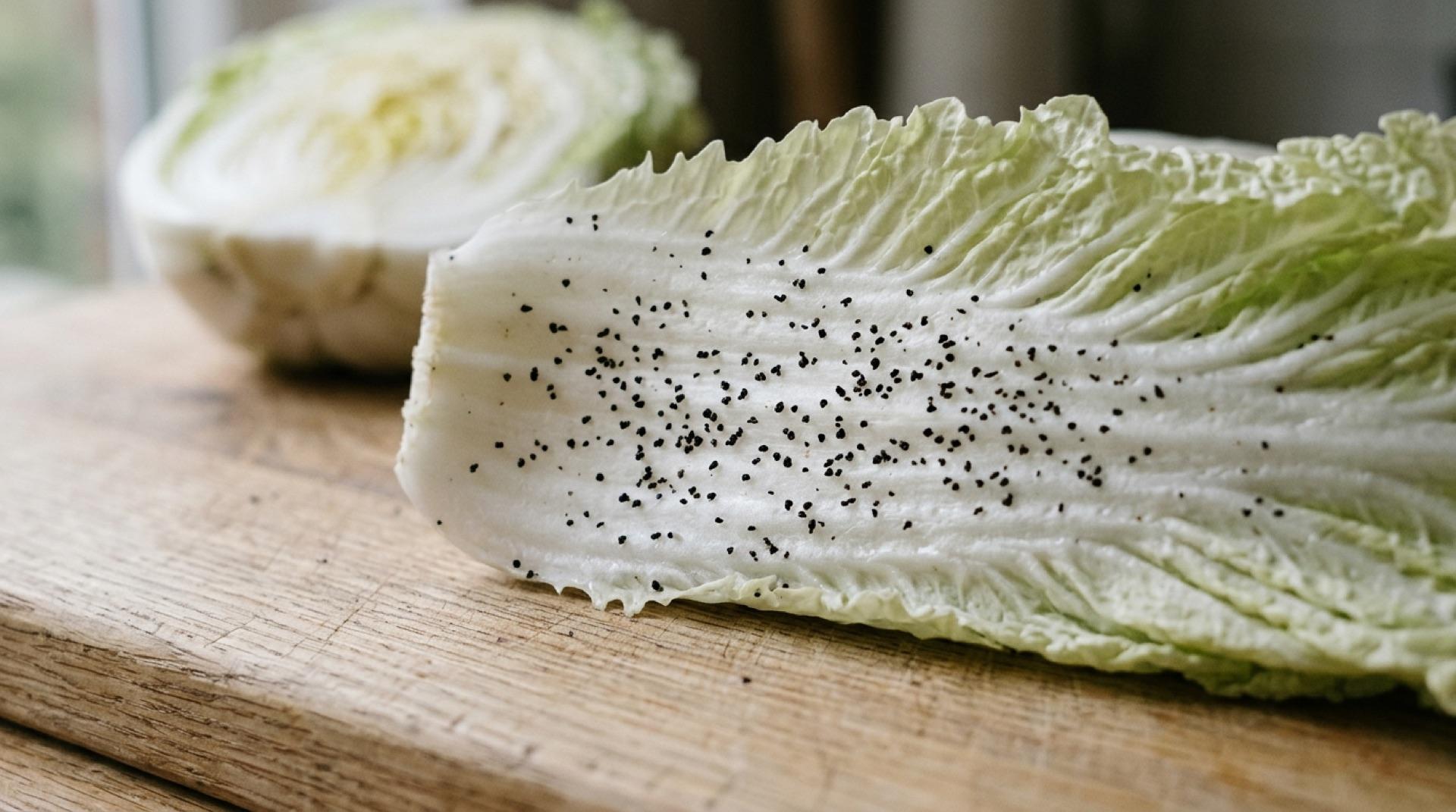
A 2024 study at the Zhejiang Academy of Agricultural Sciences looked inside the rib. Each speck begins between the cells, spreads into them and ends as a small patch of dead cells. Cabbage lines that resist the disorder process ammonium efficiently, while susceptible lines let it build up. Nothing is growing in a speck, so it will not spread once the cabbage is in the jar.
How do you keep the surface of kimchi clean?
Film yeast and mould both need air, so the work is keeping air away from the kimchi and keeping the jar cold. The World Institute of Kimchi recommends storing kimchi at 4°C or below and covering the surface with a clean sheet or keeping it under its own brine. Use a clean, dry utensil every time, and move a few days' worth into a small container so the main jar stays shut. How long kimchi lasts goes through storage in more detail.
Next time you open the jar, check its storage history and condition before the spoon goes in. Follow the golmaji advice only for confidently identified yeast growth with no other suspected spoilage. Mould, uncertain growth, widespread slime or a rotten smell means discarding the jar and brine, without tasting it.
Frequently asked questions
Is kahm yeast on kimchi safe to eat?
WiKim studied specific golmaji yeasts and found no known toxin genes in the strains examined in 2018 and no toxic effects under the conditions of its 2022 cell and rat study. For identified golmaji, its advice is to remove the growth, rinse the affected kimchi and heat it. Those findings do not establish that every white film or unknown jar is safe. Discard the whole jar and brine if the growth is uncertain or spoilage is suspected.
Can I scrape mould off kimchi and eat the rest?
No. Mould grows threads below the surface you can see, and the USDA treats soft, wet foods with mould on them as contaminated all the way through. Throw out the jar, including the brine.
Why is my kimchi pack swollen?
Fermentation can produce carbon dioxide after packing, but swelling alone does not establish the cause or safety. Follow the product's storage instructions and packaging guidance, and contact the manufacturer about unexpected swelling or damaged or leaking packaging. Do not taste a suspect pack to check it.
Are black spots on napa cabbage mould?
Small dark specks on the white rib may be pepper spot, 깨씨무늬, a non-infectious cabbage disorder. Do not assume every black spot is pepper spot or that mould must look fuzzy before it is a concern. If a mark is unexplained growth, or you are unsure whether it is spoilage, discard the jar and brine.