
Basics7 min read
Kimchi vs. sauerkraut: what's actually different?
Kimchi and sauerkraut are both fermented cabbage, but they differ in ingredients, bacteria, flavour and nutrition. Here's a clear side-by-side comparison.
This piece has not been translated into Français yet, so you are reading the English original. Translations are published after review, never automatically.
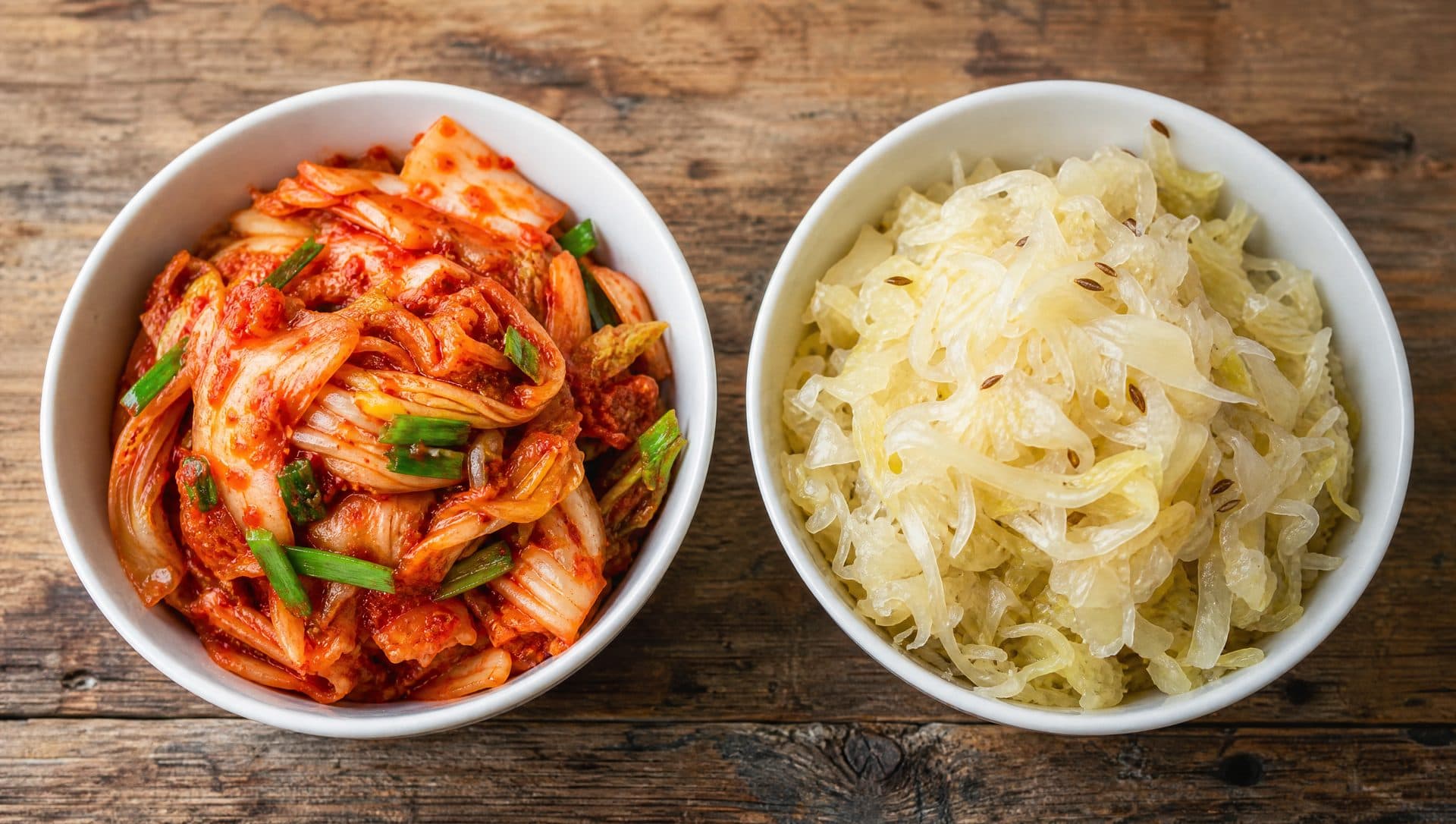
Kimchi (김치) and sauerkraut are both fermented cabbage, but they are not the same food. Kimchi is a Korean dish made from napa cabbage seasoned with chilli flakes, garlic, ginger and often fish sauce, fermented for days to weeks. Sauerkraut is a Central European dish made from shredded green cabbage and salt only, fermented for weeks. Kimchi is spicy, complex and umami-rich; sauerkraut is sour, clean and mild.
Kimchi vs. sauerkraut at a glance
| Kimchi | Sauerkraut | |
|---|---|---|
| Origin | Korea (documented since at least the 13th century; chilli added after the 1600s) | Central Europe, especially Germany and Eastern Europe |
| Main vegetable | Napa cabbage (배추, baechu) — also radish, cucumber, scallion | Green or white head cabbage |
| Seasonings | Gochugaru (Korean chilli flakes), garlic, ginger, scallion, fish sauce or salted shrimp, sometimes fruit | Salt only (sometimes caraway or juniper) |
| Cut | Quartered or hand-sized pieces, leaves kept whole | Finely shredded |
| Fermentation time | 1–3 days at room temperature, then weeks to months refrigerated | 2–6 weeks at cool room temperature |
| Flavour | Spicy, garlicky, umami, sour, slightly sweet | Clean sour, salty, cabbage-forward |
| Texture | Crunchy, juicy, leafy | Soft-crisp, uniform |
| Typical use | Side dish (반찬, banchan), stews, fried rice, pancakes | Topping for sausages, Reuben sandwiches, pork dishes |
| Vegan by default? | Usually no (fish sauce or shrimp) — vegan versions exist | Yes |
How is kimchi made differently from sauerkraut?
The core difference is what goes in the jar beyond cabbage and salt.
Sauerkraut is the simpler process. Shredded cabbage is massaged with roughly 2% salt by weight until it releases its own liquid, then packed tightly under that brine. Nothing else is added. Fermentation happens slowly at cool room temperature over several weeks.
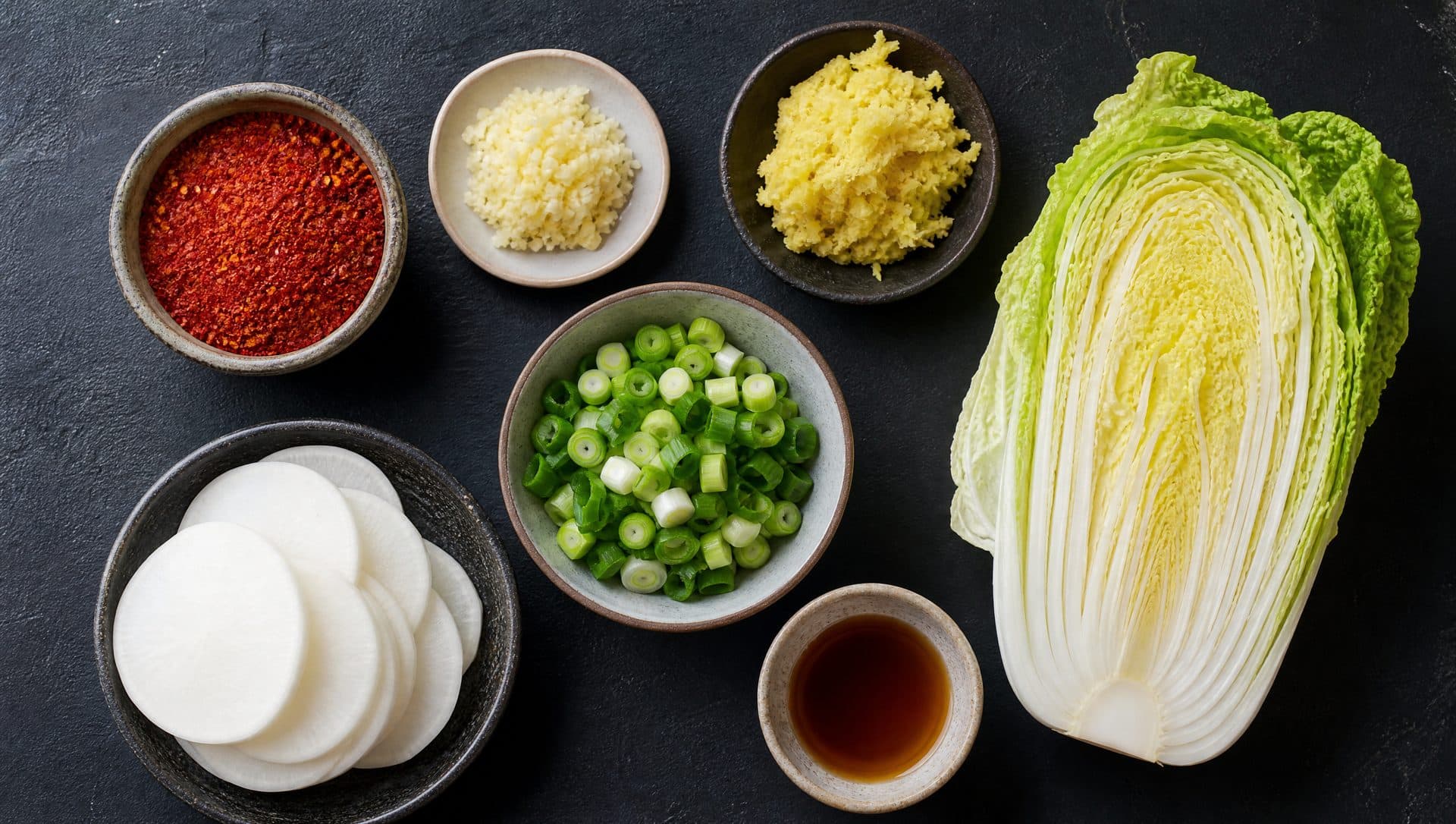
Kimchi involves two stages. First, napa cabbage is salted (절임, jeorim — often for 1–6 hours) to draw out water and soften the leaves, then rinsed. Second, the cabbage is coated in a seasoning paste — yangnyeom (양념) — built from gochugaru, minced garlic, grated ginger, scallions, Korean radish, and a fermented seafood component such as fish sauce (액젓, aekjeot) or salted shrimp (새우젓, saeujeot). Many recipes also add a rice-flour porridge to help the paste cling and feed the bacteria.
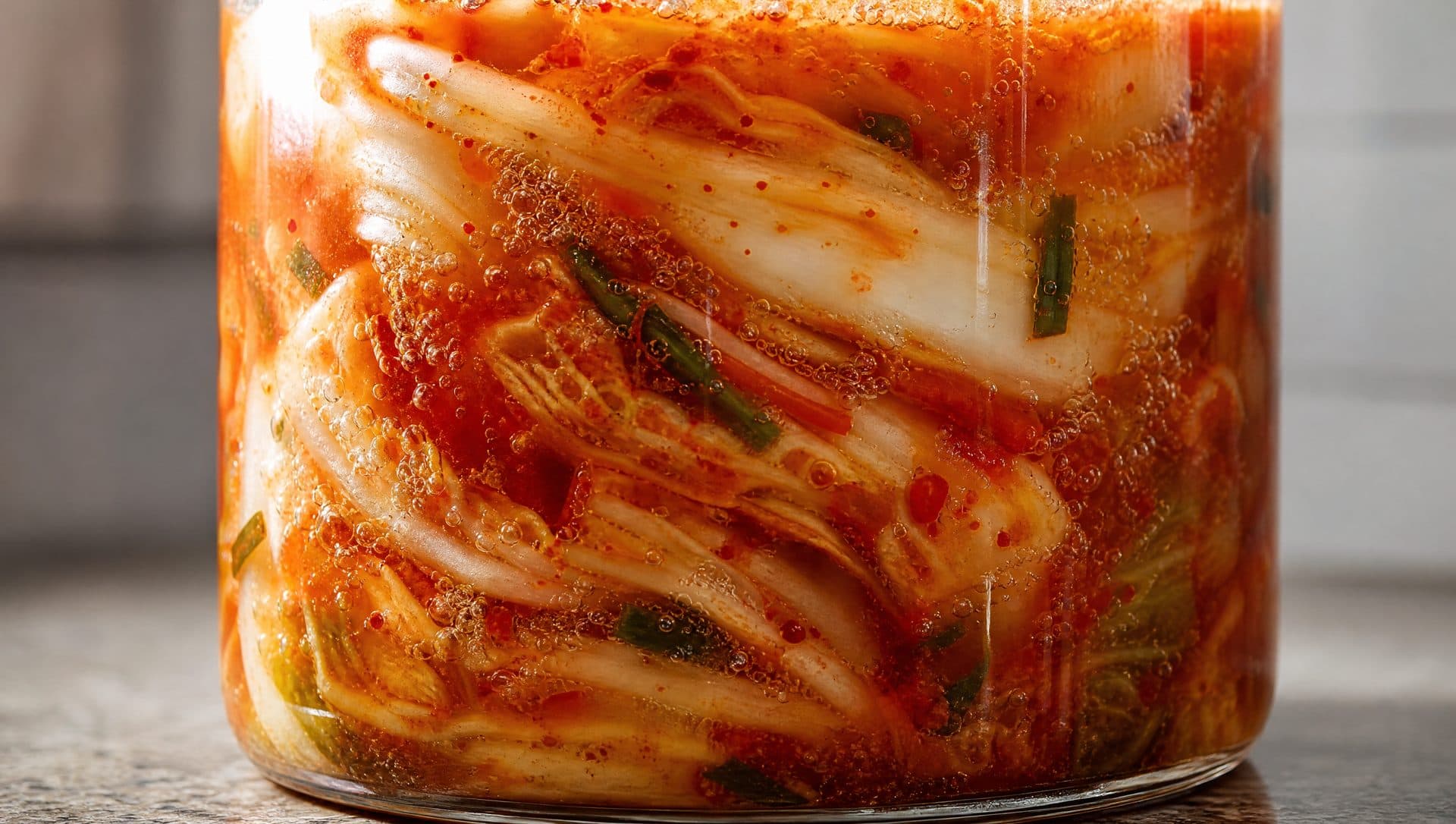
Because kimchi is more heavily seasoned and saltier at the start, it ferments faster. Most Korean households leave fresh kimchi at room temperature for one to three days, then move it to a refrigerator (or a dedicated kimchi fridge) where it continues to sour slowly for weeks or months.
Do kimchi and sauerkraut have the same bacteria?
Both are produced by lactic acid bacteria (LAB), but the dominant species differ.
Sauerkraut fermentation is typically led by Leuconostoc mesenteroides in the early days and then Lactobacillus plantarum as acidity rises. Kimchi shares those genera but also features Weissella koreensis and Lactobacillus sakei, species that thrive in kimchi's garlic-and-chilli environment and that researchers have linked to kimchi's distinctive carbonated, tangy character. A 2016 review in Frontiers in Microbiology (Patra et al.) catalogues the breadth of that community — kimchi fermentation involves dozens of LAB species across its fermentation life, dominated by Leuconostoc, Weissella and Lactobacillus.
Practically, this means:
- Both contain live cultures if unpasteurised and refrigerated.
- Kimchi tends to have a more diverse bacterial community because of its more complex ingredients.
- Canned or shelf-stable sauerkraut is usually pasteurised and contains no live bacteria; the same applies to some jarred kimchi sold at room temperature. Check the label for "raw", "unpasteurised" or "live cultures".
Is kimchi healthier than sauerkraut?
Neither is clearly "healthier" — they offer overlapping but slightly different profiles.
Where they're similar: both are low in calories (roughly 15–25 kcal per 100 g), high in fibre, rich in vitamin C and vitamin K, and both deliver live probiotics when unpasteurised.
Where kimchi has an edge: the garlic, ginger, chilli and scallions add compounds such as allicin, gingerol and capsaicin, and kimchi usually contains more vitamin A and beta-carotene from the chilli flakes. Kimchi's wider bacterial diversity is also frequently cited as a potential gut-health advantage, although head-to-head human trials are limited.
Where sauerkraut has an edge: it is lower in sodium on average (roughly 600–700 mg per 100 g versus 700–1,000 mg for kimchi, though both vary widely by brand and recipe), it's naturally vegan, and it's free of common allergens like shellfish and fish.
If you are watching sodium, rinsing either one briefly before eating removes a meaningful portion of the surface salt.
Which one should you choose?
| If you want… | Choose |
|---|---|
| Bold, spicy flavour to eat on its own or with rice | Kimchi |
| A mild, neutral ferment for sausages or sandwiches | Sauerkraut |
| The widest variety of probiotic species | Kimchi (unpasteurised) |
| A vegan ferment without checking labels | Sauerkraut |
| Lower sodium per serving | Sauerkraut (usually) |
| Something to cook into stews, fried rice or pancakes | Kimchi |
Many people keep both in the fridge: sauerkraut for European-style dishes, kimchi for everything else.
Frequently asked questions
Can I substitute sauerkraut for kimchi in a recipe?
In a pinch, yes, but expect a very different result. Sauerkraut lacks the chilli, garlic and umami that make dishes like kimchi jjigae (김치찌개) or kimchi fried rice taste the way they do. If you must substitute, add gochugaru, garlic and a splash of fish sauce to the sauerkraut.
Is kimchi just spicy sauerkraut?
No. Beyond the chilli, kimchi uses a different cabbage variety (napa rather than head cabbage), a different cut, a two-stage salting process, and a seasoning paste with garlic, ginger and fermented seafood. The bacterial communities are also different.
Which ferments faster, kimchi or sauerkraut?
Kimchi. It reaches a pleasant sourness in one to three days at room temperature, while sauerkraut typically needs two to six weeks.
Can you eat kimchi and sauerkraut together?
Yes. There's no interaction concern; both are simply fermented vegetables. Some people find eating large amounts of both in one sitting causes bloating because of the fibre and live cultures.
Does cooking kimchi or sauerkraut kill the probiotics?
Heating above roughly 115°F (46°C) for a sustained period will kill most live bacteria. Cooked kimchi and sauerkraut still provide fibre, vitamins and flavour, but not live cultures. Adding a spoonful of raw kimchi on top of a cooked dish restores some of them.