
Basics7 min read
Why does kimchi smell, and why that's a good thing
Almost all of it is garlic. Eight sulfur compounds carry the aroma, the harshest of them peaks during salting rather than fermentation, and the bacteria spend the following fortnight taking it apart. What each compound smells of, what the smell tells you about the stage the jar has reached, and how to keep it out of the rest of the fridge.
This piece has not been translated into Français yet, so you are reading the English original. Translations are published after review, never automatically.
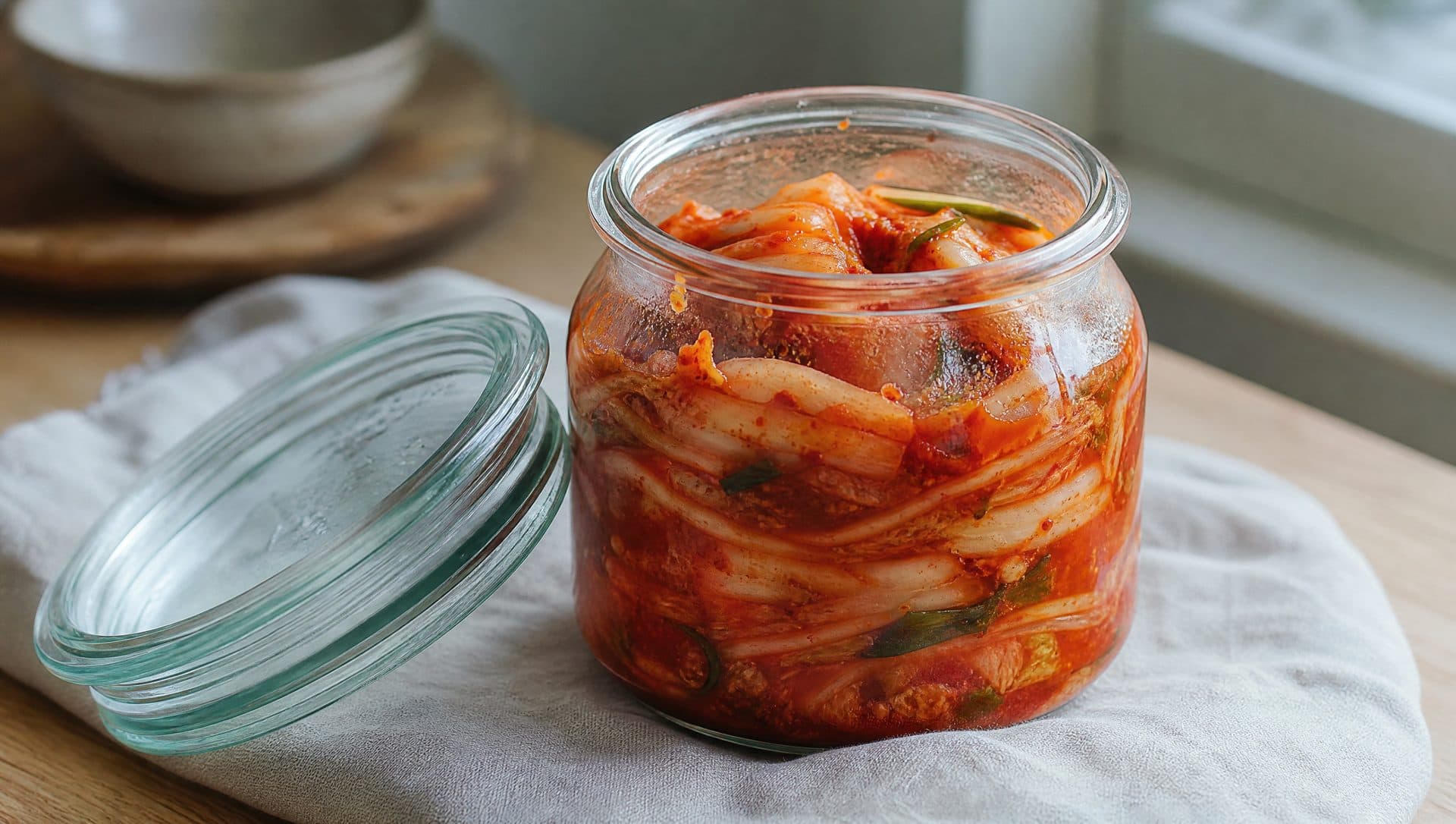
Kimchi smells because of volatile sulfur compounds, and almost all of them come from the garlic. Salting and fermentation rupture the garlic cells, releasing sulfides that evaporate at fridge temperature and travel a long way. A jar that smells strongly is a live, unpasteurised ferment. A jar that smells of nothing has usually been heat-treated, and the bacteria are dead.
What is actually making the smell?
Chemists have been taking kimchi apart compound by compound since the 1990s. Cha, Kim and Cadwallader ran fermenting kimchi through gas chromatography paired with a human nose in 1998 (Journal of Agricultural and Food Chemistry 46, 1944–1953) and found that eight sulfur-containing compounds dominated the aroma at every stage they sampled. The panel's descriptions of those compounds were garlic, garlic salt, onion, spring onion and cooked cabbage.
| Compound | What it smells of | Where it comes from |
|---|---|---|
| Dimethyl trisulfide | Cooked cabbage, savoury, sharply sulfurous when concentrated | Cabbage and garlic |
| Diallyl disulfide | Raw crushed garlic | Garlic |
| Diallyl trisulfide | Garlic, heavier and more roasted | Garlic |
| Methyl allyl disulfide | Garlic and onion | Garlic |
| Isothiocyanates | Mustard, horseradish, pungent | Napa cabbage (배추, baechu) |
| Acetic acid, ethanol, acetaldehyde | Vinegar, sharp, faintly solventy | Lactic acid bacteria |
Napa cabbage is a brassica, so it carries glucosinolates that convert to isothiocyanates when the leaves are cut and bruised. That is the horseradish edge sitting underneath the garlic. The chilli contributes heat and colour but very little aroma of its own, which is why kimchi smells of garlic rather than of gochugaru.
The strongest smell arrives before fermentation even starts
This is the part that surprises people who assume the funk builds as the jar ages.
Seo, You and Baek tracked the volatiles through salting and then through fifteen days of fermentation at 15°C (Food Science and Biotechnology, 2023). Salting alone pushed dimethyl disulfide from 63.3 to 204.6 parts per billion, and dimethyl trisulfide from 21.6 to 425.4 ppb. Twenty times more of the compound that reads as sulfurous, and the bacteria had barely started.
Then fermentation pulled it back down. By day fifteen, dimethyl trisulfide had fallen to 3.2 ppb. Acetic acid, undetectable at the start, had climbed to 1,709.4 ppb. The harsh top note faded and a sour one took its place.
Lactic acid bacteria do this dismantling directly. Kwon and colleagues fermented garlic with four LAB strains and watched them break down the unstable sulfur compounds that allicin degrades into, producing pyrazine and allyl methyl disulfide in their place (Food Science and Biotechnology, 2025). The authors describe the result as reduced pungency with more savoury and umami character. Lactobacillus brevis and Leuconostoc mesenteroides left noticeably different profiles behind, which is one reason two households following the same recipe end up with two different jars.
The smell tells you where the jar is in its life
Once you know the pattern, the fridge door becomes a readout.
Fresh kimchi is garlic-forward and barely sour. A week or two in, it fizzes and prickles: heterofermentative bacteria are producing carbon dioxide, mannitol and acetic acid, and the smell turns bright and slightly effervescent. Later the garlic recedes and a deep lactic sourness takes over as homofermentative Lactobacillus species come to dominate.
Temperature sets the pace of all of it. Kim and colleagues found that kimchi reached pH 4.0 to 4.5, the window Korean food researchers treat as properly ripe, in three days at 15°C but took 47 days at 4°C (Foods 14, 2826, 2025). Same target, fifteen times the wait. They also found the faster warm ferment produced higher lactic acid bacteria counts, more total polyphenols and more ascorbigen than the long cold one, so leaving a new jar out for a day or two before refrigerating it is doing more than saving time.
When the smell is a problem
Sour and funky covers almost the whole normal range, including the point where a jar smells strong enough that guests comment on it. What falls outside that range is a smell that has gone rotten or putrid rather than sour, or one that has turned sweet and solventy, especially alongside slime or fuzzy coloured growth. A flat white film on the brine is nearly always kahm yeast and not mould. We went through the full set of signals in how long kimchi lasts.
Keeping the smell inside the jar
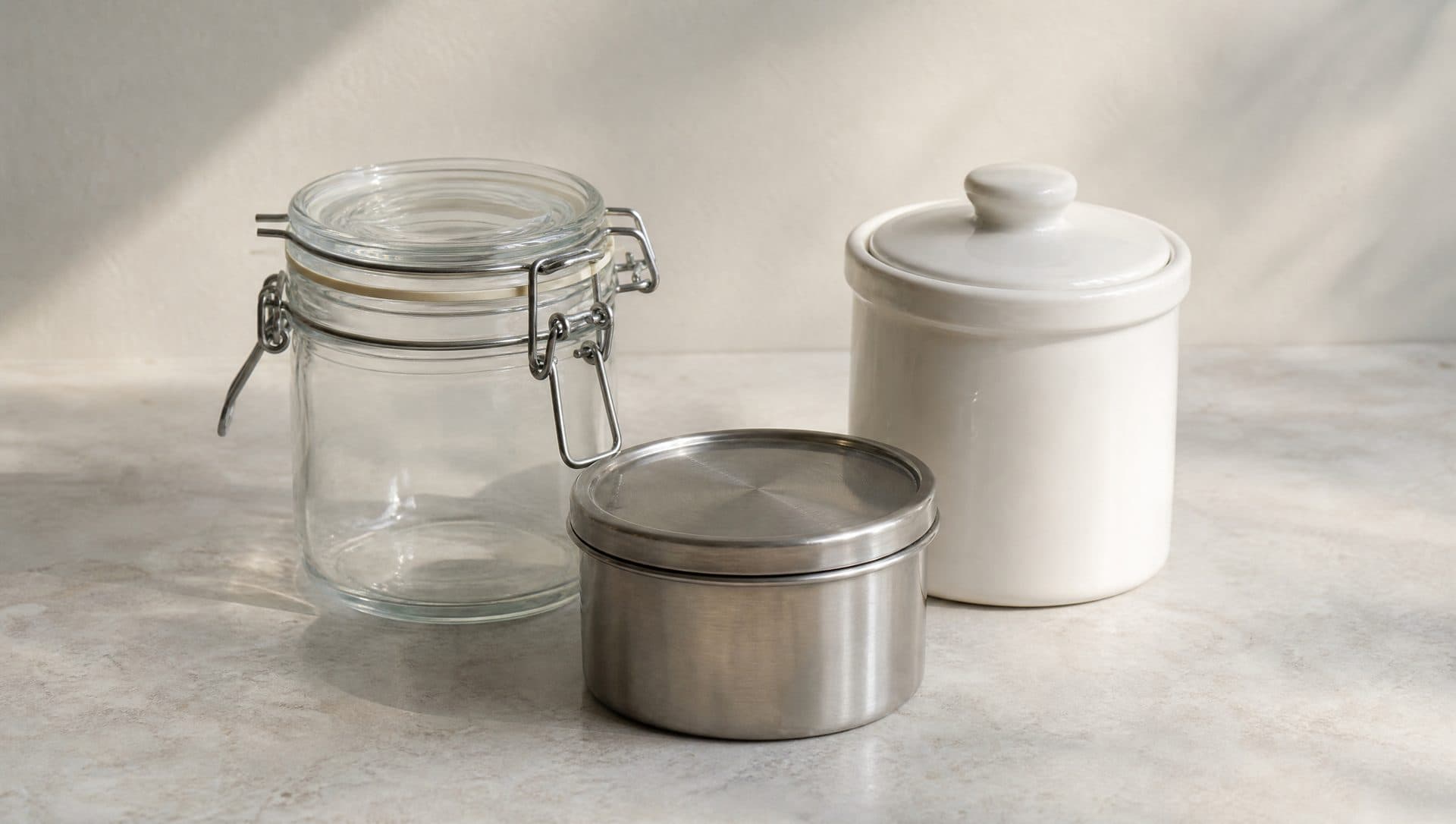
Sulfur compounds are small, volatile and poorly soluble in water. That combination is why they leave the brine so readily, and it is also why they lodge in plastic. Polypropylene tubs and silicone lid gaskets are non-polar, so non-polar molecules settle into the polymer and washing-up liquid does not lift them out.
| Problem | What works | Why |
|---|---|---|
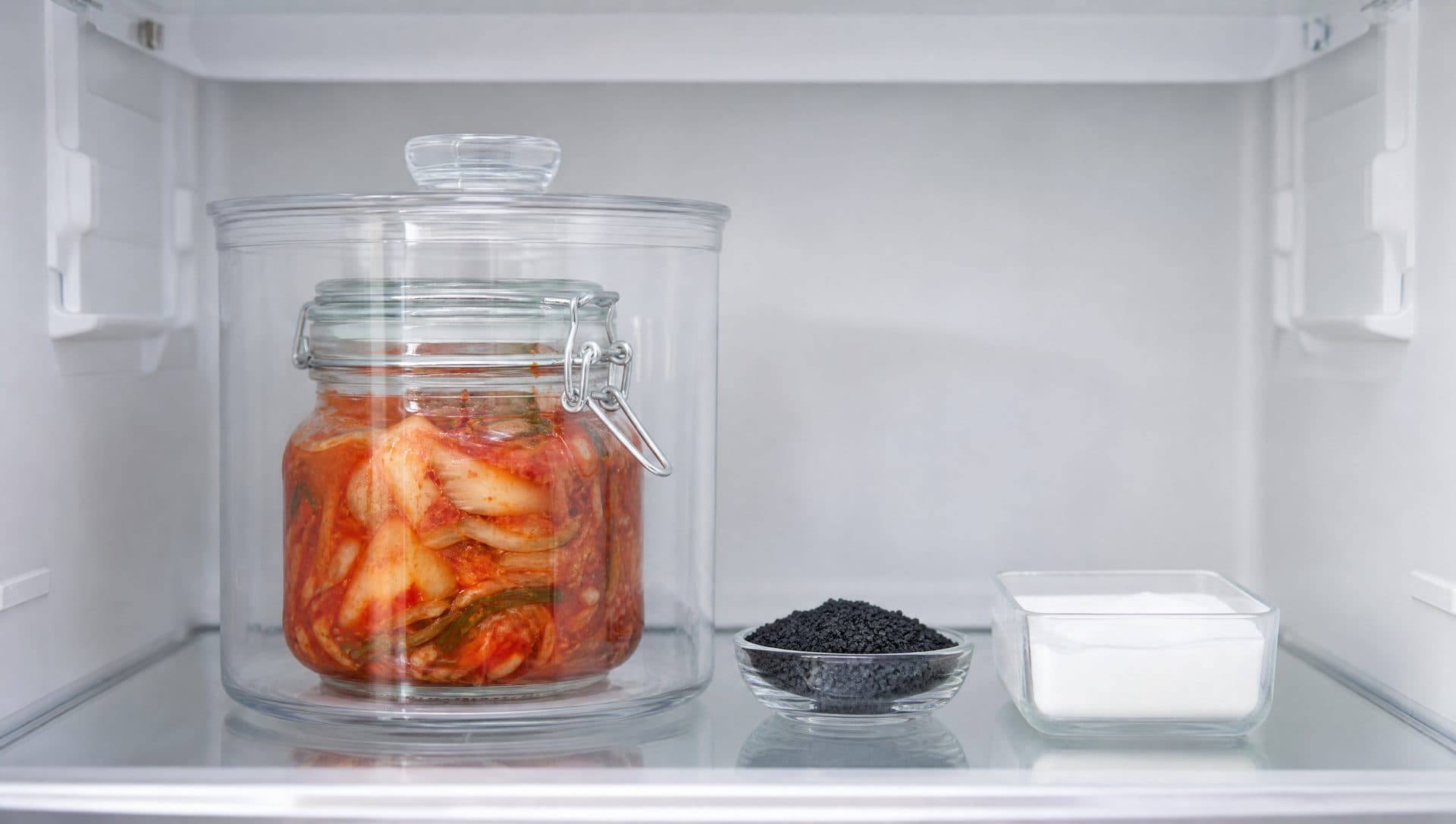
| Whole fridge smells | Put the jar inside a second sealed container, glass or stainless steel | Two gaskets between the brine and the fridge air |
| Plastic tub still smells after washing | Soak in warm water with sodium percarbonate, or a dilute bleach solution | Oxidises the aldehydes to odourless organic acids and converts sulfides to water-soluble sulfate |
| Only the lid smells | Take the gasket out, soak it separately, dry it fully before refitting | The gasket holds more than the tub does |
| Empty container between uses | Dry it completely, then store it closed with activated charcoal inside | Charcoal's porous surface adsorbs what evaporates off the walls |
| Fridge air generally | An open dish of charcoal or bicarbonate of soda, replaced every month or two | Adsorption, not masking |
Food packaging researchers are treating this as a solvable engineering problem rather than a fact of life. A team including researchers at the World Institute of Kimchi tested polyphenol extracts against kimchi's sulfur volatiles and ranked grape seed extract ahead of green tea and black tea, then built a grape seed and polycaprolactone film for kimchi packaging with a reported deodorising efficacy of 54.9 to 99.8 per cent depending on the compound (Jung, Lee, Cho and Yoo, Journal of Food Science, 2021).
If the fridge smell is the thing that bothers you, change the container before you change anything about the kimchi. Move one jar into glass with a clamp lid tonight and leave the rest of your jars exactly as they are. Two days is long enough to find out whether the packaging was the whole problem.
Frequently asked questions
Does a stronger smell mean my kimchi has gone off?
Usually the opposite. Strong garlic and sourness indicate an active, unpasteurised ferment. Worry about a rotten or putrid smell, or a sweet solventy one, particularly if the texture has turned slimy.
Why does my fridge smell of kimchi when the lid is closed?
Because the sulfides are volatile and very small, and most lids seal against liquid rather than against gas. Silicone gaskets also absorb the compounds and then release them slowly into the fridge. A second container around the jar fixes it more reliably than a tighter lid.
Can I get the smell out of a plastic container?
Often, but not always. A long soak in sodium percarbonate solution or dilute bleach removes most of it, and storing the dry container with activated charcoal inside handles the rest. Containers that have held kimchi for years sometimes never fully recover, which is why Korean households tend to keep dedicated ones.
Does cooking kimchi reduce the smell?
It changes it rather than reducing it. Heat drives off some of the lighter sulfides quickly, which is why a pan of kimchi jjigae fills a flat within minutes, and it generates new roasted and caramelised aromas from the sugars. The finished dish smells less raw and less garlicky than the jar it came from.
Why does kimchi smell of garlic rather than chilli?
Gochugaru is contributing capsaicin, sugars and pigment, none of which are especially volatile at room temperature. Garlic's organosulfur compounds are volatile at fridge temperature, so they reach your nose first and in far greater quantity.