
Culture7 min read
Kimchi myths, debunked
Seven common claims about kimchi, checked against the research: whether all kimchi is spicy, how much sodium a serving carries, what the stomach cancer studies measured, when a jar holds no live bacteria, where the virus claims came from, why sour is not spoiled, and what the ISO standard for Chinese pao cai says about kimchi.
This piece has not been translated into Español yet, so you are reading the English original. Translations are published after review, never automatically.
Most kimchi myths start from something true and stretch it. Kimchi is salty, but a 50 g serving carries about 310 mg of sodium. Its link to stomach cancer rises with the amount of salted vegetables eaten. No study in people has shown it cures a virus, and it is not Chinese pao cai.
Here are seven of them, checked against the research and the records.
| Myth | What the evidence says |
|---|---|
| All kimchi is spicy | White and water kimchi contain no chilli, and chilli kimchi is only documented from 1766 |
| Kimchi is too salty to be healthy | About 310 mg of sodium in a 50 g serving. A portion to count, not a food to avoid |
| Kimchi causes stomach cancer | Risk rises with daily intake of salted vegetables, and salt is the likely reason |
| Every jar is full of probiotics | Not if it is pasteurised, cooked or only a day old |
| Kimchi fights viruses | One chicken study and one country-level correlation. No trial in people |
| Sour kimchi has gone off | Sour is a stage of fermentation. Mould, slime and a rotten smell are the warning signs |
| Kimchi is Chinese pao cai | The ISO standard for pao cai says in its scope that it does not apply to kimchi |
Is all kimchi spicy?
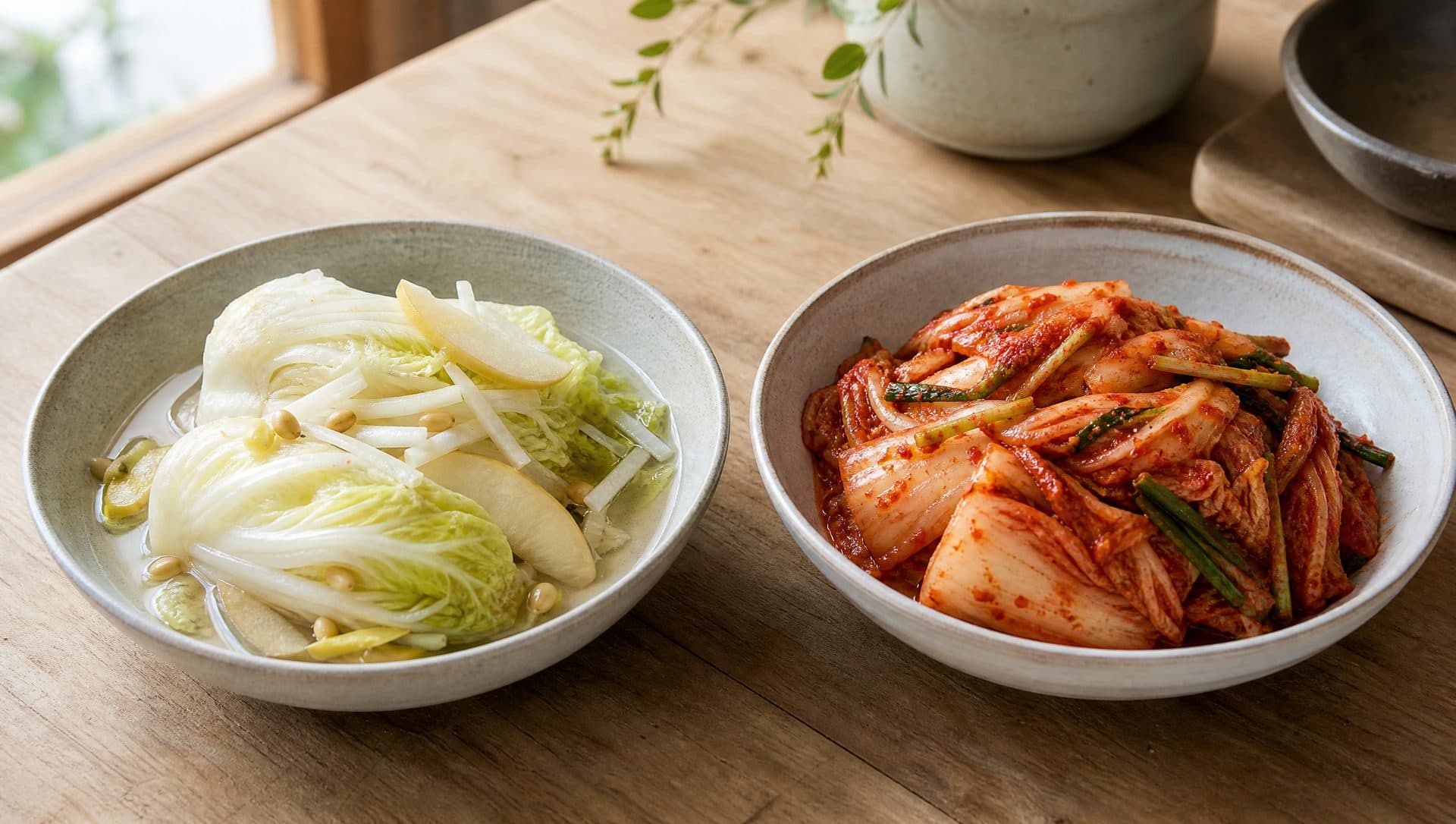
No. 백김치, baek kimchi, is napa cabbage made without any chilli, and 동치미, dongchimi, is whole radish in a clear, tart brine. Both are ordinary kimchi in Korea.
Chilli is the newcomer. It reached Korea around 1600 and was treated with suspicion for more than a century. The first kimchi recipes that use it are in the Jeungbo sallim gyeongje of 1766. Before that, kimchi was salted, sometimes seasoned with ginger or mustard, and mostly pale. The full timeline is in kimchi culture and history.
Is kimchi too salty to be healthy?
It is salty, and the amount is known. When the World Institute of Kimchi (세계김치연구소) tested commercial napa cabbage kimchi from eight Korean manufacturers across four seasons, the average was 619 mg of sodium per 100 g, with brands ranging from 534 to 783 mg.
A side-dish serving in Korea is 40 to 50 g. At 619 mg per 100 g, a 50 g serving is about 310 mg of sodium, a little over 15 per cent of the World Health Organization's daily ceiling of 2,000 mg. Two servings take you past 30 per cent before anything else on the plate.
So whether kimchi is too salty depends on the rest of your day. A brief rinse removes some surface salt, and some seasoning with it. The figures, and what they mean for blood pressure, are in the salt section of our health guide.
Does kimchi cause stomach cancer?
Eating a lot of salted vegetables is linked to stomach cancer, and in Korea that category is mostly kimchi. The risk rises with the amount.
A 2020 study in Cancers followed two Korean cohorts, about 200,000 people in all, and pooled them with earlier research. Each extra 40 g a day of pickled vegetables, one Korean serving, was associated with a 15 per cent higher risk of gastric cancer. The authors could not separate kimchi from other salted vegetables, or the salt from the vegetable.
A 2025 paper in Epidemiology and Health put the effect in national terms. High intake of salted vegetables, kimchi included, accounted for about 2.1 per cent of new cancer cases in Korea in 2020 and 1.8 per cent of cancer deaths, and the authors expect that share to fall to 1.2 per cent by 2030 as intake drops. In 2005 the average Korean ate 145.9 g of salted vegetables a day, roughly three and a half servings.
Salt is the most likely common thread, which makes this a reason to keep kimchi a side dish and count it toward your sodium.
Is every jar of kimchi full of probiotics?
No. Three kinds carry few live bacteria or none.
Pasteurised kimchi. Jars sold at room temperature have usually been heat-treated, which kills the bacteria. The live kind is in the chilled section.
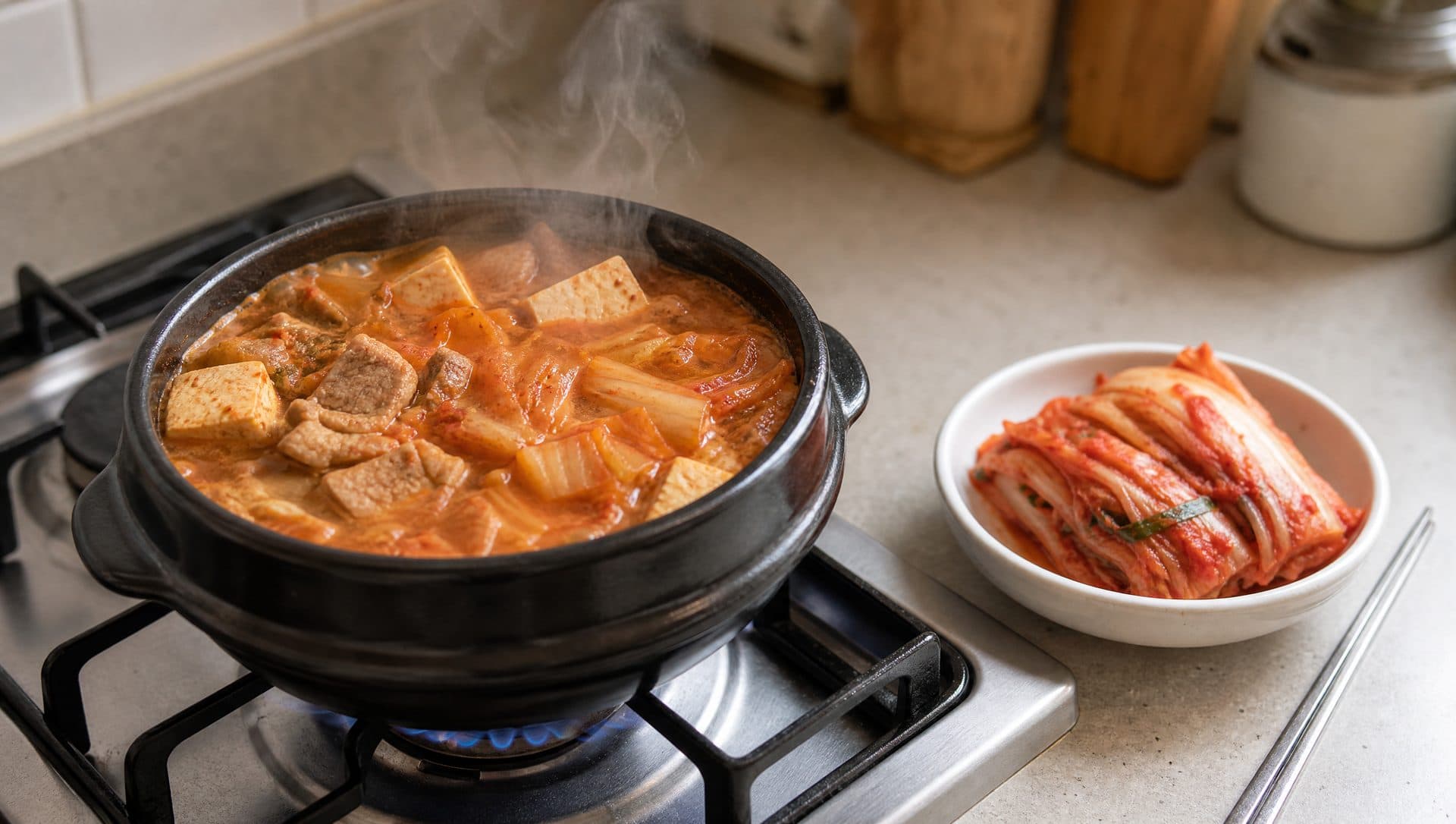
Cooked kimchi. Stew and fried rice are simmered or fried, and sustained heat well below boiling is enough to kill lactic acid bacteria. A spoonful of raw kimchi on top of the bowl puts some back.
Very fresh kimchi. On the day it was made, napa cabbage kimchi in one Korean dataset held about 200,000 lactic acid bacteria per millilitre. Two days later, at 20°C, it held 280 million. The day-by-day numbers are in kimchi fermentation explained.
Ripe, chilled, unpasteurised kimchi is a different story. Commercial Korean kimchi tested in 2016 held between 13 million and 1.6 billion lactic acid bacteria per gram. Even so, researchers at the World Institute of Kimchi describe it as a food with probiotic potential rather than a probiotic, because the strains change from one jar to the next.
Can kimchi cure the flu or COVID?
No study in people has shown that it prevents or treats any infection. The claim returns with every outbreak.
During the SARS outbreak of 2003, kimchi sales rose in Korea on the belief that it protected against the virus. In 2005 a team at Seoul National University fed a kimchi extract to 13 chickens infected with bird flu and reported that 11 recovered within a week. The lead researcher, Kang Sa-ouk, said the result was far from scientifically proven.
In 2020 a European team led by Jean Bousquet noticed that countries eating a lot of fermented cabbage had lower COVID-19 death rates. It compared whole European countries. The authors named diet as one possible factor among many, from hospitals to hygiene, and wrote that the result could not be extended to other regions.
Does sour kimchi mean it has gone off?
No. Sourness is lactic acid, and making lactic acid is what fermentation does. Kimchi keeps souring in the fridge for months. Past a point it is better cooked than raw, which is the subject of four things to do with sour kimchi.
A white film on the surface, 골마지, golmaji, is not spoilage either. In 2018 the World Institute of Kimchi traced it to five species of yeast, none carrying known toxin genes, and advised skimming it off, then washing and cooking the kimchi. Real spoilage looks different: fuzzy or coloured mould, a slimy texture all the way through, or a smell that is rotten instead of sharp. The signs are covered in how long kimchi lasts.
Is kimchi the same as Chinese pao cai?
No. Pao cai is a Chinese salted and fermented vegetable pickle, and the two have separate international standards. Kimchi's came first. The Codex Alimentarius Commission, which sets food standards for the FAO and WHO, adopted CXS 223-2001 in 2001, built around salted napa cabbage seasoned mainly with red pepper powder, garlic, ginger, spring onion and radish.
In late 2020 Chinese state media described a new ISO standard for pao cai as a standard for the kimchi industry. The standard, ISO 24220:2020, states in its scope that it does not apply to kimchi. Korea's agriculture ministry replied that pao cai has nothing to do with kimchi and pointed to the 2001 standard.
If you want to taste kimchi without the heat, buy a jar of baek kimchi. If you are counting salt, weigh out 50 g once, so you know what one serving looks like on the plate.
Frequently asked questions
Is kimchi bad for you?
Not in normal amounts. In a 2024 study of 115,726 Korean adults, one to three servings a day was associated with lower odds of obesity, and five or more with higher. Sodium is the limit, at roughly 600 mg per 100 g.
Do Koreans really eat kimchi every day?
Most do, but fewer than before. In Korea's national nutrition survey, the share of adults who ate no kimchi at all on the survey day rose from 11.7 per cent in 2010 to 22.7 per cent in 2024.
Is kimchi vegan?
Usually not. Most recipes season the paste with fish sauce or salted shrimp. Vegan versions use other sources of savoury depth, and we compared them in vegan kimchi.