
Culture6 min read
The kimjang shopping list for US kitchens
A Korean family's kimjang list divided by ten: two Korean-size heads of napa cabbage are 4 to 6 kg, or about five American ones. Where each item sits in a US store, which salt to buy and why to weigh it, and what this year's kimjang costs in Korea.
This piece has not been translated into Español yet, so you are reading the English original. Translations are published after review, never automatically.
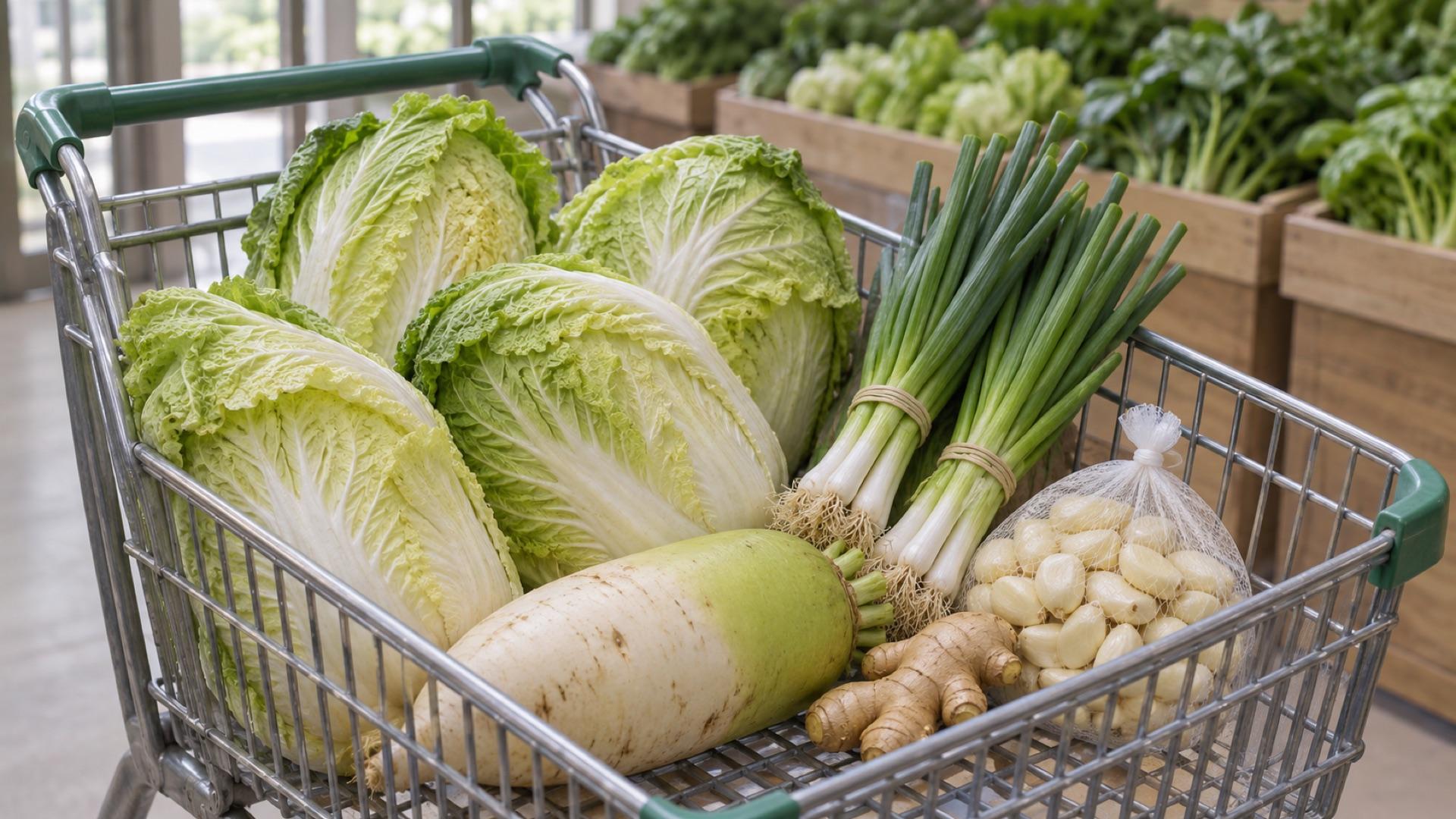
For a small kimjang (김장) in an American kitchen, buy 4 to 6 kg (9 to 13 lb) of napa cabbage, one Korean radish, a one-pound bag of coarse gochugaru, 120 g of peeled garlic, ginger, scallions, salted shrimp, anchovy sauce and 800 g of coarse sea salt. That is a Korean family's kimjang list divided by ten.
Every November, Korean agencies price a kimjang down to the won. This year the Korea Agro-Fisheries and Food Trade Corporation (aT) put the ingredients for a family of four at 199,456 won as of 9 November, 9 per cent below last year, and the survey firm Korea Price Information found a traditional-market kimjang at its cheapest of the 2020s. Both lists start from 20 heads of cabbage. How the day itself runs is in our kimjang guide. This piece is the shopping.
What is on a Korean kimjang shopping list?
The most detailed list we have found was priced in 2016 by the Seoul Agro-Fisheries and Food Corporation, which runs the city's wholesale market, and reprinted that year in a kimjang guide from the Rural Development Administration (RDA). It is a price basket for a family of four, not a recipe. It still shows what a household buys and in what proportion, and divided by ten it fits in a home kitchen.
| Item | Korean list, 20 heads | Small kimjang, 2 heads | Where to look in the US |
|---|---|---|---|
| Napa cabbage (배추, baechu) | 20 heads | 4 to 6 kg (9 to 13 lb) | Produce aisle, any supermarket |
| Korean radish (무, mu) | 10 | 1 | Korean or Asian grocer. Daikon will do |
| Dried red chillies | 1.8 kg | 180 g, bought as gochugaru | Korean grocer, dry goods |
| Peeled garlic | 1.2 kg | 120 g | Produce, often sold already peeled |
| Large spring onion (대파, daepa) | 2 kg | 200 g | Korean grocer, or the thickest scallions |
| Small spring onion (쪽파, jjokpa) | 2.4 kg | 240 g | Scallions |
| Ginger | 120 g | 12 g | Produce |
| Water dropwort (미나리, minari) | 2 kg | 200 g | Korean grocer. Optional |
| Mustard leaf (갓, gat) | 2.6 kg | 260 g | Korean grocer. Optional |
| Oysters | 2 kg | 200 g | Fish counter. Optional |
| Salted shrimp, autumn grade | 1 kg | 100 g | Korean grocer, chilled or frozen case |
| Anchovy sauce (멸치액젓, myeolchi aekjeot) | 1.2 kg | 120 g | Korean grocer, sauce aisle |
| Coarse sea salt (천일염, cheonilyeom) | 8 kg | 800 g | Korean grocer, in large bags |
The list has no glutinous rice flour, sugar or sesame. All three are in the RDA's standard seasoning formula, which our napa cabbage method follows, and in American shops the flour is sold as sweet rice flour.
How much is two heads of cabbage in an American store?
Korean recipes count heads, and a Korean kimjang head is large. The RDA guide tells shoppers to choose heads of 2 to 3 kg. American nutrition references put a medium napa cabbage at about 900 g (2 lb) and a large one at about 1.25 kg, so two Korean heads can mean five ordinary American ones. Shop by weight and ignore the count.
The guide's other advice travels well. For autumn cabbage it wants a medium head that is heavy for its size, with thin outer leaves pressed close and white ribs that feel firm when you squeeze them. Korean shoppers are told to halve a head at the stall and look inside: it should be yellow and about 80 per cent full. A head packed solid was harvested late, and it has less of the nutty sweetness a good cabbage brings.
Smaller heads with thinner ribs reach the bend test sooner, so start checking them early. Choosing and cutting the cabbage has the test and the cut.
Which salt should you buy?
The 800 g of 천일염, coarse solar sea salt, is for the brine, and much of it is poured away once the cabbage is salted. Korean grocers sell it in big bags. The RDA guide asks for crystals that are clean, even in size and not greyish.
If you cannot get it, use a pure salt without iodine. Nebraska Extension advises against iodised salt for any home preserving because it can darken or spot the food, and it warns that flaked kosher salt varies in density. Whichever salt you buy, weigh it. A cup of one brand does not hold the same amount of salt as a cup of another, and the brine strength is the number that matters. The one study we know of on whether iodine changes the ferment itself is in our troubleshooting guide.
Where do you find the jeotgal and gochugaru?
In a Korean supermarket the two seafood items sit in different places. Anchovy sauce comes in bottles in the sauce aisle. Salted shrimp, 새우젓 (saeujeot), comes in tubs or jars in the chilled or frozen case, and once opened it lives in the fridge. The Korean list prices 추젓 (chujeot), shrimp salted in autumn, a lower grade than the 육젓 that our kimjang guide names as the best for kimjang. For a first batch the autumn grade is fine.
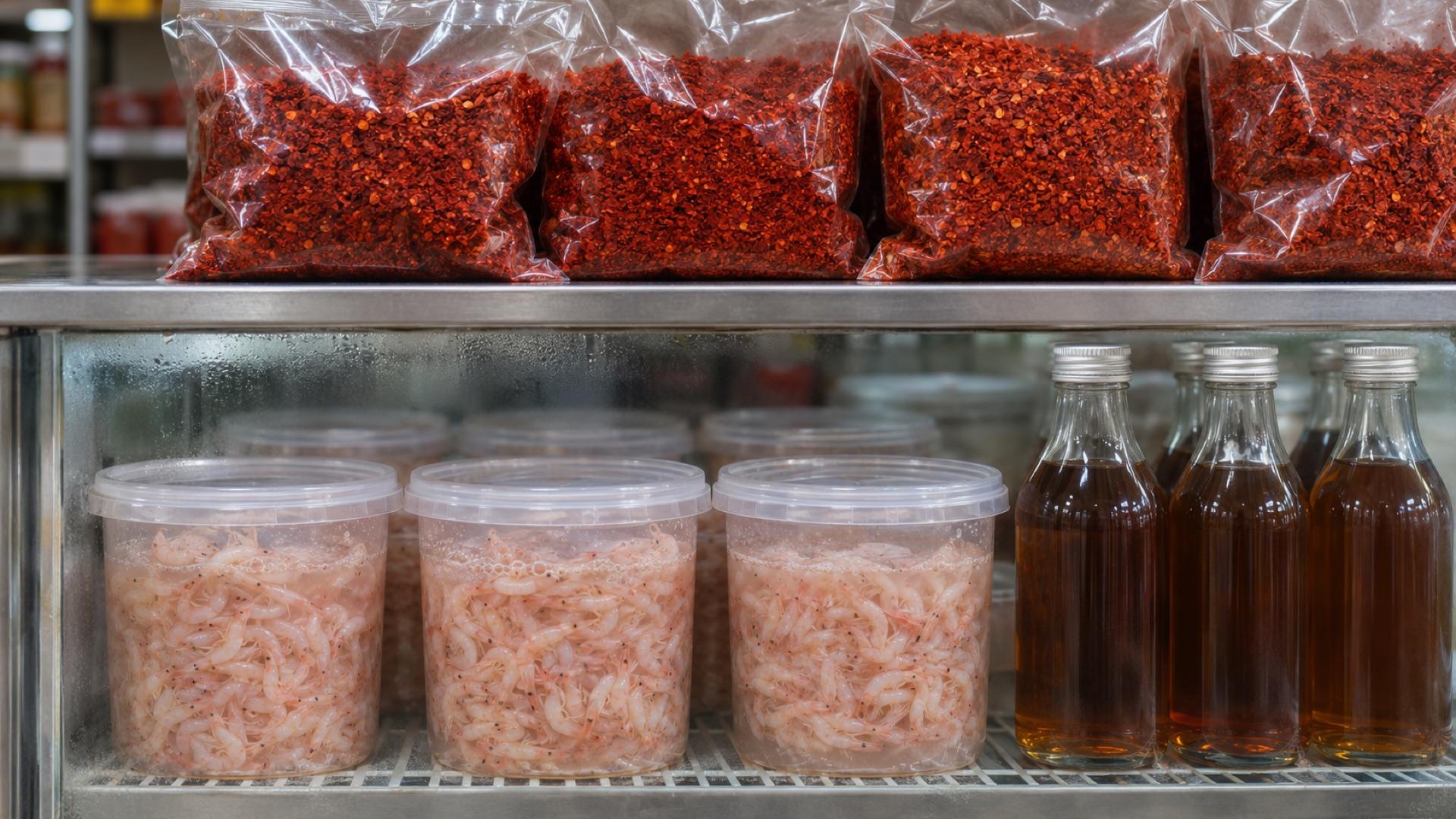
Gochugaru is with the dry goods. The Korean list prices whole sun-dried chillies, to be ground. In the US you buy them already as flakes, and a one-pound bag covers the small kimjang with plenty over, because 180 g of dried chillies grinds to less than 180 g of flakes. The rest keeps in the freezer. Look for coarse flakes marked 김치용, for kimchi. What else the bag should say, and what to use if the shop has none, is in our gochugaru guide.
What else goes in the cart?
The things that are not food. A basin or food-grade tub wide enough for a quartered head to lie flat under the brine. Rubber gloves, since the filling is mixed and pushed between the leaves by hand. A colander for draining the rinsed cabbage. And containers to hold the result: a glass jar or a food-grade plastic tub, filled no more than 80 per cent, is what our container guide recommends for a first batch.
Buy the salt, the jeotgal, the gochugaru and the containers this week, since all of them keep. Leave the cabbage and radish until the day before you salt. That is the order the Korean calendar runs in too, with the seafood and chillies bought months ahead and the cabbage last. Korea's Kimchi Day is this Sunday, 22 November, if you want a date to aim at.
Frequently asked questions
Can I use daikon instead of Korean radish?
Yes. Korean radish is shorter and stouter, pale green at the shoulder, and it is the one Korean recipes assume. Daikon works in the filling. Choose one that feels heavy for its size, as you would the cabbage.
Do I need the oysters, water dropwort and mustard leaf?
No. The RDA guide counts water dropwort and mustard leaf among the basic filling ingredients and oysters among the extras added for flavour, but none of the three is among the seven ingredients the Codex kimchi standard names. If you do buy mustard leaf, the guide says the strongly scented red kind is the one for cabbage kimchi.
Is sweet rice flour the same as glutinous rice flour?
Yes. Both names mean flour milled from glutinous rice, which contains no gluten despite the name. It is the flour for the thin porridge in our napa cabbage method. Plain rice flour is a different product.
How much does kimjang cost in Korea this year?
Less than last year. The aT survey put 20 heads of cabbage and the rest of a family's ingredients at 199,456 won as of 9 November, down 9 per cent, with the cabbage alone down 26.5 per cent. Korea Price Information's survey came to 288,500 won at traditional markets and 360,340 won at large supermarkets. Cheaper cabbage did most of that, with the autumn crop forecast 18.5 per cent larger than last year's.