
Regions9 min read
Regional kimchi across Korea: Seoul, Jeolla, Gyeongsang and Gangwon
Korean kimchi changes with the weather from north to south, lightly salted and brothy in the north, salty, red and dry in Jeolla and Gyeongsang. A region-by-region table, which jeotgal each province uses, why Gangwon's coast seasoned with pollack stock, and how much of the difference survives today.
This piece has not been translated into Español yet, so you are reading the English original. Translations are published after review, never automatically.
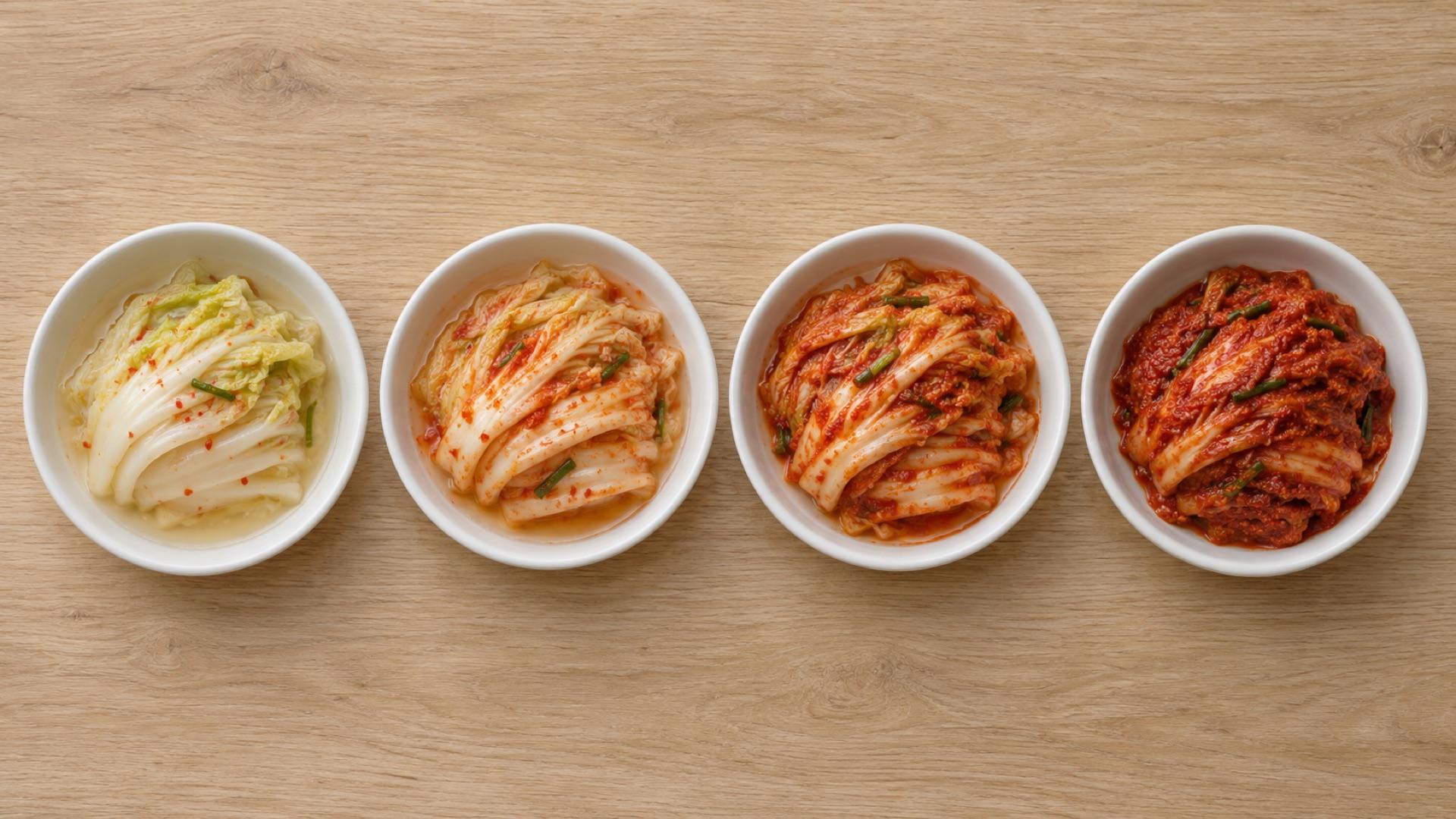
Korean regional kimchi follows the weather from north to south. The cold north salted lightly, used little chilli and kept plenty of brine. The warm south, Jeolla and Gyeongsang, salted hard, used more chilli and jeotgal, and packed the jar almost dry. Seoul sits in between, Gangwon's coast built its kimchi on pollack, and Chungcheong often used salt alone.
That is the map Korean reference works draw, and it holds across the three we leaned on most: the Encyclopedia of Korean Culture, the agriculture ministry's 2021 guide to regional kimchi, and a 2019 field study by Seoul National University anthropologists who interviewed home cooks in Seoul, Gyeonggi and Gangwon. Why temperature drives the differences is in why Jeolla baechu tastes nothing like Seoul's. This piece goes region by region, with what went into each jar and how much of the difference is left.
How does kimchi change from north to south?
The encyclopedia states it plainly in its entry on 김장 (kimjang), the late-autumn batch. In the cold north, Hamgyeong and Pyeongan, households salted lightly and kept the seasoning plain so the vegetables stayed fresh-tasting. In the south they salted hard, used a red, heavy seasoning and made less brine. Its entry on kimchi adds that the best-known northern kinds are the ones with little chilli: white kimchi (백김치, baek kimchi) and dongchimi (동치미), radish served in its own cold brine.
Cold slows fermentation, so a northern jar did not need defending against the winter. The coastline did the rest, because what a region could catch and salt is what went into its kimchi. Kimjang runs along the same line, earliest in the mountains and latest in the far south. Our kimjang guide has this year's dates.
| Region | How it is seasoned | Kimchi the sources name |
|---|---|---|
| Hamgyeong | Little chilli or jeotgal, salt to season, plenty of brine. Fresh pollack and cod go in the jar | Cod kkakdugi, 가자미식해 (gajami sikhae), flounder fermented with grain |
| Pyeongan | Little salt and a lot of brine, mild and cool. Meat stock for sweetness | Baek kimchi, dongchimi |
| Hwanghae | Salted croaker and shrimp, a light, clean seasoning, sometimes coriander | Coriander kimchi, pumpkin kimchi |
| Seoul and Gyeonggi | Neat and refined, shaped by court and aristocratic cooking | Jang kimchi, stuffed cucumber kimchi, turnip kimchi |
| Gangwon | Plain kimchi from mountain vegetables inland, seafood kimchi on the coast | Pollack gill kkakdugi, squid kimchi |
| Chungcheong | Often salt in place of jeotgal, mild and clean | Aubergine kimchi, 게국지 (gegukji) |
| Gyeongsang | Salted hard with anchovy jeotgal, almost no brine | Soybean leaf kimchi, garlic chive kimchi |
| Jeolla | Plenty of jeotgal and chilli, glutinous rice porridge in the paste | Mustard leaf kimchi, 고들빼기 (godeulppaegi) kimchi |
| Jeju | Seafood, and little kimjang, because cabbage grows in the fields through winter | Dongji kimchi, abalone kimchi |
Every dish in the table appears in the ministry's guide, the encyclopedia or both. Where the two disagree, we say so below.
Which jeotgal does each region use?
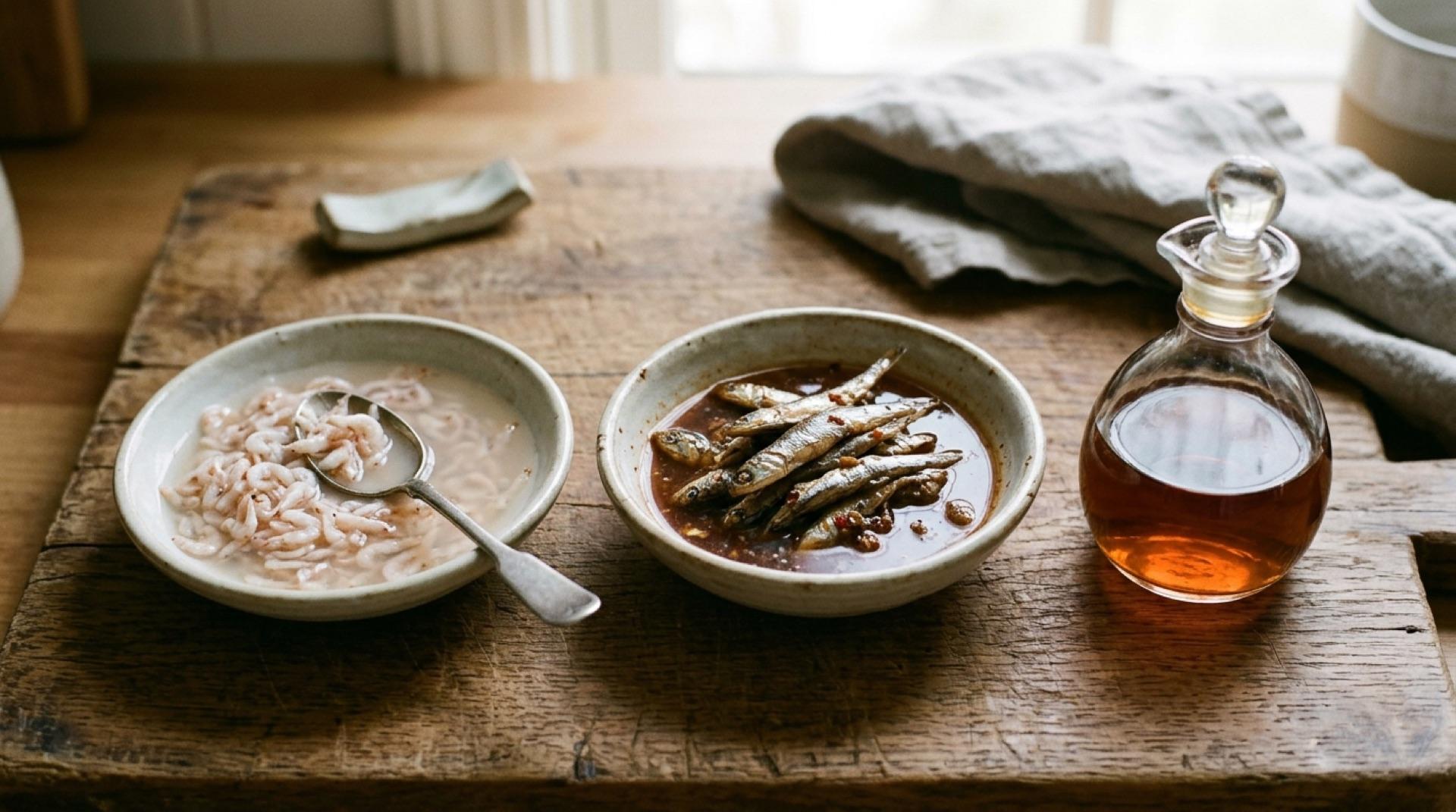
The encyclopedia's rule of thumb is that the centre and the north use salted shrimp (새우젓, saeujeot) and salted croaker (조기젓, jogijeot), and the south uses salted anchovy (멸치젓, myeolchijeot) and salted hairtail (갈치젓, galchijeot). Shrimp is light and clean. Anchovy is darker and stronger, and it deepens as the kimchi ages.
Jeolla stretches the list furthest. The encyclopedia names croaker, big-eyed herring and silver pomfret, with sesame and glutinous rice porridge in the paste. The ministry adds that Jeolla cooks boil some jeotgal down before it goes in and mix others in raw.
Chungcheong pulls the other way. It has the west coast's shrimp and croaker within reach, and both sources say it often seasons with salt instead, for a milder, cleaner kimchi. Which jeotgal tastes of what, and how much goes in, is in the seven core ingredients of kimchi.
What makes Seoul and Gyeonggi kimchi different?
Seoul's kimchi grew up around the court and the aristocratic households of the Joseon capital, and both sources describe it as neat and refined rather than heavy. The dishes they list are made for the table. 장김치 (jang kimchi) is seasoned with soy sauce instead of salt. 오이소박이 (oi sobagi) is cucumbers slit and stuffed. Gyeonggi, the province around the city, adds turnip kimchi from its own fields.
Bossam kimchi, the cabbage-leaf parcel, is harder to place. The encyclopedia files it under Gyeonggi. The ministry credits it to Hwanghae, centred on Kaesong, the old Goryeo capital that now sits just north of the border. Both can be right, since Kaesong was a Gyeonggi city until the Korean War.
The Seoul National University team found that before modernisation, Seoul and Gyeonggi households salted their cabbage raw and used salted shrimp as their main jeotgal. Cooks in both places now use the shrimp with anchovy sauce or salted hairtail as well, and grind fresh shrimp into the paste. The encyclopedia makes the same point from the other side: Seoul's own kimchi is losing its character because people from every province now live there.
Why is Gangwon kimchi built on pollack?
Gangwon is two regions in one. The ministry describes plain kimchi in the mountains, made from what could be foraged or grown, and seafood kimchi on the coast. The encyclopedia adds that this rocky province had little to spare, so its kimchi had to last until the next spring.
On the coast the fish was pollack, 명태 (myeongtae). In 2016 the Seoul National University team did fieldwork around Gangneung and inland Hongcheon, and found that the east coast traditionally used no salted shrimp at all. Cooks simmered pollack heads into a stock and seasoned with that. Pollack went into the jar too: fillets tucked between heads of cabbage at kimjang, and 서거리 (seogeori), the gills, scrubbed with salt, torn into strips, salted and mixed into kkakdugi. Squid went into shredded radish kimchi.
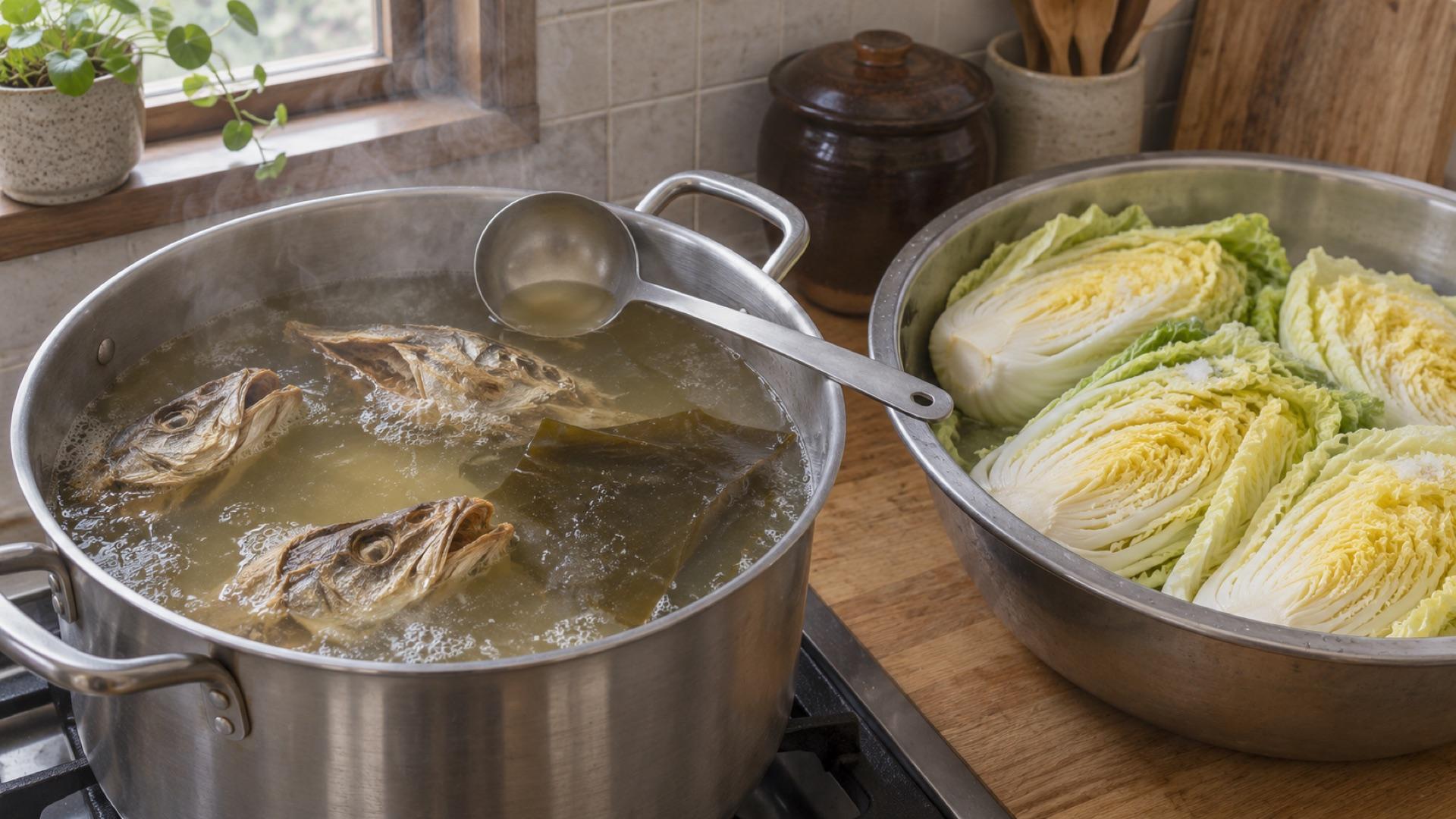
The pollack is still there. The Gangneung cooks in the study all used salted shrimp and an anchovy or sand lance sauce now, and all of them still added a seafood stock, most often from pollack heads. In Hongcheon they used salted shrimp and no stock. Cooks in both places once salted cabbage in heated brine, half cooking it, and the team found no one still doing it.
Is Jeolla or Gyeongsang kimchi saltier?
Gyeongsang, on the encyclopedia's account, which separates the two southern provinces in one line: Honam, the Jeolla side, makes spicy kimchi, and Yeongnam, the Gyeongsang side, makes salty kimchi.
Gyeongsang kimchi is salted hard, the paste leans on anchovy jeotgal, and the jar is packed with almost no brine. On the rest the two main sources part ways. The ministry describes plenty of garlic and chilli. The encyclopedia says the seasoning is comparatively light. Both agree on the salt and the dry jar.
A 1995 study from the kimchi research institute at Pusan National University counted about 35 special kimchi in Gyeongsang and set standard recipes for six of them from family practice and old cookbooks. Several are leaves, perilla, chilli leaf and godeulppaegi, a bitter wild lettuce, each soaked in brine for five to ten days before seasoning. In the study's burdock kimchi, anchovy sauce outweighs gochugaru more than two to one: 15.1 parts to 6.8 for every 100 parts of burdock.
Jeolla's paste is the richer of the two. The ministry puts the plentiful jeotgal and chilli down to warm weather: kimchi made spicy and salty so it would keep. The kimchi listed for Jeolla include godeulppaegi kimchi, which the Gyeongsang study also covers, and mustard leaf kimchi, which has its own entry in our guide to the main types.
Does regional kimchi still exist?
Less than it did. The encyclopedia dates the change to the Korean War. Before 1950 few people travelled between regions and local kimchi stayed local. Refugees then spent years in other provinces, eating and learning other people's kimchi, and roads and television carried it further. Regional kimchi lost its local character as the recipes became general.
The 2019 study found the same thing in the jars. Anchovy and sand lance sauces are now used from the west coast to the east, and the authors describe the old divisions by jeotgal as having broken down. The east coast's seafood stock is the clearest marker left. Salting cabbage in seawater, once done on both coasts, disappeared with modernisation, though the team saw a few people starting to do it again.
You can taste the main line on the map in one batch. Split the paste before the jeotgal goes in, season half with salted shrimp the way Seoul did and half with anchovy sauce the way Gyeongsang does, and eat them side by side after a week in the fridge. For the east coast, simmer pollack heads into a stock and work some into the paste, as the Gangneung cooks in the study still do. Our napa cabbage method is the base to start from.
Frequently asked questions
What is the difference between North and South Korean kimchi?
Historically, the northern provinces salted lightly, used less chilli and jeotgal, and kept more brine. Pyeongan is known for white kimchi and dongchimi, and Hamgyeong for putting fresh pollack and cod in the jar. The south salted harder and used more chilli and jeotgal. UNESCO listed North Korea's kimchi-making tradition separately from the South's in 2015.
Which region of Korea makes the spiciest kimchi?
Jeolla, by the Encyclopedia of Korean Culture's account. It describes Honam kimchi as spicy and Yeongnam kimchi, from Gyeongsang, as salty. Both southern provinces use more chilli than the north.
What is seogeori?
Pollack gills. On Gangwon's east coast they are scrubbed clean with salt, torn into strips, salted and mixed into kkakdugi. The 2019 Seoul National University study found seogeori kkakdugi still common on that coast.
What is jang kimchi?
A Seoul kimchi seasoned with soy sauce instead of salt. Both the encyclopedia and the agriculture ministry list it among the capital's dishes, which came out of court and aristocratic cooking.
Why does Chungcheong kimchi taste so plain?
Because it often skips the jeotgal. Chungcheong has salted shrimp and croaker from the west coast within reach, but both the encyclopedia and the ministry say it commonly seasons with salt alone, which gives a mild, clean kimchi.