
Basics16 min read
What is kimchi? The complete guide
Kimchi is salted, seasoned, fermented vegetables — and almost every part of that description has been true for a different length of time. What it is, how it is made, and where it came from.
This piece has not been translated into Español yet, so you are reading the English original. Translations are published after review, never automatically.
Kimchi (김치) is a Korean dish of vegetables that have been salted, seasoned and then fermented by lactic acid bacteria. The most common version is made from napa cabbage coated in a paste of chilli flakes, garlic, ginger, scallion and salted seafood. It is sour, spicy, savoury and fizzy, it is eaten at nearly every Korean meal, and it keeps for months.
That is the short answer. The longer one is more interesting, because almost every part of that sentence has been true for a different length of time. The chilli is roughly three hundred years old. The napa cabbage is younger still. The salting and the fermenting are the old parts, and they are the parts that actually make it kimchi.
What exactly counts as kimchi?
There is a formal answer to this, which is unusual for a home-cooked food.
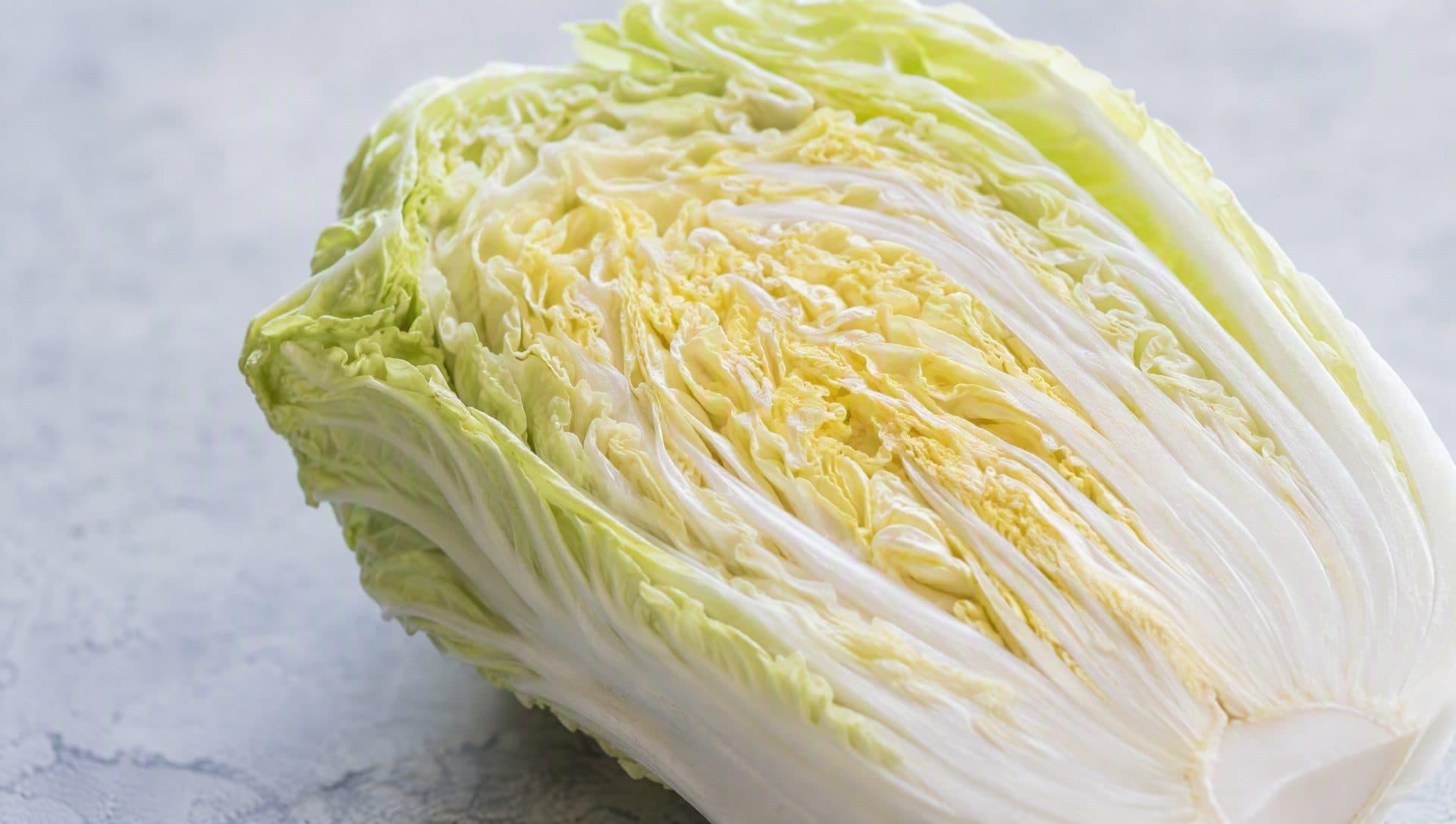
Kimchi has an international food standard: CXS 223-2001, adopted by the Codex Alimentarius Commission in 2001 and amended in 2017 and 2022. It defines kimchi as a product made with Chinese cabbage (Brassica pekinensis) as the predominant ingredient, trimmed of inedible parts, salted, washed with fresh water and drained, then mixed with a seasoning whose main components are red pepper (Capsicum annuum) powder, garlic, ginger, edible alliums other than garlic, and radish — and then fermented.
The standard even describes what the result should be like: red in colour from the red pepper, hot and salty in taste and possibly sour, and reasonably firm, crisp and chewy.
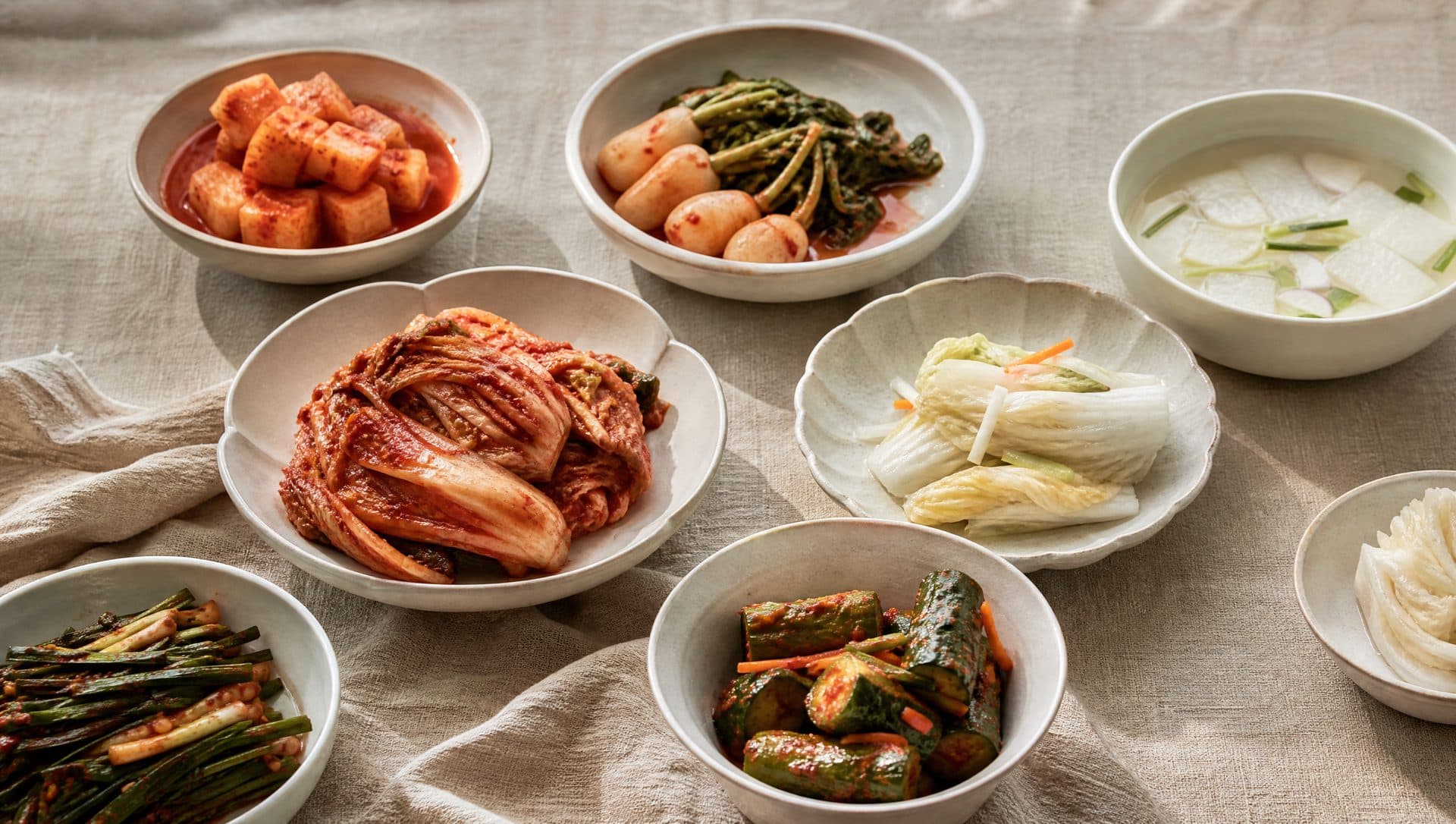
That standard is narrower than what Koreans actually mean by the word. It describes baechu kimchi (배추김치), the napa cabbage version, because that is the one that travels and gets exported. In a Korean kitchen, kimchi is a category, not a recipe. Water kimchi made with no chilli at all is kimchi. So is a jar of nothing but cubed radish.
The working definition that covers all of them is simpler:
| A dish is kimchi if it… | Notes |
|---|---|
| Starts with a vegetable | Napa cabbage, radish, cucumber, scallion, mustard leaf, and dozens more |
| Is salted first | Either dry-salted or soaked in brine, then usually rinsed and drained |
| Is seasoned | Usually chilli, garlic, ginger and a fermented seafood element — but not always |
| Is fermented by lactic acid bacteria | This is the non-negotiable part. Unfermented seasoned vegetables are a salad |
The last row is the one that matters. Salting and seasoning are preparation. Fermentation is what turns the preparation into kimchi, and it is why a jar that has been sitting in a refrigerator for four months is not spoiled — it is further along.
What does kimchi taste like?
Four things arrive at once, and their proportions change every week the jar sits in the fridge.
Sour comes from lactic acid produced by the bacteria. In fresh kimchi it is barely there. After a month it is the loudest note.
Salty comes from the initial salting and from the salted seafood in the paste. It should read as seasoning, not as preservation — well-made kimchi tastes seasoned, not cured.
Spicy comes from gochugaru (고춧가루), Korean chilli flakes. Korean chilli is warm rather than sharp, and much of what it contributes is colour and a faint fruity sweetness rather than heat. Kimchi is usually less hot than people expect.
Savoury — the part that is hardest to describe and easiest to miss — comes from the fermented seafood: fish sauce (액젓, aekjeot) or salted shrimp (새우젓, saeujeot), plus the glutamates the fermentation itself generates. This is the flavour that makes kimchi taste like a made thing rather than a pickled thing.
There is also a fifth quality that is not a flavour: carbonation. Active fermentation produces carbon dioxide, and young kimchi genuinely fizzes on the tongue. It is the single most surprising thing about eating good kimchi for the first time.
What is kimchi made of?
A standard napa cabbage kimchi has three groups of ingredients.
| Group | Ingredients | What it does |
|---|---|---|
| The vegetable | Napa cabbage (배추, baechu); often Korean radish (무, mu) julienned into the paste | The body. Its water content and cell structure decide the final texture |
| The salt | Coarse solar salt (천일염, cheonilyeom) | Draws water out, softens the leaf, and selects for salt-tolerant lactic acid bacteria over spoilage organisms |
| The seasoning paste (양념, yangnyeom) | Gochugaru, minced garlic, grated ginger, scallion, fish sauce or salted shrimp, often a cooked rice-flour porridge, sometimes grated pear or apple | Flavour, colour, and food for the bacteria |
Two of these do quiet structural work that is easy to overlook.
The rice porridge (풀, pul) is a thin cooked slurry of glutinous rice flour and water. It makes the paste cling to the leaves instead of sliding off, and its starch gives the bacteria an easy sugar source early on, which speeds up the first days of fermentation.
The salted seafood is not only for flavour. It brings its own enzymes and amino acids into the jar, which is part of why kimchi develops depth over months rather than simply getting more sour. Kimchi made without it — for vegan, allergy or religious reasons — ferments perfectly well but tastes cleaner and flatter, and most cooks compensate with more mushroom, kelp or soy.
How many kinds of kimchi are there?
More than anyone has settled on a number for, because the counting depends on where you draw the line between a variety and a household variation.
Published figures differ widely. A survey in 2000 catalogued 336 varieties. The Kimchi Field Museum in Seoul documents 187 historic and current types. Other estimates put the working number nearer 200. None of these are wrong; they are counting different things, and Korean regional cooking keeps producing new ones.
The useful way to think about it is by axis. Kimchi varies along four:
- By vegetable — cabbage, radish, cucumber, scallion, mustard leaf, young summer radish greens
- By season — what is in the ground decides what is in the jar; summer kimchi is quick and light, winter kimchi is built to last
- By region — coastal provinces use more salted seafood and salt; inland and northern regions use less of both, with more brine
- By whether there is chilli at all — white and water kimchi skip it entirely
A handful you will actually meet:
| Kimchi | Korean | Made from |
|---|---|---|
| Baechu kimchi | 배추김치 | Whole or quartered napa cabbage. The default |
| Kkakdugi | 깍두기 | Cubed Korean radish. Crunchy, sweet, served with soup |
| Dongchimi | 동치미 | Whole small radishes in clear unspiced brine. Cold, tart, almost drinkable |
| Baek kimchi | 백김치 | Napa cabbage with no chilli. Mild, for children and for cold noodle dishes |
| Oi-sobagi | 오이소박이 | Cucumbers slit and stuffed with seasoning. A summer kimchi, eaten within days |
| Chonggak kimchi | 총각김치 | Small ponytail radishes, greens attached |
The site has a fuller guide to the varieties, with what each one is for and when it is made.
How is kimchi made?
Four stages, and the first one decides more than the other three.
1. Salting (절임, jeorim). Cabbage is quartered and either packed with coarse salt between the leaves or submerged in brine — commonly in the range of 10–12% for a period of hours. It is done when a thick white rib bends without snapping. This step pulls water out of the cells, which is what lets the leaf stay crisp later instead of going limp in its own liquid.
2. Rinsing and draining. The salt is washed off and the cabbage is drained thoroughly. Water left on the leaves dilutes the paste and the brine.
3. Seasoning. The paste is mixed, then worked between every leaf by hand — not tossed over the top. Coverage is what makes fermentation even.
4. Fermenting. The jar sits at room temperature for roughly one to three days to start the bacteria, then goes cold.
If you want the reasoning behind step one in more detail, it is the subject of its own piece: salt, and why the first step decides everything after it.
What actually happens during fermentation?
Salt-tolerant lactic acid bacteria that were already living on the vegetables begin converting sugars into lactic acid, carbon dioxide and a range of flavour compounds. The pH falls, the acidity rises, and the environment gradually becomes hostile to the organisms that would otherwise spoil the food. Nothing is added to start it. The cabbage brings its own bacteria.
Researchers usually divide the process into four stages by measured acidity:
| Stage | Acidity | What it tastes like |
|---|---|---|
| Initial | Below 0.2% | Salted salad. Raw garlic, sweet, no sourness |
| Immature | 0.2–0.4% | Sourness arriving underneath. First bubbles |
| Optimum ripening | 0.4–0.9% | Balanced. This is the window |
| Over-ripe | Above 0.9% | Sharply sour, softened leaves, darker colour |
The consensus target for eating quality is a pH of about 4.2–4.4 with acidity around 0.6%. That is the point at which sourness, salt, savouriness and crunch are all present at once.
Temperature is the main lever you control. Studies of kimchi fermentation find that lactic acid bacteria such as Latilactobacillus sakei and Leuconostoc mesenteroides — the species associated with good flavour — dominate at around 4°C, while warmer fermentation in the 10–15°C range produces a broader and more variable bacterial community. Commercial kimchi is generally fermented and held between 0 and 6°C and distributed below 10°C. This is the entire reason Korean homes keep a dedicated kimchi refrigerator: it holds a steady low temperature that an ordinary fridge, opened forty times a day, does not.
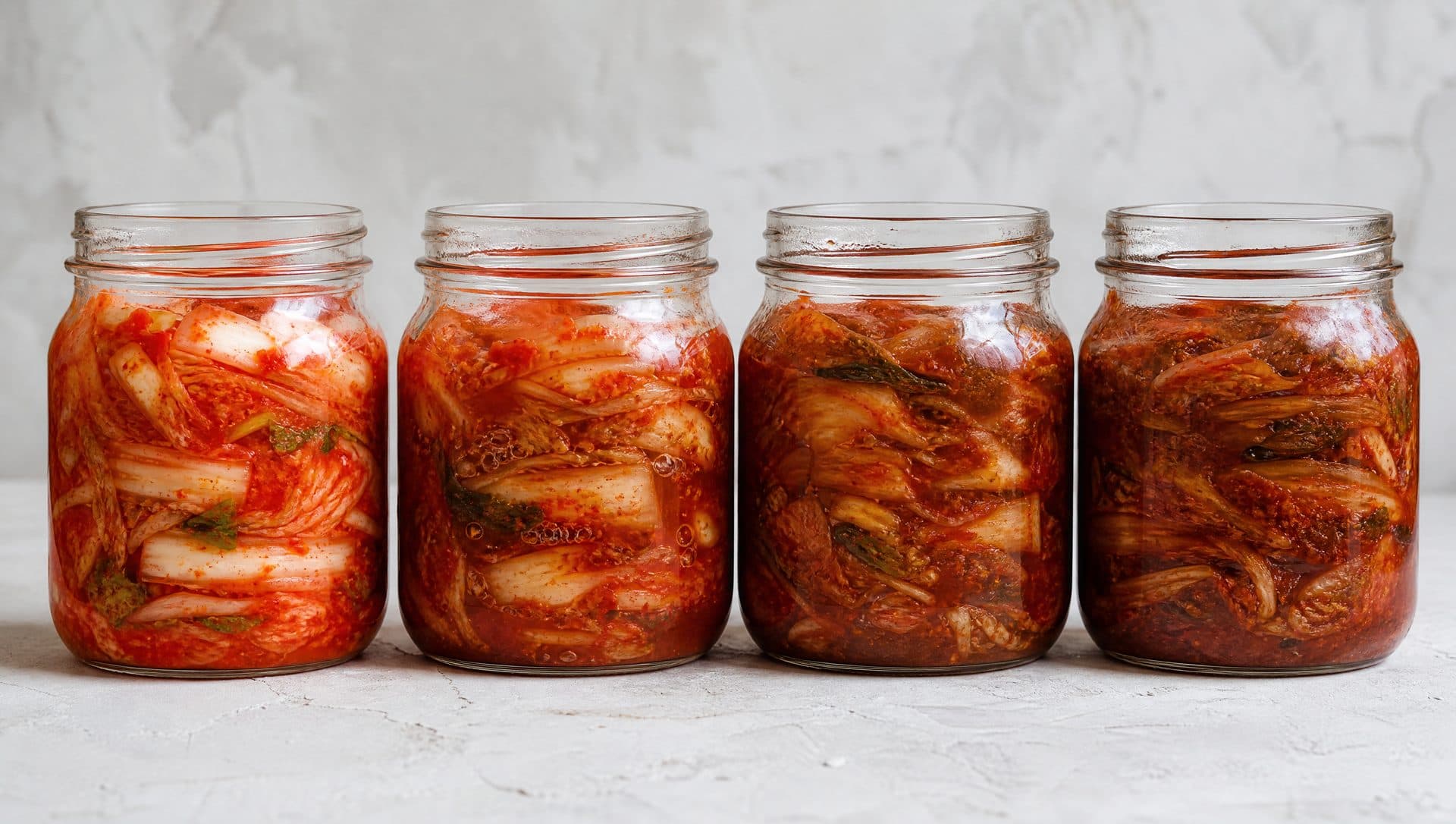
Cold does not stop fermentation. It slows it to a crawl, which is what turns a two-week process into a six-month one. The site's fermentation guide walks through the stages with what to cook at each.
Where did kimchi come from?
Kimchi began as a preservation problem. Korean winters are long and nothing grows in them, so vegetables were salted and buried to last until spring. That practice is very old and unremarkable — salting vegetables for winter is something most cold-climate cuisines arrived at independently.
What makes Korean kimchi distinctive happened much later, and more recently than most people assume.
Chilli arrived in the early 17th century, most likely via China and Japan in the years just after the Imjin War. But it did not go into kimchi immediately. Korean records show chilli was not added to kimchi until around the middle of the 18th century — more than a hundred years after it reached the peninsula. For that entire century, kimchi was white.
Napa cabbage arrived later than the chilli. Kimchi before the late 18th century was made mainly with radish, cucumber and aubergine. Napa cabbage appears as a kimchi vegetable only in the late 18th century, and the tightly headed variety we use now was introduced from China after that, spreading widely across Korea in the late 19th and early 20th centuries — carried in significant part by Chinese immigrants from Shandong.
Which means the red napa cabbage kimchi that the whole world now pictures when it hears the word is, in its current form, roughly a century and a half old. The dish is ancient. This particular version of it is not.
That history is worth knowing for a practical reason as much as a cultural one: it explains why baek kimchi and dongchimi are not modern "mild" adaptations for foreigners. They are older than the red kind.
What is kimjang, and why does UNESCO have a listing for it?
Kimjang (김장) is the communal late-autumn making of the winter kimchi supply. Families and neighbours gather over one or two days, process a very large quantity of cabbage together, and divide the result among the households that helped.
UNESCO inscribed Kimjang, making and sharing kimchi in the Republic of Korea on the Representative List of the Intangible Cultural Heritage of Humanity in 2013. The listing is explicitly not about the food. It is about the practice — the cooperation, the division of labour, the sharing across households, and the transmission of specific family recipes from one generation to the next.
Kimchi also has a legal commemorative day in Korea. 22 November was designated Kimchi Day under an amendment to the Kimchi Industry Promotion Act in 2020, making kimchi the first food in Korea to receive one. The date is constructed: the 11 stands for the individual ingredients coming together, and the 22 for the twenty-plus health functions attributed to the finished food.
Is kimchi good for you?
It is a low-calorie fermented vegetable, and that is most of the answer.
The USDA's entry for kimchi puts it at roughly 15 kcal per 100 g, with about 1.6 g of fibre, 1.1 g of protein and 498 mg of sodium. Treat the sodium figure as one data point rather than a rule — it varies substantially between recipes and between commercial brands, and the label on the jar in front of you is more reliable than any average.
Unpasteurised, refrigerated kimchi contains live lactic acid bacteria. Shelf-stable jarred kimchi sold at room temperature generally does not, because pasteurisation is what makes it shelf-stable. If live cultures are why you are buying it, buy it from the refrigerated aisle.
Beyond that, be careful with what you read. Kimchi attracts a large volume of health claims that outrun the evidence behind them, and a great deal of what circulates in English traces back to preliminary or animal studies presented as settled. A piece specifically on what the research does and does not support is scheduled on this site; until then, the honest summary is that kimchi is a vegetable, it is fermented, it is high in sodium, and those three facts cover most of what can be said confidently.
How do you store kimchi, and how long does it last?
Kimchi does not expire so much as move along a scale.
- Keep it cold and keep it submerged. The brine is the seal. Press the contents down so the vegetables stay under the liquid, and use a clean utensil every time — introducing crumbs or oil is what starts surface mould.
- Expect the jar to build pressure. Fermentation makes gas. Open it over a sink for the first couple of weeks, and use a container with room at the top.
- Refrigerated, it stays good for months. Sourness climbs steadily. Most people find the eating window best in the first two to four weeks and the cooking window best after that.
- Sour is not spoiled. Kimchi past its balanced point is the correct ingredient for stew, fried rice and pancakes — heat converts the acidity into depth. There is a whole piece on what to do with it.
The genuine warning signs are fuzzy mould on the surface, a slimy rather than crisp texture throughout, or a smell that reads as rotten rather than sharp. Sourness alone never is one. The storage windows by temperature, what the date on a packet means and how to read a white film are covered in how long kimchi lasts.
How do Koreans actually eat kimchi?
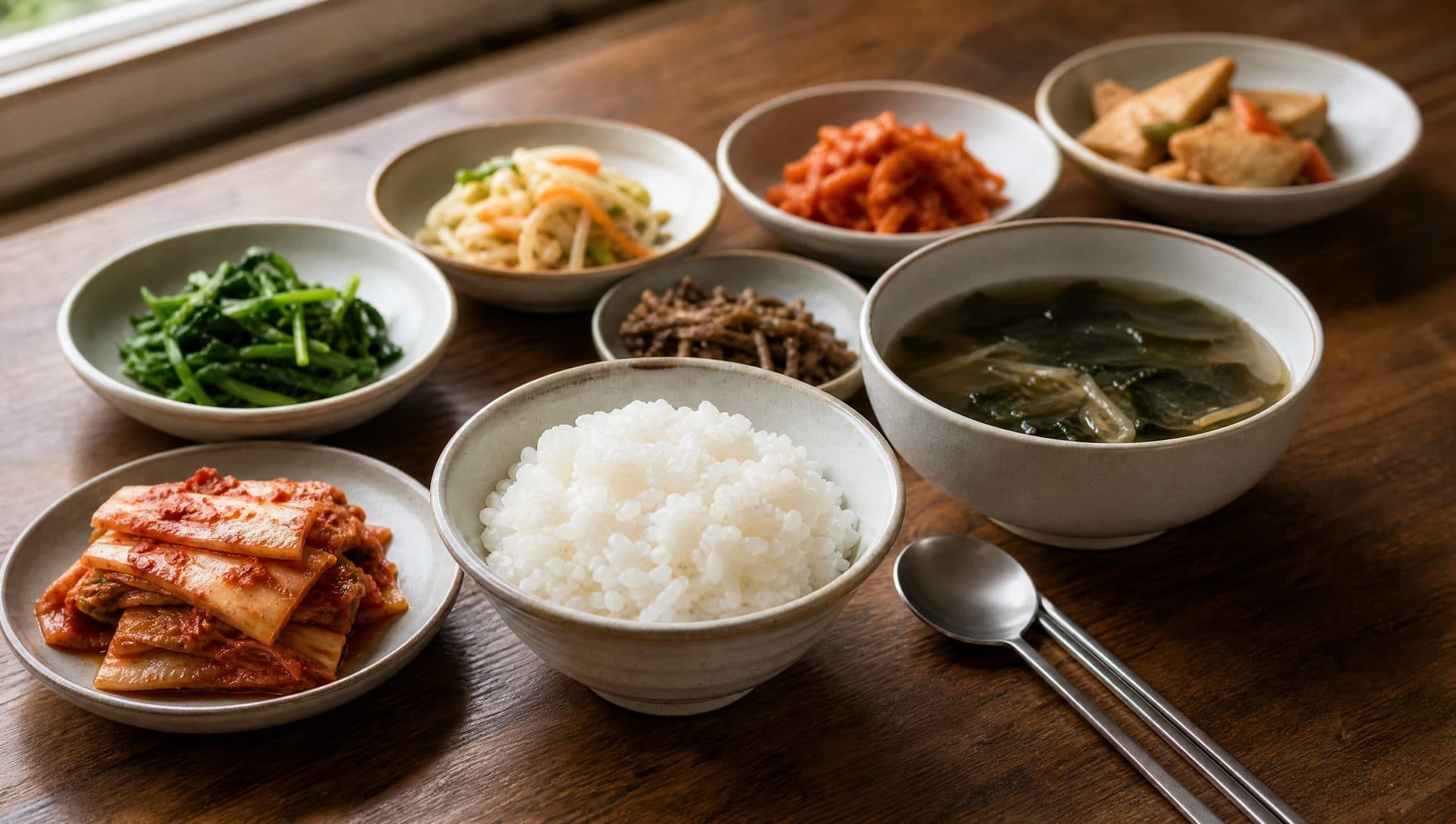
Mostly as banchan (반찬) — one of several small side dishes set out beside rice and soup, eaten in small amounts throughout the meal rather than as a course. It is on the table at breakfast, and there are easy ways to put it on a Western breakfast table as well.
The other major use is as an ingredient, and this is where older, sourer kimchi goes:
- Kimchi jjigae (김치찌개) — a stew of sour kimchi with pork or tofu. The single most common destination for a jar that has gone too far
- Kimchi bokkeumbap (김치볶음밥) — fried rice, usually with the kimchi brine included
- Kimchijeon (김치전) — a thin savoury pancake, kimchi chopped into the batter
- Mandu filling — squeezed dry and mixed with pork and tofu
And it is the standard partner to grilled pork belly, where a piece of fresh, barely fermented kimchi is often laid on the grill to warm through and cut the fat.
Frequently asked questions
Is all kimchi spicy?
No. Baek kimchi (백김치) and dongchimi (동치미) contain no chilli at all and taste clean and tart rather than hot. Even standard red kimchi is milder than its colour suggests, because Korean chilli flakes contribute more colour and fruitiness than heat.
Is kimchi vegan?
Usually not. Most recipes include fish sauce or salted shrimp. Vegan kimchi exists and is widely sold, and it ferments normally — it simply tastes cleaner, with less of the deep savoury note. Check the ingredient list rather than assuming, since the seafood component is often listed as "anchovy extract" or "shrimp".
Do I need a special refrigerator?
No, but it explains what one is for. A dedicated kimchi fridge holds a stable low temperature without the constant door-opening of a normal fridge, which keeps fermentation slow and even. An ordinary refrigerator works; the kimchi simply ripens less predictably.
Can I eat kimchi straight from the jar?
Yes. It is fully preserved and ready to eat at every stage of its life. There is no point at which it must be cooked.
What is the difference between kimchi and sauerkraut?
Different cabbage, different cut, different seasoning, different bacteria and a much faster fermentation for kimchi. There is a full side-by-side comparison here.
Why is my kimchi bubbling?
Because it is fermenting, which is what it is supposed to do. Carbon dioxide is a normal product of lactic acid fermentation. The bubbling slows and stops as the process matures — what that means is its own piece.
Related reading
- Kimchi culture and history: from salted vegetables to UNESCO
- Why does kimchi smell, and why that's a good thing
- How long does kimchi last? Storage, spoilage signs and best-by myths
- Kimchi health benefits: what the evidence actually says
- How to make classic napa cabbage kimchi at home
- Kimchi vs. sauerkraut: what's actually different?
- Salt, and why the first step decides everything after it
- Sour kimchi is not spoiled kimchi. Four things to do with it